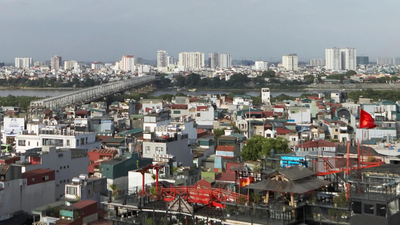
Vietnam’s capital Hanoi is undergoing one of its biggest urban redevelopment drives, with authorities spending $2.4 billion in the first half of 2026 to clear land for nearly 1,500 projects as part of a long-term plan to modernise the city and boost economic growth.The ambitious overhaul includes new business districts, roads, bridges, transport hubs, parks and waterfront developments, while replacing colonial villas, traditional shophouses and low-rise neighbourhoods with modern infrastructure.The centrepiece of the transformation is a $28-billion redevelopment project along both banks of the Red River. Spread across 11,400 hectares, the project will create new urban districts, roads and parks while incorporating drainage systems and flood-control measures to tackle Hanoi’s chronic flooding and climate-related risks.Authorities are also planning a $35.2-billion Olympic sports district, backed by Vingroup, which will feature one of the world’s largest football stadiums with a capacity of 135,000 spectators. A broader transport overhaul is also planned to improve connectivity with airports and neighbouring provinces.Analysts say the infrastructure push is critical to attracting foreign investment and supporting Vietnam’s long-term growth ambitions.“There are huge economic opportunities arising from those projects, but at the same time, there are risks that need to be considered,” said Nguyen Khac Giang, a visiting fellow at the ISEAS–Yusof Ishak Institute in Singapore.He cautioned that the construction boom could divert investment away from high-tech industries while fuelling property prices and increasing financial risks.Apartment and land prices have already risen sharply, making housing increasingly unaffordable in Vietnam’s largest cities. According to a 2025 S&P Global report, many developers are heavily indebted compared with peers in Indonesia and the Philippines.Although real estate contributes around 3.5% of Vietnam’s GDP, it accounts for roughly a quarter of total bank lending, highlighting the sector’s importance to the country’s financial system.
Redevelopment displaces residents
The rapid redevelopment has also displaced thousands of residents whose homes are being acquired for infrastructure projects.Nguyen Thi Nhan, whose 300-square-metre roadside home was demolished to make way for a road, said she has yet to receive compensation and is currently renting accommodation for her family.“We just have to wait. I don’t know where they will relocate us,” she said.Residents in the Bac Cau community along the Red River have also opposed the redevelopment, fearing planned roads will erase neighbourhoods that have existed for generations.“We want to continue to live here, we’ve been here for generations,” said local resident Van.While Hanoi has established compensation and resettlement policies for affected residents, several families said they remain uncertain about relocation timelines and future housing.Giang said the challenge is not modernisation itself but the speed of redevelopment and limited consultation with affected communities.“Once we depart from the city’s history, it’s very hard to revert or to turn back,” he said.Linh Nguyen, lead analyst at Control Risks, said Hanoi’s redevelopment marks a shift from expanding the city outward to rebuilding its existing urban core.“The last 20 years were about building a bigger Hanoi. The next 20 years will be about rebuilding the Hanoi that already exists. That’s a fundamentally different challenge,” she said.