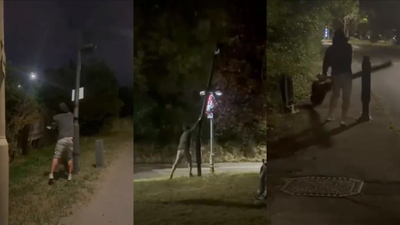
Americans across the country are vandalising surveillance cameras made by Flock Safety. Incidents have been reported from Florida to California amid growing concerns over privacy and government surveillance. The backlash has also reached city governments, with several US cities deactivating the cameras or cancelling contracts with the company.The opposition cuts across political lines. Critics argue the nationwide camera network infringes on personal privacy, while Flock maintains that its technology is designed to improve public safety.“It’s a violation of people’s privacy,” said Caleb Williams, a 24-year-old from South Carolina. Responding to the criticism, Flock CEO Garrett Langley told CNN, “Oftentimes our critics will say we need to make a choice between safety or privacy. And I think that’s, I think that’s wrong. As a country, as a society, as a species, we have proven over and over and over again that we can have safety and privacy.”
Cameras targeted across multiple US states
According to The Guardian, people have cut down Flock cameras with electric saws in New York, thrown paint on them in Oakland, California, rammed vehicles into them in Idaho and physically blocked their view in Florida.The opposition has also reached local governments. Cities including Fort Collins, Colorado; Eugene, Oregon; Madison, Wisconsin; Knoxville, Tennessee; Syracuse, New York; and Walla Walla, Washington, have either deactivated Flock cameras or ended agreements with the company.Flock says it has deployed about 120,000 automated license plate reader (ALPR) and pan-tilt-zoom (PTZ) cameras across the United States. The system captures tens of billions of vehicle data points every month, allowing participating law enforcement agencies to search vehicle movements across jurisdictions.
Privacy concerns unite different political groups
The opposition to Flock’s surveillance network has brought together people with different political views.“Rational people know it comes down to violating personal liberties,” said Adrien Kaiser, who described himself as a constitutional conservative.“I firmly believe the government can do things to make life better for people, but a surveillance state is the first step towards a police state,” said Jon Dendy, a progressive from Massachusetts.Kaiser said both conservatives and progressives are reaching similar conclusions through different perspectives.“Individual rights have always been big on the left, and conservatives see things in terms of constitutional rights. So that’s where there’s coming together,” he said. “We see the same problem from two different angles.”
Reports of misuse have added to criticism
The debate has intensified following reports that some police officers used Flock’s system to monitor former partners and colleagues. Journalists have also reported that, despite the company’s statements that it tracks vehicles rather than people, the system can be used to search for individuals using descriptive information.According to 404 Media, a Flock feature called “FreeForm” allows searches using characteristics such as clothing, tattoos or race. The publication also reported that some police officers conducted searches to assist immigration enforcement.Flock told 404 Media that FreeForm includes “guardrails” which alert administrators when search terms include “race, ethnicity, religion, nationality.” The company has also said it does not share its data directly with Immigration and Customs Enforcement (ICE). Langley said Flock has introduced an automated audit process that flags suspicious searches for administrator review.
Questions over surveillance and accuracy
Privacy advocates say Flock differs from traditional security cameras because its connected network allows law enforcement agencies to search vehicle movements nationwide.“Once people start learning about the massive scale of the data that’s being collected and who it’s being accessed by, it starts to freak them out,” said Dave Maass, director of investigations at the Electronic Frontier Foundation.The system has also faced questions over accuracy. In June, automotive journalist Joel Feder said he was stopped by police in Minnesota after a Flock camera incorrectly identified the dealer plate on a Range Rover he was test-driving as matching a stolen vehicle report. Similar concerns over Flock’s license plate recognition accuracy have also been reported elsewhere.According to Feder, officers later determined that a similar plate number had been entered incorrectly into the FBI’s National Crime Information Center database, which Flock uses for alerts. Langley later described the incident as an “edge case” and said the underlying federal database was the larger issue.While Flock remains at the centre of the current debate, privacy advocates note that other companies, including Motorola, Vigilant Solutions and Axon, also operate connected license plate recognition systems, suggesting the broader discussion extends beyond a single surveillance provider.