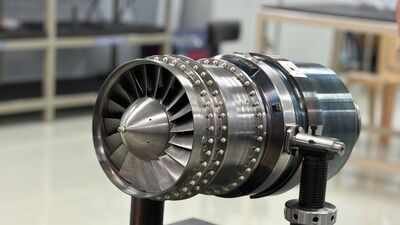
NEW DELHI: India has entered an exclusive club of countries capable of designing and producing indigenous expendable turbojet engines after the Defence Research and Development Organisation (DRDO) successfully developed the country’s first 350kg thrust-class expendable turbojet engine. Designed by DRDO’s Gas Turbine Research Establishment (GTRE) and manufactured by Hyderabad-based Azad Engineering, the engine is intended for one-time military applications including cruise missiles, jet-powered loitering munitions, target drones and unmanned aerial vehicles (UAVs). The first production unit was recently delivered to GTRE, marking a significant milestone in India’s indigenous aerospace propulsion programme. The development is important because compact turbojet technology is considered among the most difficult engineering disciplines in aerospace. Unlike rockets, which carry both fuel and oxidiser, turbojet engines continuously ingest atmospheric air, compress it, burn fuel and generate sustained thrust. Designing such engines requires expertise in aerodynamics, high-temperature metallurgy, precision manufacturing, combustion physics and turbine engineering, capabilities possessed by only a handful of nations. Defence officials say the engine will reduce India’s dependence on imported propulsion systems while providing a domestic powerplant for several future missile and unmanned combat programmes. The successful delivery also reflects the growing maturity of India’s defence industrial base, where public laboratories and private manufacturers are increasingly collaborating to produce sophisticated aerospace systems.
Why this engine matters
Although the engine develops 350kg of thrust, its importance lies less in raw power and more in what it enables. Modern warfare is increasingly shifting towards long-range precision strikes using unmanned systems. Cruise missiles and loitering munitions have emerged as some of the most cost-effective weapons for attacking strategic targets deep inside enemy territory without risking pilots or expensive combat aircraft.
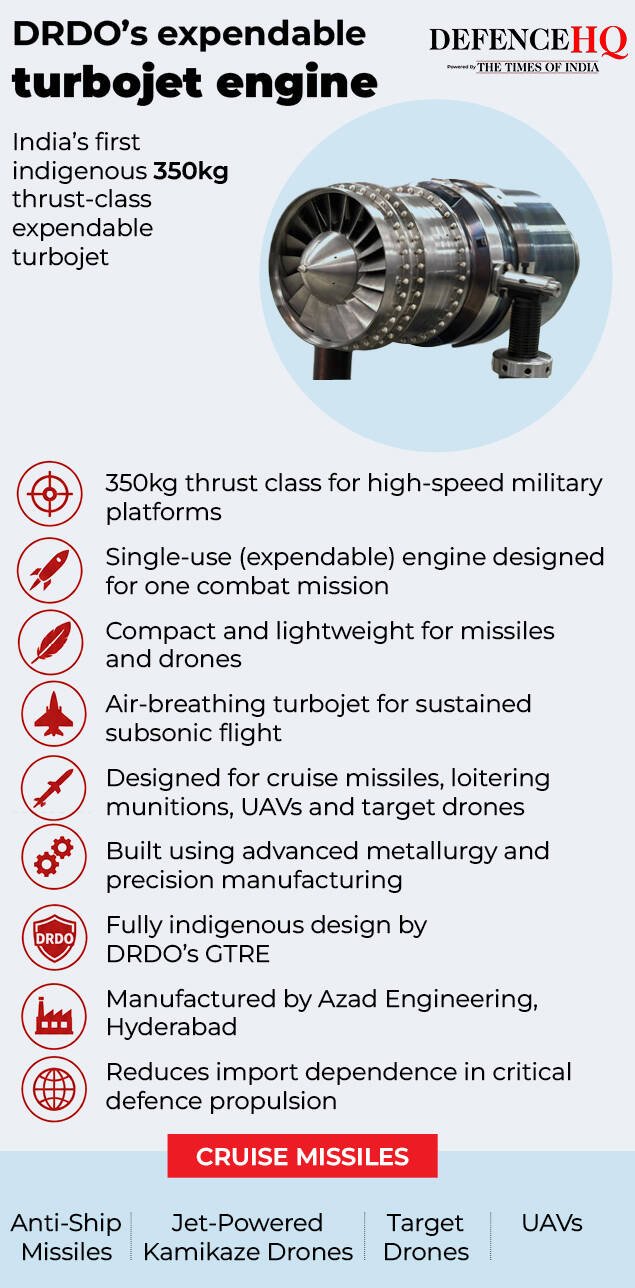
The small engine that could reshape India’s military aviation ambitions
Until now, India has largely depended on imported propulsion technologies or foreign collaborations for compact jet engines. Developing such an engine domestically gives India greater freedom to design future weapons without worrying about export restrictions or supply disruptions. It also complements India’s broader push towards Aatmanirbhar Bharat in defence manufacturing.Sijan Pal Singh, author and former Advisor for Policy and Technology to Dr APJ Abdul Kalam, told The Times of India that the development should be viewed as much more than the arrival of a new propulsion system.“The development of India’s first indigenous 350 kg thrust-class expendable turbojet engine is an important milestone for the country’s aero-engine ecosystem. Although it is not a fighter engine, it represents another step in mastering the technologies needed to design, manufacture and test modern gas-turbine engines. Every successful engine programme strengthens India’s knowledge base in areas such as compressors, turbines, combustion systems, materials and precision manufacturing. The engine is intended for expendable platforms such as long-range cruise missiles and unmanned systems, where reliability, compactness and cost are critical. Developing such an engine indigenously reduces dependence on foreign suppliers and gives India greater flexibility in producing these systems at scale. More importantly, aero-engine development is cumulative. The expertise gained from smaller engines can be applied to more powerful engines in the future. While a 350 kg thrust turbojet is very different from a fighter engine producing over 100 kN of thrust, many of the underlying technologies and manufacturing processes are common. In that sense, the significance of this achievement goes beyond the engine itself. It expands India’s design and manufacturing capabilities, builds confidence in indigenous engine development and strengthens the technological foundation for future military and civilian aero-engine programmes.”
What exactly is an expendable turbojet engine?
Unlike fighter aircraft engines that are designed to operate reliably for thousands of flying hours, an expendable turbojet is built for a single mission. Once launched, the engine powers the weapon until it reaches its target. It is never recovered. Because of this, engineers optimise these engines differently. Instead of focusing on decades of service life, designers prioritise simplicity, reliability, compact size and low production cost while still delivering sufficient thrust. A recent engineering study on expendable turbojet development notes that such engines typically operate in the 300-400 daN thrust category and are designed specifically for missiles and unmanned aerial vehicles, where reliability during a single mission is more important than long operational life. The paper cites systems such as the Harpoon missile and Storm Shadow cruise missile as representative applications.
What can the new engine power?
The engine has been developed for a broad family of precision strike systems.
- Cruise missiles: The most obvious application is India’s future generation of cruise missiles. Cruise missiles require compact, fuel-efficient engines capable of flying long distances at low altitude while maintaining subsonic speeds. Such missiles can strike command centres, logistics hubs, ammunition depots, radar installations and strategic infrastructure hundreds of kilometres away. India is already developing long-range land attack cruise missiles (LR-LACM), and indigenous turbojet technology could eventually support future variants while reducing reliance on imported propulsion.
- Jet-powered loitering munitions: The engine could also power high-speed kamikaze drones. Unlike propeller-driven loitering munitions that generally fly below 200 kmph, jet-powered systems can reach speeds exceeding 400 kmph, dramatically reducing enemy reaction time. India recently inducted the Agniveg (Peacekeeper) loitering munition, capable of speeds approaching 450 kmph and designed for precision strikes in contested environments. Faster loitering munitions are harder to intercept and better suited for attacks against time-sensitive targets.
- Target drones: Another important application is high-speed target drones used to test air defence systems. Such drones simulate enemy cruise missiles or aircraft during military exercises, allowing armed forces to evaluate interceptor performance under realistic conditions.
- Tactical UAVs: Compact turbojets also enable higher-speed unmanned aerial vehicles for reconnaissance, electronic warfare and specialised strike missions.
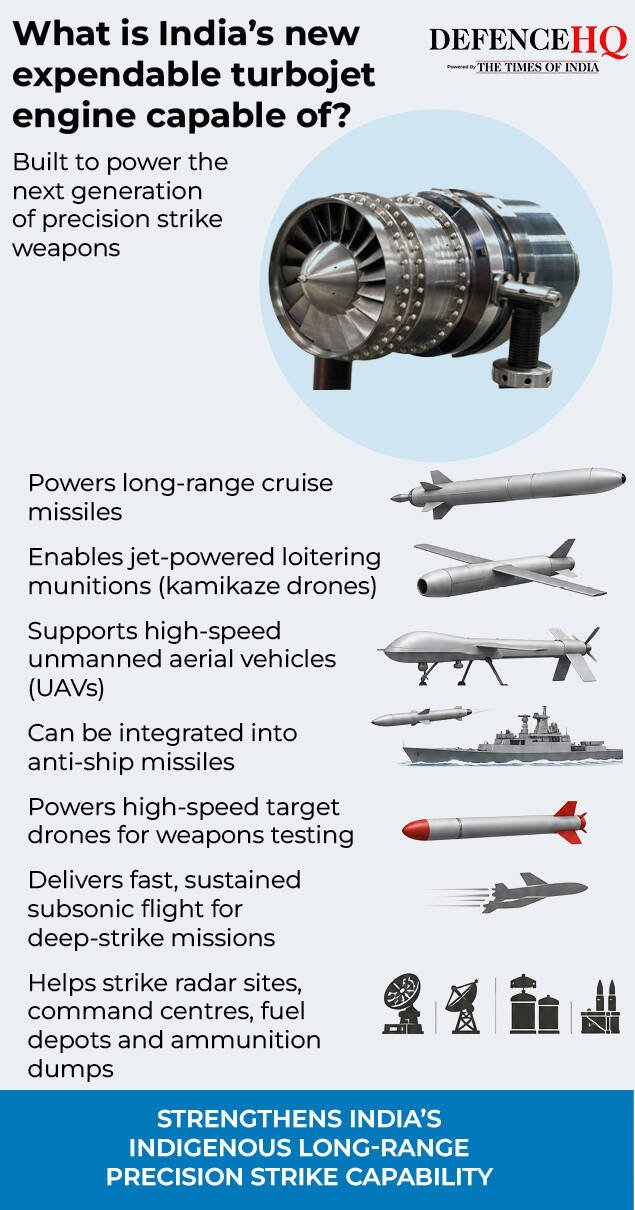
From cruise missiles to combat jets: India’s turbojet breakthrough cuts import dependence and opens new defence possibilities.
According to Singh, the new engine is less about one specific weapon and more about creating an indigenous propulsion ecosystem that can support multiple future programmes.“The new 350 kg thrust-class expendable turbojet engine is expected to benefit a wide range of Indian long-range precision strike systems. Its most immediate applications are likely to be cruise missiles, long-range loitering munitions and unmanned aerial vehicles (UAVs) that require a compact, reliable and affordable propulsion system. More broadly, the engine is an enabling technology rather than a platform-specific achievement. Once India has mastered this class of propulsion, it can be adapted and scaled for a variety of future missile and unmanned systems. That makes it an important building block for India’s long-term missile and drone ecosystem, while reducing dependence on foreign engine technology.”
Why are turbojet engines so difficult to build?
Developing a jet engine is widely regarded as one of the toughest technological challenges in aerospace. Every stage of the engine operates under extreme conditions. Air entering the compressor must be compressed efficiently through multiple stages of rotating blades. The combustion chamber must burn fuel at temperatures exceeding 1,000 degrees Celsius while maintaining stable airflow. The turbine must then extract enough energy to drive the compressor without melting under intense heat. All these components rotate at tens of thousands of revolutions per minute. A tiny manufacturing defect or imbalance can cause catastrophic failure. According to the engineering methodology described in the uploaded technical paper, expendable turbojets still require sophisticated compressor, combustor and turbine design despite their relatively short service life, combining precision aerodynamics with advanced materials and manufacturing.
How is this different from India’s fighter aircraft engines?
The newly developed engine should not be confused with the much larger turbofan engines required for fighter aircraft. A fighter engine produces tens of thousands of kilograms of thrust, often using afterburners and advanced cooling technologies while remaining reliable over thousands of flight hours. An expendable turbojet has a far simpler mission. It powers a missile or drone for only one operational sortie before being destroyed. Although technically less demanding than a modern fighter turbofan, mastering expendable turbojet technology still represents an important stepping stone in developing indigenous gas turbine expertise.
India’s long journey in jet engine technology
India’s quest for indigenous jet engines stretches back more than four decades. The most ambitious effort has been the Kaveri engine programme, initiated by GTRE to power the Light Combat Aircraft Tejas. Despite decades of development, the Kaveri programme faced major challenges involving thrust generation, weight, reliability and high-temperature materials. The engine was eventually delinked from the Tejas programme, which instead adopted General Electric’s F404 engines. However, the Kaveri programme created valuable expertise in compressor design, combustors, turbine technology and testing infrastructure that continues to benefit newer propulsion projects. The newly developed expendable turbojet represents another milestone in this long technological journey. Unlike Kaveri, it focuses on smaller military systems rather than fighter aircraft, making it a more achievable technological objective while strengthening India’s domestic propulsion ecosystem.While describing the significance of the achievement, Singh cautioned that building an expendable turbojet is only one step towards India’s larger ambition of developing indigenous fighter aircraft engines.“Developing an expendable turbojet engine is an important milestone, but a reusable fighter engine is a far more demanding challenge. The two operate in very different environments. An expendable engine is built for a short, single-use flight. A fighter engine has to run reliably for thousands of hours through extreme temperatures, high speeds and repeated take-off and landing cycles. The biggest technological challenge lies in the engine’s hot section. India must master single-crystal turbine blades, advanced high-temperature alloys, thermal barrier coatings and efficient cooling technologies. These determine how much temperature and stress an engine can withstand while still delivering high thrust. The next challenge is achieving a high thrust-to-weight ratio without compromising reliability or fuel efficiency. Fighter engines also require advanced digital engine control systems, precision manufacturing and rigorous quality control to ensure consistent performance over their entire service life. Finally, extensive ground and flight testing is essential. A fighter engine must prove itself through thousands of hours of endurance testing before it can power an operational aircraft. Once India masters these technologies, the transition from expendable engines to indigenous high-performance fighter engines will become much more achievable.”
Other indigenous engine programmes
India is simultaneously pursuing several propulsion projects across different categories.
- Small
Turbofan Engine (STFE): DRDO has also developed a 450kg thrust-class Small Turbofan Engine intended for future long-range land attack cruise missiles. Compared with turbojets, turbofans provide improved fuel efficiency, making them suitable for longer-range weapons. - Manik engine: GTRE has developed the Manik small turbofan, which has undergone testing for cruise missile applications. The programme represents another step towards reducing dependence on imported propulsion technologies.
- Kaveri derivatives: Although the original fighter engine programme faced setbacks, various Kaveri derivatives continue to support research into future combat aircraft and unmanned systems.
- Future fighter engines: India is simultaneously working with international partners on next-generation high-thrust engines for programmes such as the Advanced Medium Combat Aircraft (AMCA).
Which countries have mastered expendable turbojet technology?
Only a small group of nations possess complete indigenous capabilities in compact military turbojet engines.
- United States: The United States pioneered expendable turbojet propulsion for cruise missiles through companies such as Williams International, General Electric and Pratt & Whitney. The Tomahawk cruise missile remains among the best-known examples powered by compact turbojet technology.
- Russia: Russia has decades of experience producing compact propulsion systems for cruise missiles, anti-ship missiles and tactical weapons. Its missile inventory includes several indigenous turbojet-powered systems used extensively by Russian armed forces.
- France: France, through Safran and earlier
Microturbo , has developed compact turbojet engines used in missiles including the SCALP/Storm Shadow family. French industry has remained one of Europe’s leaders in precision missile propulsion. - United Kingdom: Britain has historically contributed through Rolls-Royce and collaborative European missile programmes. British expertise forms part of several advanced missile propulsion initiatives.
- China: China has rapidly expanded indigenous production of compact military turbojets and turbofans through state-owned aerospace manufacturers. These engines now power a growing range of Chinese cruise missiles, unmanned combat aircraft and loitering munitions. India’s latest achievement places it among this limited group of countries capable of independently developing compact expendable turbojet propulsion.
Why future wars are driving demand for such engines
Recent conflicts in Ukraine, the Middle East and elsewhere have demonstrated how unmanned precision strike systems are transforming warfare. Cruise missiles and loitering munitions can destroy air defence systems, fuel depots, logistics hubs, command centres and ammunition storage facilities without exposing pilots to enemy fire. Jet-powered drones also offer greater speed than propeller-driven systems, making interception considerably more difficult. As militaries increasingly prioritise long-range precision attacks and non-contact warfare, demand for compact indigenous jet engines is expected to rise significantly.
What comes next?
The successful development of the 350kg thrust-class expendable turbojet does not solve India’s long-standing challenge of building high-performance fighter aircraft engines. However, it marks a major technological achievement in an area mastered by only a few countries. Beyond reducing import dependence, the programme strengthens India’s domestic ecosystem of propulsion technologies, manufacturing expertise and precision engineering. For DRDO and GTRE, it represents another important step in a broader journey towards self-reliance in aerospace propulsion, one that began with ambitious fighter engine programmes decades ago and is now expanding across missiles, drones and next-generation unmanned combat systems.