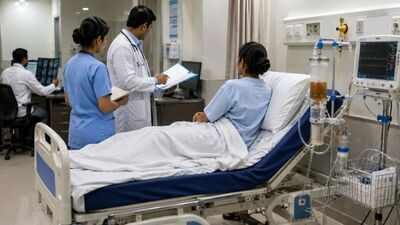
NEW DELHI: The National Consumer Disputes Redressal Commission (NCDRC), in an order dated August 4, held a Ludhiana hospital and two doctors responsible for deficiency in service after a 36-year-old woman developed paralysis of her lower limbs following treatment for leakage of fluid from her nose. The commission directed them to pay Rs 15 lakh compensation.How did the medical negligence dispute arise?According to the commission’s order, Kiran Bala was leading a healthy life when she developed unusual leakage of fluid from her nose in September 2011. She was taken to Satguru Pratap Singh Apollo Hospitals in Ludhiana, where she was diagnosed with CSF rhinorrhoea, a condition involving leakage of cerebrospinal fluid through the nose.She was admitted to the hospital on September 20, 2011, and underwent endoscopic surgery to repair the leak. The surgery was initially successful, but the leakage returned the next day. Doctors then advised placing a lumbar drain to divert the fluid and help the repair heal. The procedure was carried out on September 23.Soon after the procedure, Bala complained of pain and discomfort in both legs. The hospital’s records noted that the pain had continued from before the procedure. Her condition worsened through the night, and by around 4am on September 24, she had lost sensation and movement in her lower limbs.An MRI conducted on September 24 showed changes in the spinal cord suggesting myelitis and inflammation around the spinal cord. Her condition later progressed to complete paraplegia, with bladder and bowel involvement. She was discharged from the hospital on September 27 and was subsequently treated at Medanta Hospital and the Indian Spinal Injury Centre.Bala and her husband alleged that the hospital and doctors failed to properly respond to her complaints of pain and numbness after the lumbar drain was placed. They alleged that despite repeated complaints, she was given painkillers but was not promptly examined or investigated, resulting in permanent paralysis.The hospital and doctors denied negligence. They said the procedures were carried out properly and that myelitis could occur as a rare complication or due to an unrelated infection. They also said there was no evidence that the lumbar drain had caused the paralysis and that the patient had been properly attended to.Why did the commission hold the hospital liable?The bench comprising president A P Sahi and member Bharat Kumar Pandyasaid the main issue was not simply that Bala developed myelitis after treatment, but whether the hospital and treating team responded appropriately after she began complaining of increasing pain and numbness in her legs.It noted that the medical records showed she had complained of discomfort in both lower limbs soon after the lumbar drain procedure. However, there was no clear record of any detailed examination, investigation or urgent specialist intervention during the critical hours that followed.The commission observed that the hospital had not shown the level of urgency that was required after the patient’s symptoms worsened.“We do not agree that the degree of care, caution, preparedness and responsiveness to quickly identify and investigate the likely complication from lumber drain, has been exhibited by the incharge hospital team,” the commission said.The commission also noted that the MRI was conducted only around 1pm on September 24, although the patient had been complaining of pain and numbness since the previous evening. The MRI report was received around 4.30pm and showed inflammation in the spinal cord.It said the hospital had failed to give a satisfactory explanation for the delay in investigating the symptoms and obtaining specialist advice. The commission noted that it could not say whether an earlier MRI or treatment would have prevented the paralysis, but the delay itself showed a lack of urgency.“The whole team, the resident incharge and the nursing staff could and should have obviously been able to clinically take measure/diagnose the continuing reduction in the motor power of the lower limbs,” the commission observed.The commission, however, did not conclude that the lumbar drain itself had been improperly inserted. It said there was no positive evidence or expert opinion proving that the procedure had been carried out negligently. Instead, it found that the hospital and treating team had failed to respond adequately to the serious symptoms that developed afterwards.It held that the patient had suffered a sudden and serious complication while under the hospital’s care and that the medical team should have acted with greater urgency in investigating her pain, numbness and falling motor power.“Our final conclusion is that there is collective lack of urgency with which the team of incharge experts and the hospital’s system could have responded given the procedure underwent and the complaint/feed back constantly provided by the patient,” the bench further observed.The commission also noted that the hospital’s medical records did not clearly explain the decisions taken during the critical period and said there was “some lack of transparency and clarity” in the doctors’ notes.The commission rejected the family’s claim for Rs 2 crore, saying the amount was excessive and not supported by sufficient evidence of the financial loss claimed. Considering Bala’s age, the physical and emotional burden on her and her family, further treatment expenses and the nature of the deficiency, it awarded a lump-sum compensation of Rs 15 lakh.The amount will carry 6 percent annual interest from the date of the complaint until payment. The hospital will bear 90 percent of the liability, while the two doctors will each bear 5 percent.