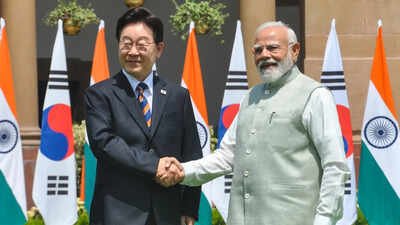
NEW DELHI: India and South Korea have agreed to broaden their defence partnership during the bilateral talks between PM Narendra Modi and South Korean President Lee Jae Myung on Monday, as the two countries have planned for the third phase of cooperation that will emphasise greater technology transfer, co-development and joint design of advanced military systems.The two sides already co-manufacture the K9 Vajra, a specialised artillery gun, and now plan to extend the same manufacturing model to futuristic technologies.Addressing a media briefing in Delhi, MEA secretary (East) P Kumaran said on Monday, “Korea supplies K9 Vajra systems, anti-aircraft systems. There are already two phases of supplies that have happened. We’re looking at the third phase, which involves a greater technology transfer. We’re also looking at other kinds of anti-aircraft guns and missile systems.”The K9 Vajra-T is a 155 mm, 52-calibre tracked self-propelled howitzer that forms a key component of the Indian Army’s modern artillery capability. Manufactured in India by Larsen & Toubro with technology transferred from South Korea’s Hanwha Aerospace, the system is based on the widely used K9 Thunder platform.Equipped with a 155mm/52 calibre gun mounted on a 50-tonne chassis with all-welded steel armour up to 19 mm thick, K9 Vajra-T self-propelled howitzers can fire 47 kg shells at distances of up to around 50 km. The Army has successfully deployed K9 Vajra-T in high-altitude, mountainous terrain, specifically in Ladakh and the northeastern border. These 155mm/52-calibre tracked guns were originally designed for desert warfare but after successful trials in 2021, are now operationalised in hilly areas to enhance long-range, rapid-deployment firepower.Kumaran said, “The earlier two phases of cooperation were primarily oriented towards direct acquisitions and progressive localisation, but Phase III will take the relationship even further with advanced manufacturing and technology transfer.”“Co-development and technology transfer, co-design, etc of next-generation defence systems are some other areas where we want to explore cooperation. Then there are possibilities of co-operation on procurement of defence hardware, telecom equipment, cyber security…,” he said.While the production of artillery weapons systems such as the K9 Vajra has been the highlight of this joint venture, there are ongoing talks on developing air defence systems, which include both anti-aircraft guns as well as missile platforms to tackle new aerial threats such as drones.