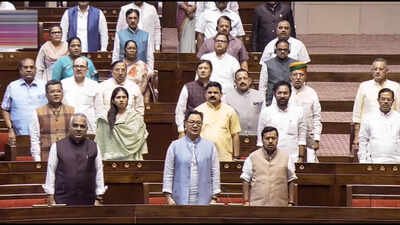
NEW DELHI: Parliament’s Monsoon Session concluded on Thursday with both Houses adjourned sine die after weeks marked by legislative business, opposition protests and repeated disruptions over the Jantar Mantar protest and other political flashpoints.The Lok Sabha’s final morning was strikingly brief. In just three minutes and 10 seconds, members assembled, all six stanzas of Vande Mataram were rendered, MPs including Prime Minister stood to attention, and Speaker Om Birla adjourned the House sine die.The closing proceedings unfolded amid familiar slogans, with the Opposition shouting “apologise, apologise” and “who ordered the lathi-charge?” as home minister Amit Shah entered. Birla also skipped his customary valedictory remarks on the House’s performance, underscoring a session dominated by disruption. Rajya Sabha witnessed Mallikarjun Kharge remarks over Haldwani ‘Suddhikaran’ row followed by JP Nadda’s clarification and condemnation of the event.Meanwhile, in Rajya Sabha, leader of opposition Mallikarjun Kharge raised the Haldwani ‘suddhikaran’ row, alleging that a havan was conducted at the venue after his rally. Leader of the House JP Nadda condemned the incident and assured Kharge that the matter would be investigated.
Lok Sabha, Rajya Sabha adjourned sine die
The Lok Sabha was adjourned sine die by Speaker Om Birla at 11.06 am, followed by the Rajya Sabha, bringing the 19-sitting Monsoon Session to an end. The session had been scheduled from July 20 to August 13. Parliamentary Affairs Minister Kiren Rijiju had said before the session that the government wanted the Houses to see “meaningful debate, discussion and decisions on issues of National importance”.The closing proceedings, however, came amid a continuing logjam over the opposition’s demand for a government response to the police action against students protesting the NEET controversy.
Rijiju flags low Parliament productivity
Parliamentary affairs minister Kiren Rijiju said 12 Bills were passed during the Monsoon Session, but acknowledged that parliamentary discussion remained limited. “It was a good session…we have passed 13 bills; but it was not a good session in terms of discussion,” he said. Lok Sabha productivity stood at 19%, compared with 39% in Rajya Sabha, he added. He also accused the Opposition of avoiding debate despite the government’s willingness to discuss issues.
Six stanzas of Vande Mataram played in Lok Sabha
On the last day of the Monsoon Session, Lok Sabha proceedings opened with all six stanzas of Vande Mataram on Thursday, marking a first for Parliament. Prime Minister Narendra Modi, Union home minister Amit Shah and other senior leaders were present. The move followed fresh Union home ministry directions on the National Song’s protocol. During the session, Parliament also passed the Prevention of Insults to National Honour (Amendment) Bill, providing statutory protection around national symbols.
Kharge raises ‘purification’ row in Rajya Sabha
Congress president and leader of opposition in the Rajya Sabha Mallikarjun Kharge used the final day to raise an alleged “purification” ritual at the Ramlila Maidan in Haldwani after his public meeting there.Kharge said, “I was in Haldwani where I made a public speech at Ramlila Maidan. Lakhs of people were there. At that time, I did not mention the name of any community or religion; I only reiterated the issues of the Govt. But after my speech, people of BJP performed a ‘havan’ there to ‘purify’ that stage…Is this the way in a democracy? How are you protecting the Constitution? I am the LoP.”Union minister JP Nadda responded that the BJP did not support such an act and said it would be investigated. “BJP does not subscribe to such activities. Never. But we will investigate this. I assure you that whatever happened there will certainly be investigated,” Nadda said, adding that he condemned the incident.
Modi and Shah present as session closes
PM Narendra Modi and Union HM Amit Shah were present during the closing proceedings, as the student protest controversy remained the dominant unresolved political issue. The Opposition had demanded Shah’s statement and his presence in the Houses over the police action during the July 20 march by students towards Parliament.On Wednesday, Shah said the government was prepared for a detailed discussion. “As far as the discussion is concerned, Kiren Rijiju, who is our parliamentary affairs minister, has made it very clear that the government is ready to discuss every aspect of the student protests regarding NEET,” Shah said.He added, “On my part, I have also said that I am ready to answer any question in Parliament. But they don’t want the discussion to happen at all. Now let the public decide who is running away.”Rahul Gandhi rejected the offer, saying the Opposition was not interested in an “Amit Shah lecture” and questioning who ordered the use of force against protesting students.
Bills: 12 introduced, 11 passed by both Houses
The Monsoon Session saw 12 Bills introduced, with 10 cleared by both Houses, according to PRS Legislative Research. Key legislation covered public examinations, national honour, birth and death registration, the Supreme Court, MSMEs, taxation, tribunals, cooperative development, Kerala’s name and mining.The Public Examinations (Prevention of Unfair Means) Amendment Bill received the most debate, 17 hours and 34 minutes across both Houses. Several other Bills passed with limited discussion, including four minutes each for the birth and death registration and Supreme Court judges Bills.
NEET protests and the political battle that dominated the session
The NEET controversy and police action against student protesters dominated the Monsoon Session, with the Opposition demanding a debate on alleged examination irregularities, education minister Dharmendra Pradhan’s resignation and accountability for the July 20 crackdown. Repeated protests led to adjournments, while the government said it was ready for discussion.The Opposition, however, linked any debate to accountability over the alleged police action. The issue remained unresolved at the session’s close. Opposition leader Rahul Gandhi asked, “Who shot the students? Who gave the order to beat up the students with lathis with nails?”
The wider legislative and political legacy
Beyond the NEET confrontation, the session produced a broad legislative package. Parliament cleared the Supreme Court (Number of Judges) Amendment Bill, raising the sanctioned strength of Supreme Court judges other than the Chief Justice from 33 to 37; the MSME Development Amendment Bill; taxation amendments; the Tribunals Reforms Bill; the Kerala (Alteration of Name) Bill; the National Cooperative Development Corporation Amendment Bill and the Mines and Minerals Amendment Bill.
Share your thoughts in the comments
Be respectful · TOI community guidelines
The Kerala Bill was among the final measures passed, clearing the Lok Sabha on August 11 and the Rajya Sabha on August 12. The Mines and Minerals Amendment Bill cleared the Rajya Sabha on the final day.The Foreign Contribution (Regulation) Amendment Bill became another major political flashpoint. Instead of being passed, it was referred to a Joint Parliamentary Committee for detailed scrutiny amid Opposition demands that it be withdrawn.