Veteran Bengali filmmaker Raja Sen died on Sunday at the age of 71 after undergoing treatment at a state-run hospital in Kolkata, where he died, news agency PTI reported. The filmmaker’s demise left the industry mourning. Actor Prosenjit Chatterjee and Rituparna Sengupta expressed his grief over Sen’s death.
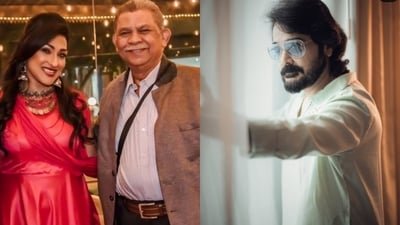
Tributes pour in after Raja Sen’s death
On Sunday, Prosenjit Chatterjee took to Instagram and shared a picture of Raja Sen. He penned an emotional farewell in Bengali: “The farewell of a legend is always painful. His contribution to Bengali cinema is invaluable to us. Rajada, we remember you with deep respect. Your creations and memories will live on forever.”
Actor Rituparna Sengupta also took to Instagram and sharing a photo with the late filmmaker, she wrote, “Rajada was a phenomenon for us. Raja Sen’s legacy lies in the kind of work he created, nuanced, very deep and full of warmth. That quality of a compassionate human being was reflected in his work as well. Through his films, and the variety of subjects he explored, he was somewhat like Tapan Sinha. The way he dealt with such a wide range of subjects, sometimes Damu, sometimes Atmiyo Swajan, sometimes Khacha, sometimes Teen Murti, sometimes Mayamridanga, sometimes Debipaksha, and so many other films — was remarkable. He also made extraordinary documentaries, including one on a personality like Shambhu Mitra.”
She added, “He was a bright star, and his passing is a great loss. It is the loss of a bright star from our film industry and our creative world. But did he receive the recognition he truly deserved? Many people who perhaps do not deserve it receive immense recognition, while Raja Sen, who was worthy of so much more, perhaps did not receive it in the way he should have. We could not give him the respect and recognition that his work and achievements deserved.”
Rituparna said that Raja Sen had brought several National Awards to the country and West Bengal, yet there came a time when he struggled to find producers for his films. She recalled that he would often tell her that good producers were rare and that he wanted to make good films and do meaningful work. Rituparna also questioned whether good work receives the recognition it deserves today.
She added, “His passing makes me feel as though I have lost a guardian. He was like a father figure to me. He gave me so much affection. On the day he was admitted to hospital, I went to see him. He held my hand and said, “Why did you come? Why aren’t you wearing a mask?” Where will I find such affection now? Where will I find that love? We can never recreate that love, that affection, that concern. His work will be learning material and research material for future filmmakers and students. I hope they study it sincerely because he was a very rare director.”
Rituparna expressed her love and support for Raja Sen’s wife Papia and his family, saying she would always stand by them and remain connected to his legacy and work. She also credited Raja Sen with playing a significant role in shaping her into the actor she is today, saying he taught her a great deal.
Remembering him, Rituparna wished Raja Sen peace and said she hoped that all the dreams he could not fulfil in this life would come true in his next.
About Raja Sen’s death
According to a report in PTI, the three-time national award-winning filmmaker was admitted to SSKM Hospital for multiple health complications and was on ventilator support. “He had multiple complications, and his condition remained critical despite treatment. He was on ventilator support,” the doctor said.
The filmmaker was suffering from prolonged health problems for years. It all began years ago when he sustained a serious back injury after falling on the set of his film Maya Mridanga. The injury affected his mobility. He was initially treated at a private hospital after a back injury, but his condition deteriorated there, following which he developed lung and cardiac complications. Last week, he was shifted to SSKM Hospital, where he later reportedly developed kidney-related complications.
Raja Sen was a prominent Bengali filmmaker whose career spanned feature films, television, documentaries and literary adaptations. A three-time National Film Award winner, His feature-film journey began with Nimalu (1994) and his subsequent film Damu (1996), a moving story about an orphaned, simple-hearted man played by Raghubir Yadav, won the National Film Award for Best Children’s Film. He followed it with Atmiyo Swajan (1998), a family drama dealing with changing values and relationships, which won the National Film Award for Best Film on Family Welfare.
Sen subsequently directed films such as Chakrabyuha (2000), Desh (2002), Debipaksha (2004), Krishnakanter Will (2007), Teen Murti (2009), Laboratory (2010), Moubone Aaj (2011), Colonel (2012), Khancha (2013) and Maya Mridanga (2016). Beyond feature films, Sen had a substantial documentary career. His documentary Suchitra Mitra won the National Film Award for Best Arts/Cultural Film in 1993.