
A bridge in Nebraska, US, has been using a special type of concrete to fight snow and ice for more than a decade. Instead of relying only on salt, chemicals or snow-clearing vehicles, the bridge can heat its own surface by carrying an electrical current through the concrete.According to the University of Nebraska-Lincoln (UNL), the 150-foot Roca Spur Bridge, located about 15 miles south of Lincoln, became the world’s first bridge to use conductive concrete in 2002. It has 52 conductive concrete slabs built into its surface. The system was developed by Chris Tuan, a civil engineering professor at the University, with the Nebraska Department of Roads.The idea is based on changing the way ordinary concrete behaves. Tuan added steel shavings and carbon particles to a standard concrete mixture. These materials make the concrete capable of conducting electricity. When electrical current passes through the slabs, the concrete produces enough heat to melt snow and ice from the surface.The system was demonstrated during a winter storm in Omaha in December 2015. A 200-square-foot slab outside UNL’s Peter Kiewit Institute initially collected snow like the surrounding ground. But as time passed, the snow began melting from the surface of the slab. The concrete was carrying enough current to produce heat while remaining safe to touch.
How conductive concrete works
The concrete used in the project is mostly made like standard concrete, but about 20% of the mixture contains the additional conductive materials. Steel shavings and carbon particles allow electricity to move through the slab.When the electrical current passes through the conductive concrete, the material heats up. That heat is then used to melt snow and ice sitting on the surface.Tuan’s team has been studying where this approach makes the most sense. The researchers do not suggest replacing all ordinary road surfaces with conductive concrete. Tuan said that would not be cost-effective. Instead, the technology could be used at locations where ice repeatedly creates problems.“Bridges always freeze up first, because they’re exposed to the elements on top and bottom,” Tuan said in a statement shared by University of Nebraska–Lincoln UNL News Release.
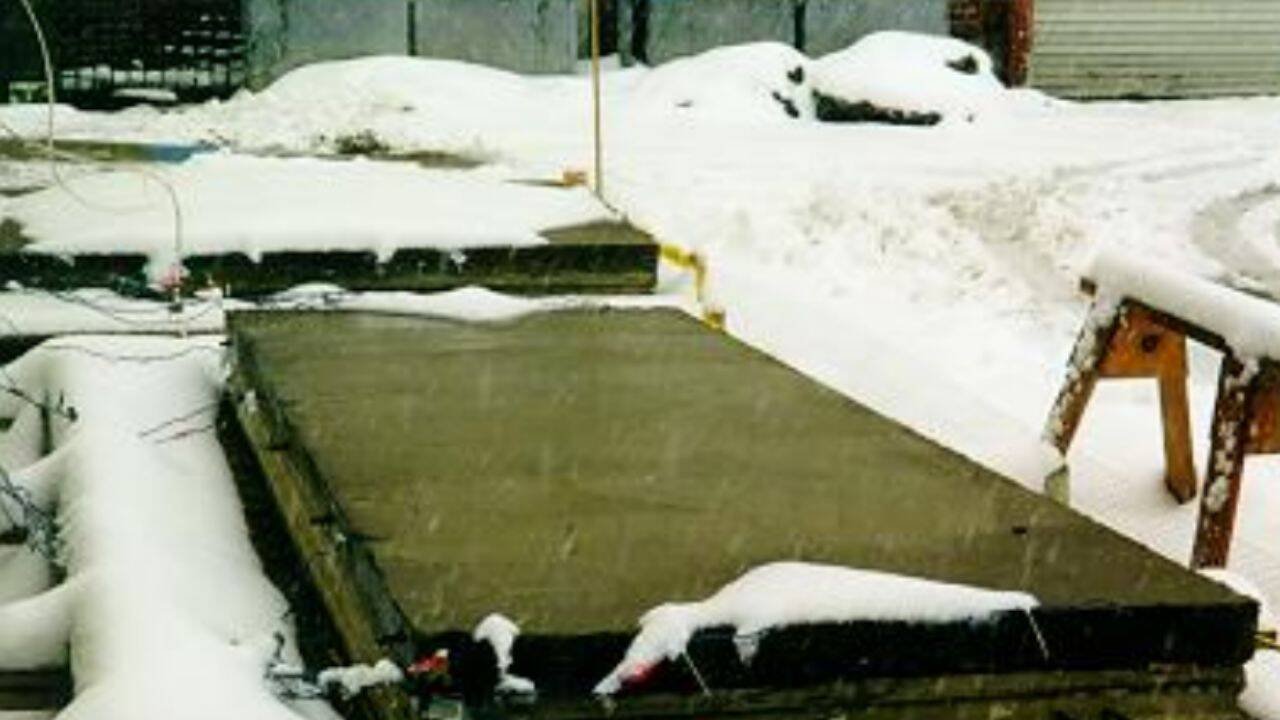
Conductive concrete being tested to see if electrical current can melt snow and ice. (Photo: UNL)
System can reduce chemical use
One reason Tuan sees conductive concrete as an alternative to traditional de-icing methods is the use of salt and other chemicals on roads. According to Tuan, heavy use of these materials can contribute to concrete corrosion and groundwater contamination.The conductive system instead uses electricity to produce heat directly in the concrete. Tuan said the cost of powering the Roca Spur Bridge’s thermal de-icing system during a typical three-day storm is about $250. He compared that cost with the price of a truckload of de-icing chemicals and said the electrical system can be several times cheaper to operate in that situation.The technology was also being tested for use at airports. Tuan’s research team worked with the Federal Aviation Administration during a testing programme. However, the team was not initially focused on heating airport runways. The FAA was more interested in areas around airport gates, where many service vehicles need to operate.“To my surprise, they don’t want to use it for the runways. What they need is the tarmac around the gated areas cleared, because they have so many carts to unload including luggage service, food service, trash service, fuel service, which all need to get into those areas.”
Blocking electromagnetic waves
Tuan’s research also found that changing the materials used in concrete could also give it the ability to shield against electromagnetic waves. For this, limestone and sand normally used in concrete were replaced with magnetite, a mineral.Electromagnetic waves include radiofrequency waves used to transmit and receive signals from devices such as mobile phones. The magnetite-based concrete was therefore studied as a possible way to block such signals.Tuan and his colleagues built a small structure in their laboratory to demonstrate the shielding effect. People entering the structure with mobile phones received no service.“We invite parties that are interested in the technology to go in there and try to use their cellphones,” Tuan said. “And they always receive a no-service message.”The work therefore has applications beyond winter road safety, although de-icing remained one of the main areas being tested. Tuan had also used it at home. “I have a patio in my backyard that is made of conductive concrete,” he said with a laugh. “So I’m practicing what I preach.”