
The US-Iran war may have led the world to see one of the biggest oil supply disruptions in history but crude prices have largely seen a limited spike. But, for how long? The Middle East conflict is showing no signs of ending – the global oil market may have survived the first few months of the war relatively unscathed, but what if the war doesn’t end for another six months? For how long can the global economy, and India, survive an oil shock that may be snowballing slowly to possibly hit hard?In its August outlook on oil, US Energy Information Administration estimates that it will take until early 2027 for oil production and trade patterns to generally return to pre-conflict status.Not only that, EIA also believes that oil prices will continue to stay high for some time. “…because of the large drawdown in global inventories triggered by continued disruptions in the Strait of Hormuz, we forecast that oil prices will remain elevated until global oil flows return to normal and oil inventories are replenished,” it says.
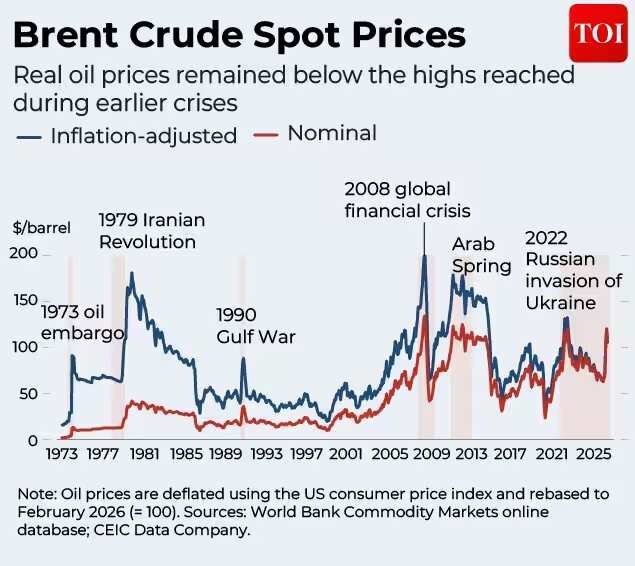
Real oil prices remained below the highs reached during earlier crises.
In fact, the IEA says that global oil supply will fall by 4.3 million barrels per day, or around 4%, this year.How will the world, and India be able to handle a prolonged oil crisis? We decode:
What’s prevented an oil crisis till now?
Let’s first understand what has helped the oil supply thus far:As the Middle East conflict unfolded and traffic through Strait of Hormuz came to a standstill, the International Energy Agency (IEA) responded by announcing the emergency release of 400 million barrels of oil from member countries’ reserves in March. This was the largest ever coordinated release of oil stocks.
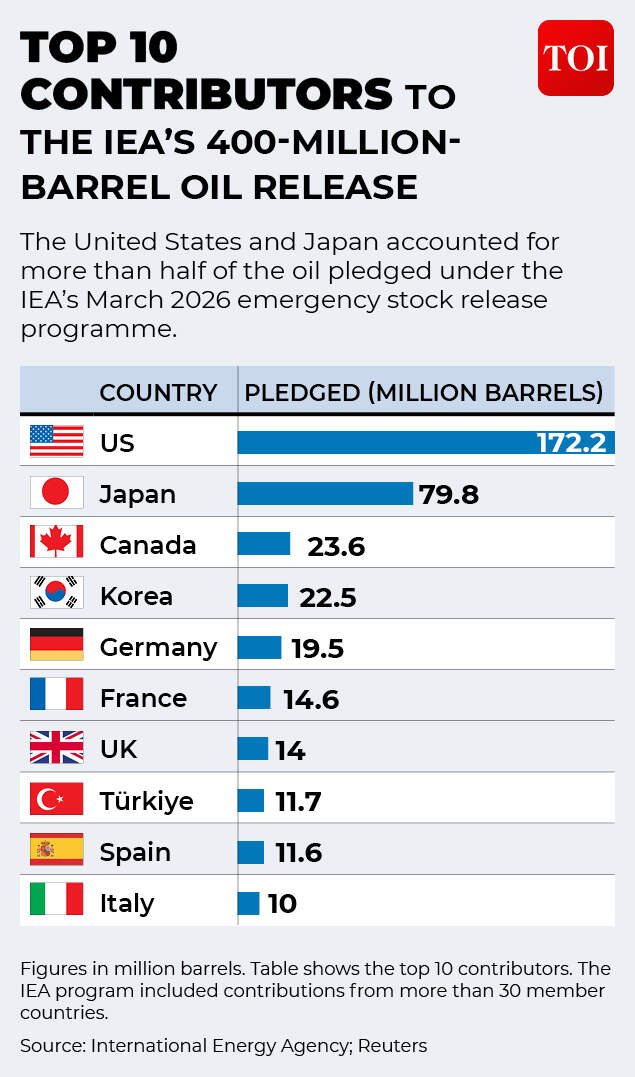
Top 10 contributors to IEA’s 400 million barrel oil release
IEA also said that more supply would be released, in case the situation worsens. The US has also been drawing down from its Strategic Petroleum Reserves, which according to a Reuters report is now at the lowest since January 1983.China’s move to reduce its demand for oil imports and use up its strategic reserves has been a big factor in controlling the demand-supply gap from widening. It is estimated that while the supply loss from the Gulf is at around 11 million barrels per day, the gap compared to the demand is just around 5 million barrels per day.By some estimates, the current global crude oil inventory should be able to cover several months. But, the calculation could be tricky since one cannot assume that the entire inventory would be available for release.Also Read | Beijing’s billion-barrel weapon: Why India must prepare for China-driven oil prices
Slippery road ahead: How long can the world take the hit?
According to a Reuters analysis, global oil stocks are under pressure, and the scale of disruption is particularly difficult to determine since the length of the conflict is unknown. Hence, it is not easy to gauge whether the current supply of reserves will be sufficient to prevent a bigger crisis from unfolding.
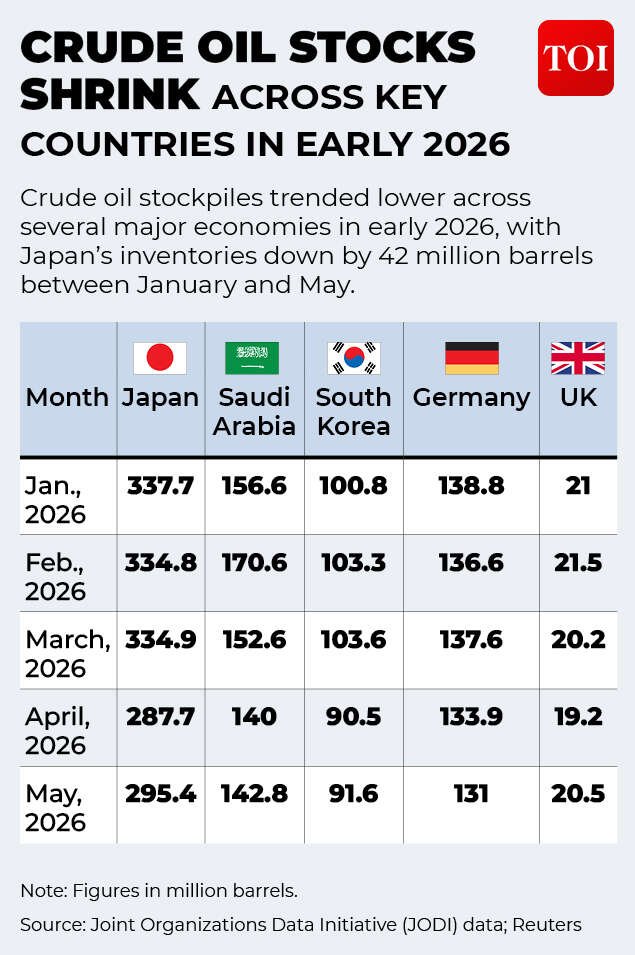
Crude oil stocks shrink across key countries in early 2026
Saudi Aramco has estimated that the world has lost as many as 2.6 billion barrels of oil since the conflict started. This is the largest cumulative disruption that the world economy has seen apart from the 1979 Iranian revolution. This means around 25 days of pre-war global consumption has been hit.According to a Reuters report, the total government and commercial stocks with IEA are theoretically sufficient to cover the current 5 million barrels per day supply gap for around 300 days. But, only some part of the stock is readily releasable, reducing the gap covering capacity to around 180 days.OPEC estimates global oil stocks at roughly 8 billion barrels, including commercial inventories, strategic reserves, and oil in transit.Praveen Rai, Director, Grant Thornton Bharat explains that each IEA member country that is a net oil importer must maintain oil stocks equivalent to at least 90 days of the previous year’s net oil imports.The US has about 700 million barrels of strategic petroleum reserves. Confirmed US inventories stand at about 350 million barrels currently, after falling by roughly 100 million barrels since March. China holds roughly 1–1.4 billion barrels of crude oil inventory and India around 100 million barrels.
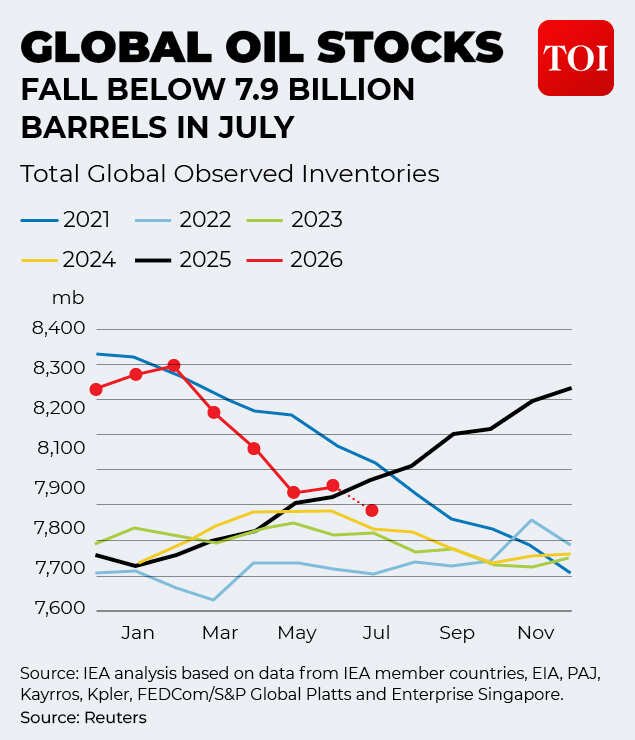
Global oil stocks fall below 7.9 billion barrels in July
“Overall, global oil inventories remain substantial, but only a portion is readily available to offset a major supply disruption. However, much of oil stocks is operational inventory required to keep refineries and supply chains functioning,” Praveen Rai tells TOI.Pankaj Srivastava, Senior Vice President, Commodity Markets – Oil at Rystad Energy explains that in practice, crude inventories are unevenly distributed geographically, and a significant portion is held as strategic or operational stocks.“Countries are unlikely to release large volumes of their own inventories for export if doing so would compromise their domestic energy security. Even where inventories are technically available, logistical constraints, crude-quality requirements, refinery configuration and regional supply preferences limit their effective usability,” he tells TOI.But supply constraints may ease as additional production becomes available from the UAE, US, Guyana, Brazil and potentially Venezuela.“Any increase in supply from these producers would reduce the rate of inventory drawdown and extend the period over which the market can absorb the current supply disruption,” Srivastava says.Also Read | 100% tariffs: Why India may ignore Trump threat and continue buying Russian crude oilAnother important point to understand is that the definition of ‘operable’ or minimum usable inventory varies significantly by country and region.“Countries such as China and the US, with substantial strategic and commercial storage capacity, can draw down inventories to relatively low levels while maintaining refinery operations. In contrast, countries with only 2-4 weeks of crude inventory coverage are significantly more exposed to supply disruptions and market volatility,” says Pankaj Srivastava, Senior Vice President, Commodity Markets – Oil at Rystad Energy.So the impact can be uneven, depending on the ability to replenish stocks.The math is further complicated by the fact that a big portion of the spare production capacity in the world sits in the Gulf. Non-OPEC producers like the US, Brazil, Canada and Guyana can gradually increase output, but any large production response tends to take months.
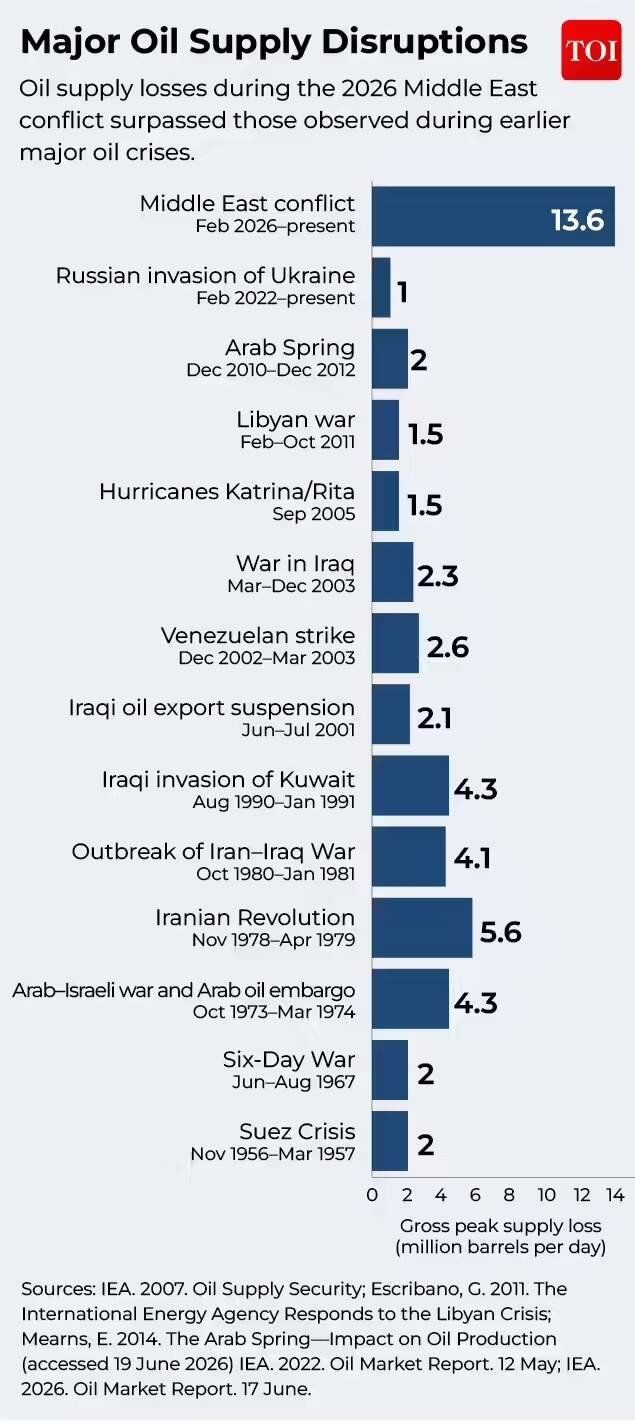
Major Oil Disruptions in the world
“So, spare capacity can reduce the severity of a supply shock, but it is unlikely to completely neutralize the impact of a prolonged and large-scale loss of Gulf supplies,” says Praveen Rai.According to Naveen Das, Senior Crude Oil Analyst at Kpler, the stocks are less of a problem, the bigger issue is the logistics.“Storage volume isn’t the problem. Global stocks have barely moved despite a sustained deficit, so there’s no tank-space crisis. The real bottleneck is logistics: getting crude out of the Gulf via limited bypass pipeline capacity, and the rerouting and queuing showing up in floating storage. Government caution about releasing strategic reserves is a secondary constraint. Refining capacity matters at the margins but isn’t the global chokepoint,” he tells TOI.Globally, inventories appear more comfortable when commercial stocks, oil at sea, the US SPR and China’s reserves are included, but not all of these represent immediately usable supply.One factor that needs to be understood is this: the scope of further release in emergency stocks is narrowing since many countries have depleted their stocks.
China emerges a major player
China is seen to be a notable exception, even though it doesn’t disclose its reserves: Among higher estimates of 1.7 billion barrels, China could actually cover its pre-war Hormuz imports of around 5.5 million bpd for almost a year. This puts it among the better-positioned major economies alongside Japan.“China has reduced its crude imports by around 30–35% since the US–Iran war, which has helped prevent the global crude market from becoming excessively tight. The resulting demand moderation in China has provided an additional balancing mechanism, partially offsetting the supply disruption from the Gulf,” Pankaj Srivastava tells TOI.
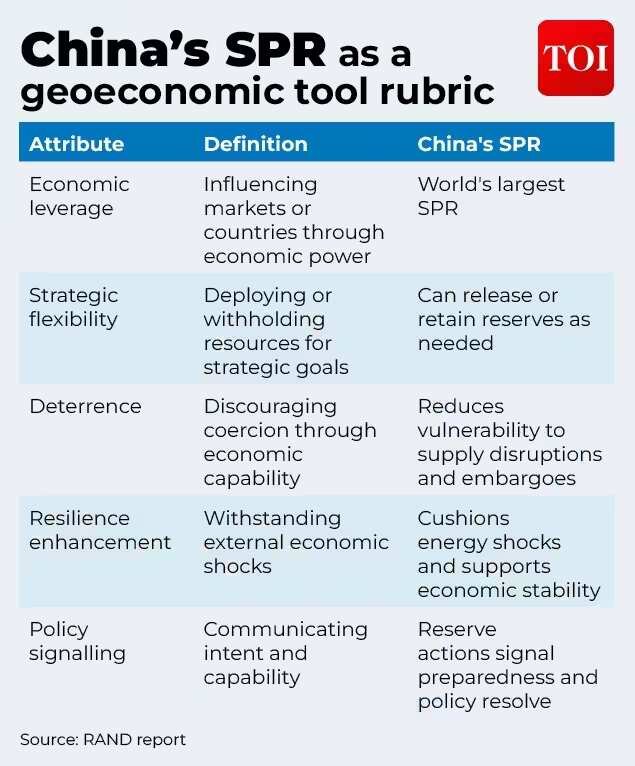
China’s SPR as a geo-economic tool rubic
“If the Gulf crisis persists, China is likely to continue playing a stabilizing role in the global crude market, particularly through a combination of lower imports, refinery run adjustments and utilization of its domestic crude inventories,” he says.But as experts note, China’s pattern is to buy aggressively when prices are soft, not to release reserves for the world’s benefit.“If pushed, a plausible six-month release might be 1-2 million barrels, or roughly 180-360 million barrels total. This would be enough to ease China’s own import needs and indirectly free up barrels for others, but not a deliberate act of global market support,” says Kpler’s Naveen Das.China is not part of the IEA’s coordinated stock-release mechanism and traditionally treats inventories as a strategic national asset.“China is more likely to use its reserves primarily to stabilize domestic demand rather than support global markets. If disruptions persisted for six months, China could release a meaningful portion of its stocks, potentially several hundred million barrels over time, but policymakers would be cautious about drawing inventories down too aggressively given uncertainties around future energy security,” says Praveen Rai of Grant Thornton Bharat.“Therefore, China’s reserves can provide an important stabilizing influence, but they should be viewed as a partial buffer rather than a solution capable of fully offsetting a major and sustained supply shock,” he cautions.
What it could mean for India
Experts believe India’s comprehensive diversification strategy will protect it from oil supply shocks.Naveen Das of Kpler points out that even though India imports nearly all its crude, it has adapted well. “Russian barrels now consistently make up 60-75% of what’s on the water heading its way, alongside Brazilian, US, and West African supply. That diversification means India isn’t as exposed to a prolonged war as a Gulf-heavy importer would be. The volumetric supply security looks manageable,” he tells TOI.But the shock would not be of supply alone, and this is where India’s exposure is important. If global crude oil supplies continue to narrow, India would have a limited pool to buy from, increasing the price of crude.Also, China which has till now used up some of its strategic reserves, could also compete for the same oil. Higher crude oil prices would have a direct impact on India’s oil import bill, which had also become a cause of worry at the start of the US-Iran conflict.Also read: Crude prices cross $90 as ceasefire hopes dim, Hormuz disruption weighs on supplyAlternative barrels generally come with higher freight, premiums and/or less favorable pricing.“The real costs are higher freight from longer voyages, refinery adjustments to run non-Gulf crude, and price: India still pays global benchmark prices, so a persistent global deficit means continued high and volatile costs even as its physical supply holds up,” Naveen Das explains.Additionally, even as Russian crude supplies to India have hit a record high in recent months, India faces the prospect of a new sanctions bill being passed in the US which would empower the Trump administration to impose up to 100% tariffs on big importers of Moscow’s oil“India’s reliance on Russian crude could face some pressure from the proposed 100% US tariff, particularly for refiners with significant exposure to Western markets. However, historical experience suggests that energy security is likely to take precedence over trade considerations, especially during periods of supply disruption,” says Pankaj Srivastava of Rystad Energy“India is therefore likely to continue optimizing its crude basket based on availability, economics, refinery compatibility and geopolitical constraints, rather than moving away from Russian barrels solely because of tariff pressure,” he concludes.