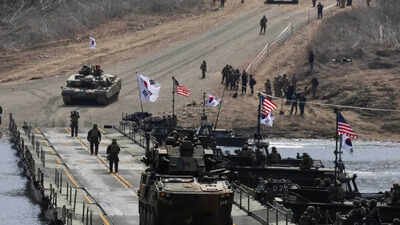
South Korea and the United States have agreed to shorten their annual joint military exercises from 11 days to five, following President Donald Trump’s order to “substantially reduce” the US role in the drills.The Ulchi Freedom Shield exercise, which began on August 17, will now end on Friday, August 21, instead of August 27, South Korea’s Joint Chiefs of Staff and a Pentagon official said on Wednesday, according to Reuters.The allies will also scale back some joint field training exercises, while parts of the programme will be cancelled or shifted to computer simulations.The changes came after Trump instructed the Pentagon on Sunday to reduce the exercises, citing his “very good relationship” with North Korean leader Kim Jong Un.Trump has also said Kim responded to his recent outreach, although he has not disclosed details of the contact.
Second phase of drills likely scrapped
South Korea’s defence minister Ahn Gyu-back said the second phase of the exercise, which was expected to focus on counteroffensive operations, would be cancelled, according to media reports cited by Reuters.The first phase has focused on defensive operations and simulated responses to potential North Korean attacks. The second phase was expected to involve counteroffensive scenarios — an aspect North Korea is particularly sensitive to.A US department of defense official said the US had substantially reduced the exercise and associated live-training events, with some activities cancelled or converted into simulations.The official said the changes would preserve essential readiness and training objectives.The South Korean military said the allies would continue discussing measures to meet the objectives of the exercises and maintain their combined defence posture.The decision has nevertheless raised concerns among military analysts about the impact on the allies’ readiness.Ulchi Freedom Shield is primarily a computer-simulated command-post exercise designed to improve the allies’ ability to respond to a potential North Korean attack, while field training exercises are conducted alongside it.“The drills and a similar springtime exercise are a central pillar of the US-South Korea alliance,” the news agency Associated Press reported, noting that reductions in such exercises could affect the allies’ combined readiness.Yang Uk, an analyst at Seoul’s Asan Institute for Policy Studies, said a prolonged suspension could create problems because military commanders regularly rotate.
Trump signals fresh push to revive talks with Kim Jong Un
President Donald Trump’s decision to scale back the US-South Korea military drills appears closely linked to his renewed effort to re-engage North Korean leader Kim Jong Un.Trump has described the exercises as costly and “hostile” towards Pyongyang and said North Korea had been “unthreatening and respectful” during his presidency.Later, Trump said Kim had responded to his outreach, telling reporters, “he has,” without providing details.The Wall Street Journal reported on Tuesday that Trump was pushing aides to arrange an in-person meeting with Kim as early as this autumn, potentially during his expected November trip to Asia for the APEC summit in Shenzhen, China, citing unnamed US officials.
North Korea condemns drills, leaves room for diplomacy
North Korea denounced the exercises on Wednesday, calling them “frantic” and “extremely dangerous” in a commentary published by its state news agency KCNA.“The dangerous escalation of the war drills staged by the US and its vassal forces is posing a more serious threat to the security rights” of North Korea, the commentary said.It added that North Korea’s exercise of its right to self-defence would continue to “completely neutralise the enemies’ military threat.”Pyongyang routinely condemns US-South Korean exercises as rehearsals for an invasion and has often responded with missile launches. It fired two ballistic missiles into the sea days before this month’s drills began.However, North Korea’s latest response did not mention Trump, his order to reduce the exercises or the shortened schedule.Reuters cited researcher Hong Min of the Korea Institute for National Unification as saying the decision to issue a general commentary rather than a statement by a senior official or a military demonstration could indicate that Pyongyang wants to leave room for diplomacy.Trump and Kim held three summits in 2018 and 2019, but those talks collapsed over disagreements about sanctions relief and North Korea’s denuclearisation. Trump has since signalled an interest in restarting engagement with Kim.
Iran and South Korea’s US ties add another dimension
Trump’s decision to reduce the exercises may also be linked to tensions between Washington and Seoul over the Iran conflict.In his post ordering the reduction, Trump criticised the cost of the drills and said South Korea had declined to support US efforts involving Iran. He wrote that the exercises sent a signal that was “totally inappropriate and hostile” to North Korea, which he described as “unthreatening and respectful” during his presidency.South Korean officials have said Seoul is discussing possible military contributions with Washington, including measures related to freedom of navigation in the Strait of Hormuz, while also considering its defence requirements on the Korean Peninsula.Analysts cited by Reuters said Trump’s decision could therefore serve several objectives, including putting pressure on Seoul, shifting attention from Iran and creating an opening for renewed diplomacy with Pyongyang.Ellen Kim, a senior fellow at the Korea Economic Institute of America, described Trump’s approach as an attempt to “catch three birds with one stone.”
Seoul caught between alliance readiness and diplomacy
South Korean President Lee Jae Myung has maintained that the annual exercises are defensive and are not intended to threaten North Korea.On Tuesday, Lee called for South Korea to strengthen its own defence capabilities while maintaining its alliance with Washington. He said stronger independent capabilities would reinforce the alliance rather than weaken it.South Korea’s foreign minister Cho Hyun told lawmakers on Wednesday that neither South Korean nor US officials had been aware in advance of Trump’s order.The latest reduction is not unprecedented. Trump cancelled a major US-South Korean military exercise in 2018 after his first summit with Kim, describing the exercises at the time as “provocative” and saying their suspension would save money.The allies subsequently cancelled or scaled back other exercises during diplomatic efforts with North Korea and the Covid-19 pandemic.Security analysts have warned that repeated reductions could eventually weaken the two countries’ ability to operate together effectively in a crisis.