Writer, historian and researcher Chandrachur Ghose has spent the last 22 years researching Netaji Subhas Chandra Bose, his mysterious disappearance and the possibility that he did not die in the 1945 plane crash. He has written several books on the subject.
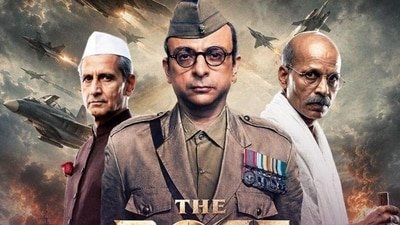
His research now forms the basis for The Bose Network, a microdrama based on Bose’s wartime journey. The series, which premiered on August 15 on the Story TV app, was released as a vertical title designed for mobile-first viewing. It is also one of the few projects which uses an AI-integrated production pipeline to recreate period settings and locations featured in the story.
In a conversation with Hindustan Times, Ghose spoke about his two-decade-long research, the declassified files he studied, his theory about Netaji’s disappearance, the Gumnami Baba mystery and how his research inspired The Bose Network.
You have spent 22 years researching Netaji Subhas Chandra Bose. What has this journey been like?
We have been working on Netaji Subhas Chandra Bose’s history for the last 22 years, and it is thanks to our efforts that the government has declassified 2000 secret files. We have gone across the country, met people, collected private documents, and a lot of things were strewn around. This is what I’m talking about: the private documents, not what the government has revealed, because many government documents remain secret and have not been disclosed to the public.
What did your research into these files reveal?
Based on the study of these files, and not just from India, but we also got files declassified by the US’s CIA, from the UK’s MI5, from Germany, Australia, Taiwan, and so and from across the world, we have gotten files declassified and studied them. Based on those files and other collected information, we have written three books in a series.
Your research challenges the official account of Netaji’s death. What did you discover while working on the books?
The third book in the series deals with the theory that there was no plane crash and Netaji‘s death could not have happened at that time, so the big question is what happened to him. So, we have reconstructed it based on the evidence. We have not made a single claim which is not substantiated by evidence. So, eyewitness account, documentary evidence, and even forensic evidence, based on all these evidences, we have established one fact, which I am not sure you are familiar with: Gumnami Baba.
The storyline goes like this — Netaji went to Russia. The plane crash was a smokescreen created by the Japanese military to give him an escape route. The Japanese government announced the plane crash four days after it happened. The plane crash happened on August 18. The Japanese government announced it on August 22. Those four days were needed to give him the cover to escape to Russia. Because Japan had surrendered, World War II had ended, and he needed another country’s support to continue the freedom struggle from there. At that time, Russia was the best bet. However, what happened after he reached Russia is not very clear.
We figured out that he returned to India in the early 1950s and lived there until his death in 1985. These are the facts we have established based on the evidence.
How did the legend of Gumnami Baba begin?
The local Hindi press in Faizabad named him Gumnami Baba. He used to talk to former revolutionaries, mainly from Bengal. He was always taken care of by a small group of well-placed politicians; among them were 5 chief ministers of Uttar Pradesh.
What did you learn about the network Gumnami Baba had built?
He did not want to participate in politics because he had lost all interest in that, and he had taken sanyas. He was doing India’s work anonymously in his own way, out of the public eye. He was travelling across the world, so we have gathered various bits and pieces of information from various places where he claimed he had participated as an advisor. He claimed that he had participated as an advisor in the Korean War and the Vietnam War, and that he had played a critical role in stopping the Chinese invasion. He explained that he had put pressure on the Chinese leadership, with whom he was very close.
He also made absolutely mind-boggling claims, particularly about the Bangladesh war. Six to seven years ahead of the war, he started talking about what was going to happen.
Is this network the inspiration for the title The Bose Network?
Among the statements he made was that he had his own network in civilian clothes across different governments around the world, particularly in India, and that they were his men working in the national interest, guided by him, and that nobody knew their identities. That is where the producer of this series picked up the idea of The Bose Network and how it worked during the 60s and the 70s, guided by him, and that the network has continued. This series is an extension of what we have written. We have not claimed that there is a Bose network now, but this is a fictional extension of that idea.
The Bose Network is a fictional story rather than a documentary. How much of it is rooted in fact?
Since this is not a documentary but a creative project, so they have used the basis of facts and created situations which are imaginary. It is realistic but not always factual. I don’t think they have held back anywhere. They have gone ahead and shown everything.
The series also explores Netaji’s association with Adolf Hitler. How do you look at that aspect of his story?
In the series, Bose’s character clearly explains why it was essential to meet Hitler and take Hitler’s help. Also, taking Hitler’s help does not mean subscribing to his ideas. It’s a standard geopolitical procedure. Every country makes pacts with dictators and the worst kind of leaders because of national interest. What Bose did was for India’s interest and not to promote Hitler’s ideology. In fact, in private talks, he used to call Hitler a madman. He had absolutely no respect for him, but his help was essential to India.
The casting of Netaji is often scrutinised, particularly by Bengali audiences. What did you think of Joy Sengupta’s portrayal in the series?
It was an interesting choice because Bengalis naturally get the feel. The audience is very sensitive to the accuracy and the similarity of the facial cut. Even Prosenjit Chatterjee got a lot of flak when he was cast as Bose in the 2019 Bengali film Gumnaami because of a lack of resemblance. But since this is a micro series, this is not an essential factor. People don’t really watch them as movies, and that way, I think he has done a good job, and he has at least captured the spirit of it.
The Bose Network, a microdrama based on Bose’s wartime journey, stars Joy Sengupta in the lead role. It is streaming on the Story TV app.