The US Department of Homeland Security (DHS) has proposed raising the fee for certain H-1B visa petitions to $103,265. The proposal, posted in the Federal Register on Monday, would turn the controversial $100,000 H-1B payment introduced by the Donald Trump administration last year into a formal regulatory requirement.The proposed rule will now enter a 30-day public comment period, after which DHS could finalise it by the end of the year.The move comes amid growing uncertainty around the H-1B programme, particularly for Indian professionals who account for the largest share of H-1B beneficiaries.
From $100,000 fee to permanent rule
The proposed $103,265 charge follows Trump’s 2025 proclamation that imposed a $100,000 payment for certain new H-1B petitions. Although that proclamation is due to expire in September, it instructed DHS to pursue regulations that would make the payment permanent.The fee has already become the subject of a legal battle. On June 8, 2026, the US District Court for the District of Massachusetts vacated agency guidance implementing the $100,000 payment requirement in State of California v. Mullin. DHS challenged the decision and sought a stay from the US Court of Appeals for the First Circuit.
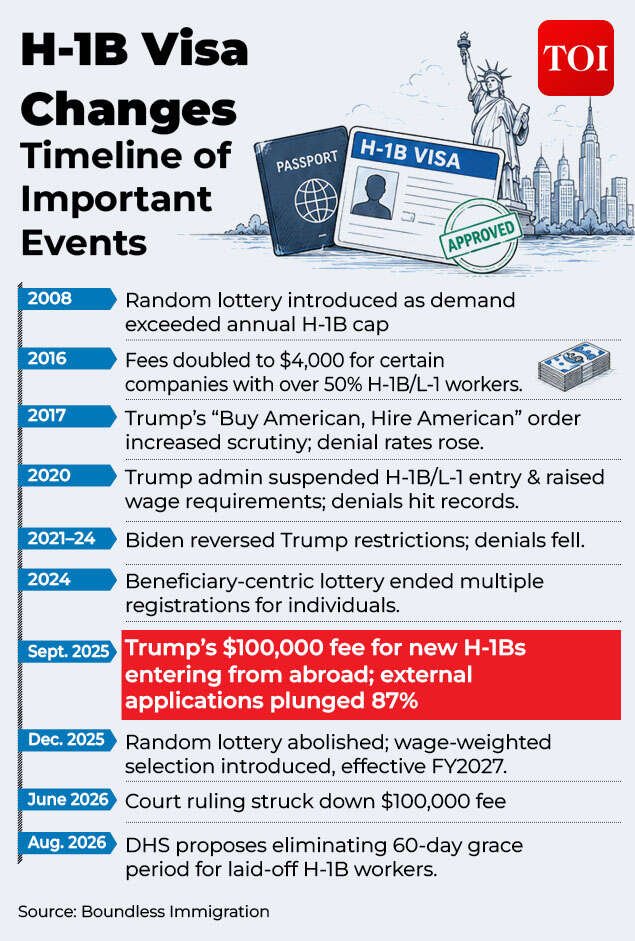
H-1B Visa Changes: Timeline of Important Events
The First Circuit rejected the government’s request on July 24. DHS said it disagrees with the ruling but will comply with the court’s order while it considers its next steps. The department has also made clear that if the court order is eventually lifted, it still intends to collect the payment.Meanwhile, the US Citizenship and Immigration Services (USCIS) has already received enough petitions to reach the congressionally mandated 65,000 regular H-1B cap and 20,000 master’s cap for fiscal year 2027.The proposed fee is therefore arriving alongside a broader tightening of the H-1B system, which has become increasingly difficult for employers and prospective migrants to navigate.
Why Indians face a tougher H-1B road
For Indian professionals, the proposed fee adds to a series of changes affecting the traditional route from education and employment in the US to long-term residency.The H-1B programme has historically been a major pathway for Indian engineers, technology workers, researchers, financial professionals and healthcare workers seeking employment in the US. But higher costs, tighter selection rules and greater scrutiny are making the route more selective and unpredictable.Xiao Wang, CEO of Boundless Immigration, said the $100,000 fee has already affected the market, particularly India-based IT consulting companies whose business models rely heavily on sending employees to US client sites. He also pointed to a shift among major H-1B employers, with Amazon, Meta, Microsoft and Google ranking among the leading sponsors in FY2025 rather than traditional Indian IT firms.Another major change has been the shift towards a wage-weighted selection process. According to Wang, Boundless client data showed that senior, Level III candidates had a 68% selection rate in the March 2026 cap season, compared with 40% for entry-level, Level I candidates. That difference could be particularly significant for Indian students graduating from US universities and seeking their first jobs.The proposed End H-1B Visa Abuse Act of 2026 could add another layer of restrictions if enacted. The bill would call for a three-year pause on new H-1B visas, reduce the annual cap from 65,000 to 25,000 and introduce a minimum annual salary threshold of $200,000.