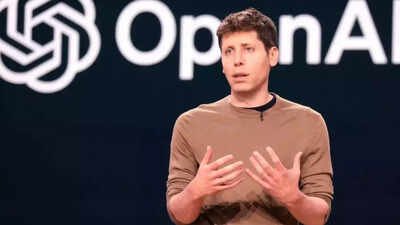
OpenAI CEO Sam Altman says he worries that artificial intelligence could one day be controlled by only a handful of companies, models or individuals, leaving most consumers without influence over how the technology shapes society. According to a report by Business Insider, speaking on David Senra’s podcast, Altman said, “The right approach is to say we want people deeply in control of the future. Society and the models are going to co-evolve.” Altman’s comments come as Microsoft, Amazon, Google, Meta, and Nvidia pour billions into AI infrastructure, fueling a global arms race. China has embraced open-weight models, allowing developers to share and modify AI systems at lower cost, while U.S. firms debate whether to follow suit. OpenAI has released two open-weight models but has kept its frontier systems closed.
Sam Altman cautioned that fears of AI breaking free from human oversight
Altman cautioned that fears of AI breaking free from human oversight could paradoxically lead to tighter control by a few players. He argued that some leaders, including Anthropic CEO Dario Amodei, emphasise risks so strongly that they advocate trading liberty for safety. Amodei has warned that Anthropic’s new Mythos models pose “very real risks” to cybersecurity, finance, and national security, and has pushed for greater government regulation.Altman also criticized U.S. AI leaders for failing to show how the technology can empower individuals. “We are about to see the greatest boom in people starting smaller businesses than we have ever seen,” he said, arguing that AI could give people greater autonomy in their lives.
Sam Altman admits he was ‘very wrong’ on OpenAI’s AI timeline after GPT-4
On the same podcast, OpenAI chief executive finally said the quiet part out loud: the clock he keeps setting has been wrong. “I thought when we got to GPT-4, which was back in 2023, that very quickly after that there was going to be much more disruption, software businesses up for grabs right away, than it turned out to be,” he said.What he blames is not the technology. It is us. “I think I was wrong about a few things, but one in terms of the speed: the economy just has so much inertia,” Altman said, pointing out that people keep buying from the same vendors and using the same tools in the same way. He framed that stubbornness as good news, saying it will make the transition “smoother and slower” and that he is grateful for it. Then came the line that will follow him around: “But it means we’ve all been too ambitious on timelines. Even with this incredible technology, society and the economy will adapt more slowly.”