The late 1990s and early 2000s were an interesting time in Indian cricket. Several players broke into the Indian team for a brief period, only to never be seen again. Some realised they weren’t cut out for that level of competition, while others lingered on until they were eventually dropped. Dodda Ganesh, Sujith Somadundar, Jacob Martin, Ashish Kapoor, Harvinder Singh, Rajesh Chauhan, Abey Kuruvilla, SS Das, Sameer Dighe, Reetinder Sodhi, Hemang Badani and Ajay Ratra are among the names that come to mind. Then again, there were others who never got their India caps despite brimming with talent.
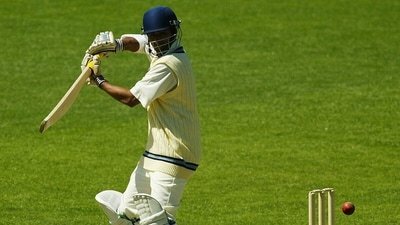
Amol Muzumdar and Ranadeb Bose are arguably the two unluckiest cricketers to have never played for India. One scored over 10,000 first-class runs, the other picked up more than 450 wickets. Yet, neither represented the national team. And then there were those who went out as quickly as they came through the ranks. However, in between these two categories was a bracket of what-ifs – players whose careers promised so much more. Players who did not put a foot wrong. Players who played a 50-over World Cup but were dropped through no fault of their own.
Also Read: His action became a World Cup symbol; he took 10 wickets in an innings, yet his Test career ended after two games
He was part of India’s iconic 2001 Test series win against Australia, though few talk about him. He scored 323 runs in his first three Tests and averaged 53.83 after six, with scores of 43, 5, 60, 96, 79 and 40. What takes the cake is that he achieved these numbers as an opener, even though opening wasn’t his forte. He began as a middle-order batter, was gambled as an opener and excelled in the role against the likes of Wasim Akram and Waqar Younis, whose reverse swing was a source of terror back in the day, especially on subcontinental pitches. Yet, he played them without breaking a sweat.
That, folks, is Sadagoppan Ramesh for you.
Ramesh’s dream start
Ramesh was backed by Kris Srikkanth, who, during his stint as coach of the India A team, oversaw the left-hander’s progress and pitched his name to the selectors after a fine run of scores. His Test debut was expected to take place against Pakistan in Delhi, but intruders dug up the surface in the aftermath of the emotions surrounding the Kargil War. Hence, the venue for the second Test was shifted, and Ramesh got to bat in his hometown of Chennai, where he scored 43 and 5. At the Feroz Shah Kotla, Ramesh could have been Player of the Match for India after scoring 60 and 96, but his performance was overshadowed by Anil Kumble’s perfect 10. Ramesh’s dream run against Pakistan continued in the Eden Gardens Test, where he scored 79 and 40. So good was Ramesh that Mohammad Azharuddin hugged him and said, “I’ve never seen any youngster or anybody bat against Wasim like this.”
Runs came thick and fast against New Zealand at home, where Ramesh produced 287 runs from three Tests, with one hundred and two fifties at an average of 47. He missed one match of the 1999 Border-Gavaskar Trophy, but during the return tour, Ramesh scored a gritty 61 in Chennai and, along with SS Das, provided India with a decent start in the Kolkata Test. Even when India toured Sri Lanka a couple of months later, Ramesh was among the runs, scoring 223 runs from three Tests, with scores of 42, 47, 31, 46 and 55. But as surprising as it may sound, that was the last series Ramesh featured in for India.
When things began to fall apart brick by brick
Ramesh was named in India’s Test squad for the famous 2003-04 Border-Gavaskar Trophy, but did not feature in a single game, with Sourav Ganguly opting for the fresh pair of Virender Sehwag and Aakash Chopra. In an interview with ESPNcricinfo, Ramesh had expressed his surprise at being benched throughout the series despite doing well in a practice match against Victoria
“Sachin Tendulkar and I had a very good partnership in that match. We lost Dravid, Sehwag, Aakash Chopra and Ganguly. We went on to a 180 or 200-run partnership [128 runs]. Even in the second innings, I got some forty-something,” Ramesh recalled.
“In the next side game, I was pushed to No. 8. So where is the question of me going to play the Test matches? There was no reason given. Maybe they wanted to try the Sehwag and Aakash Chopra opening combination for the entire Test series.”
India’s next series after drawing the BGT Down Under was going to be the historic Test tour of Pakistan – their first in 15 years. And considering Ramesh’s success against them the last time around, he should have been an automatic pick. Hence, he put in the hard work and went back to the domestic grind. Ramesh scored 97 and 42 in the Deodhar Trophy and followed it with a 57 in a Duleep Trophy game. But the management seemed to have moved on from him. When the squad was announced, Ramesh’s name was missing, with Ganguly and then coach John Wright preferring Yuvraj Singh as the third opener.
Ramesh’s ODI career lasted all of 187 days
Ramesh made his ODI debut against Sri Lanka on March 30, 1999, and his final game in the format came against South Africa on October 3, 1999. That’s his entire 24-match ODI career squeezed into 187 days. He never played another ODI after 1999. In between, he went to the 1999 World Cup in England, just months after making his international debut. He played five matches and scored 144 runs at 28.80, with a best of 55 against Zimbabwe.