What if the rocks beneath our feet could one day be turned into a giant hydrogen factory, not by drilling up an existing fuel reserve, but by sending controlled bursts of electricity deep underground? That is the idea being explored by Massachusetts-based startup Eden GeoPower. The company is using powerful high-voltage electrical pulses to fracture hard, tightly packed rock and create pathways that could allow water to reach minerals capable of naturally producing hydrogen through chemical reactions. The unusual approach, sometimes compared to creating tiny lightning strikes underground, could potentially open a new route for producing geologic hydrogen. IEEE Spectrum, the technology and engineering publication of the Institute of Electrical and Electronics Engineers (IEEE), reported the development, describing the company’s underground electrical fracturing technology and its potential application to stimulated geologic hydrogen.
Turning rocks into hydrogen factories
Hydrogen is widely considered an important potential clean-energy fuel because, when used in a fuel cell, it produces water and heat rather than carbon dioxide. But producing hydrogen cleanly remains expensive. Most of the world’s hydrogen is still made using fossil fuels, particularly natural gas, while cleaner methods such as electrolysis require substantial amounts of electricity. That has encouraged researchers to look underground for another possibility: geologic hydrogen.Earth can naturally produce hydrogen through water-rock reactions involving certain iron-rich minerals. During these chemical reactions, iron is oxidised and hydrogen can be released as a by-product. In some locations, the gas can accumulate underground, creating natural hydrogen reservoirs. But there is another possibility. Instead of simply searching for naturally occurring deposits, scientists are investigating whether the process can be deliberately stimulated. This emerging approach is known as stimulated geologic hydrogen or engineered hydrogen.The basic concept is relatively simple: find suitable iron-rich rocks, introduce water and create enough pathways for the water to reach the minerals. The resulting chemical reactions can then generate hydrogen. The difficult part is getting the water deep into hard, tightly packed rock.
The underground lightning approach
This is where Eden GeoPower’s technology comes in. The company uses electrodes lowered into boreholes and sends extremely high-voltage electrical pulses between them. Instead of relying primarily on enormous volumes of pressurized water, the electrical pulses create intense, localised effects inside the rock. According to IEEE Spectrum, the pulses can form tiny plasma channels in moist areas between mineral grains. These channels expand extremely rapidly, producing shock waves that fracture the surrounding rock. Repeated pulses create a network of cracks, making the previously tight rock much more permeable.In simple terms, Eden is trying to open up the rock from the inside. The company calls its system electrical reservoir stimulation. Its approach was originally developed for applications such as geothermal energy, where engineers need to create pathways through hot, hard rock so fluids can circulate and carry heat back to the surface. The same principle could potentially be used for hydrogen production.
A 10-fold increase in permeability
Eden’s technology has already moved beyond small laboratory samples. In 2025, the company tested its pulsed-power system in an abandoned gold-and-silver mine in Colorado. Using a device called Thor, Eden fractured a hard igneous-rock column and increased its permeability by 10 times, as per IEEE Spectrum.That result is important because permeability determines how easily fluids can move through rock. A highly impermeable formation may contain the right minerals for hydrogen production but still be practically inaccessible to water. By creating fractures, Eden hopes to make more of the rock’s mineral surface available for reactions. The company’s equipment uses Marx generators, which charge multiple capacitors and then rapidly discharge them to create extremely short, high-voltage pulses. Eden has built two custom systems, named Zeus and Thor, capable of producing surges of several hundred kilovolts.
Why the horse farm matters
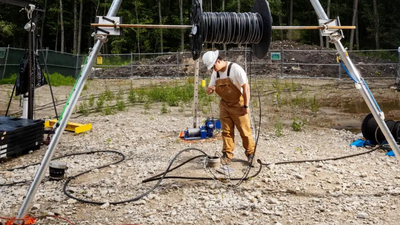
The next stage is happening in Massachusetts. Eden began setting up a field-testing site at a horse farm in March 2026. Actual fracturing operations began in June after delays caused by weather, equipment issues and other logistical challenges. The location gives the company an opportunity to study how its electrical fracturing system performs in a real underground environment rather than only in laboratory samples or a mine.Two electrodes can be positioned at similar depths in separate boreholes. High-voltage pulses are then sent through the rock between them. Each pulse delivers a concentrated burst of energy, producing what looks, in effect, like a tiny lightning strike underground. The company says it takes roughly 100 pulses to penetrate about 10 metres of hard rock. Fracturing longer distances or multiple depths can take hours or even days, making labour a potentially larger cost for Eden than electricity during these operations. The biggest question, however, is whether it can produce enough hydrogen.Creating fractures is only the first step. For stimulated geologic hydrogen to become a practical energy source, the process must generate hydrogen quickly, continuously and cheaply enough to compete with existing production methods. In laboratory tests, Eden found that its pulsed-power fracturing technique could produce up to four times more hydrogen from rock samples than unfractured samples. However, that increase alone may not be enough to make stimulated geologic hydrogen commercially viable.Temperature, rock chemistry, water chemistry, acidity and microorganisms can all influence hydrogen production. Researchers also suggest that fracturing may need to be combined with other techniques, such as catalysts or repeated stimulation, to maintain production over time. Unanswered questions also remain about how hydrogen would be collected, purified, stored and transported once produced underground. Environmental impacts and regulatory requirements would need to be understood as well.
A promising idea still in testing
Eden GeoPower’s approach does not yet prove that underground lightning can create commercially viable hydrogen. Instead, it represents an experimental attempt to solve one of the central problems facing stimulated geologic hydrogen: how to get water into enough of the right rock to make the chemistry work at scale. If the technology succeeds, ordinary iron-rich rock could potentially become a resource rather than simply something to drill through. But much more testing is needed before that possibility can translate into large-scale hydrogen production. For now, the horse farm experiment is an early but striking test of whether controlled bursts of electricity can transform hard underground rock into a far more accessible chemical reactor, and potentially unlock a new way of producing hydrogen.