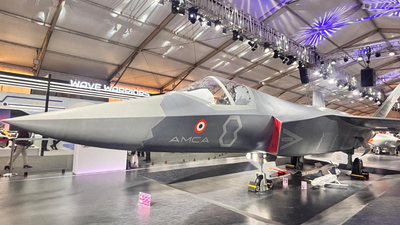
The Aeronautical Development Agency has extended the submission deadline for one of India’s most closely watched defence programmes, giving industry bidders two additional months to file their proposals for the Advanced Medium Combat Aircraft. The revised deadline is now October 30, pushed back from the original August 27 cutoff, with bids scheduled to be formally opened a day later, on October 31.The tender, floated in May this year for a programme valued at around Rs 15,000 crore, invited private industry to compete for the role of Development-cum-Production Partner on India’s indigenous fifth-generation stealth fighter. Bidders had originally been given a tight 60-day window to respond, but sources indicate the extension came after companies in the fray sought additional time to put together comprehensive proposals for a project of this scale and complexity.Three consortia are currently in contention for the AMCA contract – Tata Advanced Systems, Larsen & Toubro along with Bharat Electronics Limited, and a grouping involving Bharat Forge and Bharat Earth Movers Limited. The L&T-BEL combination has already brought aerostructures specialist Dynamatic Technologies on board as an exclusive partner, aiming to combine L&T’s systems integration expertise with BEL’s strength in defence electronics.The stakes attached to this bid are considerable. Under the terms of the RFP, whichever partner is selected will be required to achieve the AMCA’s first prototype flight within 30 months of signing the contract, an extremely tight timeline for a fifth-generation stealth aircraft programme. The winning bidder will also need to complete 1,800 test sorties across five separate prototypes within a firm 84-month window, roughly seven years, from the date of the agreement.The urgency is tied directly to the Indian Air Force’s own planning, with the service aiming to induct its first AMCA squadrons by the mid-2030s. The IAF eventually plans to field around seven squadrons of the aircraft, beginning with the Mk-1 variant powered by American GE-F414 engines, before transitioning to a more powerful Mk-2 version equipped with a jointly developed 110 kN engine.By placing private industry at the centre of manufacturing rather than routing everything through DRDO’s traditional public-sector channels, the government is betting on faster prototyping, more agile supply chains, and better production efficiency, key ingredients if India hopes to join the small club of nations capable of designing and building a fifth-generation fighter on its own timeline.