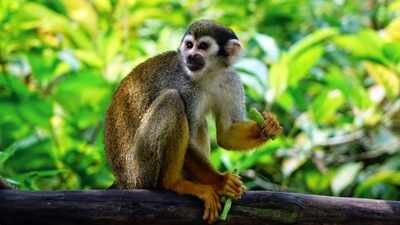
Goliath weighed barely less than a carton of milk and stood just six inches tall, but he became a ‘Spaceman’, a feat he perhaps never understood or wanted. A squirrel monkey like him would hope to climb the forest canopy at best, rather than be sent on a space mission he could never have signed up for. Yet, on November 10, 1961, he found himself in a metal capsule, unrestrained, and launched from Cape Canaveral on an Atlas E rocket. He was on a mission to help Americans put more men into space. But just 35 seconds after liftoff, it veered violently off course, tragically ending Goliath’s adventure. That was one of the most tragic spaceflights of the early space programme.
A short-lived space career
Goliath’s short-lived career is perhaps not celebrated as much as others in the history of space exploration. He was not remembered like Ham, the first chimpanzee, aka ‘Astrochimp’, in space, whose successful Mercury flight paved the way for Alan Shepard’s launch just weeks earlier. He was not celebrated like Enos, who would orbit the Earth just three weeks later. Goliath’s failure and ‘bad luck’ perhaps paved the way for other missions.The squirrel monkey, however, made it high enough to see the curve of the Earth, though it only lasted for 35 seconds.He was assigned as part of the SPURT (Small Primate Unrestrained Test) mission. While other missions in 1961 suggested humans could survive the physical demands of space travel, they wanted to find out if a primate could be sent into space, allowed to move freely during weightlessness, and brought back alive.Goliath was supposed to find out the answer to that. So the scientists designed a capsule where he could move around, and they wanted to observe how an unrestrained animal behaved in microgravity. He would transmit biometric data the entire time. At worst, he would gather crucial information about how living creatures handle weightlessness. At best, he would return safely and inspire confidence in the programme.So, Goliath was brought from the Amazon, and he was enrolled in a four-month training programme. Only the squirrel monkey and the team knew the extent of the training.Before launch, Goliath was sealed inside his capsule. No one could really know what was going on in his head when the countdown began. At T-minus zero, the Atlas E ignited. The rocket lifted off cleanly, carrying its cargo skyward over the Atlantic. The first 35 seconds appeared nominal. The rocket climbed, accelerating through the lower atmosphere.But then something went catastrophically wrong. The vehicle went violently off course. The alarms went off in mission control. The rocket was no longer flying where it was supposed to fly. Worse, it was developing a trajectory that would bring it back over Cape Canaveral. If it continued on its current path, a rocket of that size, falling from space, would crash back onto the facility itself. The danger was catastrophic. Mission control had only two choices: let the rocket fall back to the city or destroy it mid-air. They chose the second.Goliath, who was unrestrained in his capsule as the experiment required, might have tumbled along its violent course. Neither his life in the Amazon jungle in South America nor the four months of space training prepared him for this mission. A radio signal was beamed upwards, transmitting a command to an explosive charge aboard the Atlas. The rocket detonated in the upper atmosphere, 35 seconds after launch, with Goliath still aboard. In the explosion, he burned to death. There was no mechanism for Goliath’s escape. And just like that, his space career ended. It was brief. Just 35 seconds.Goliath’s mission failed, and that is why not many people remember him today as we look back at the history of space exploration. History only remembers its heroes. But here, humans failed him. He never asked to be their hero. He never wanted to be remembered or forgotten. He wanted what every squirrel monkey wants: to move through the branches, live without fear, and exist in his own world. He was happy there, munching on the berries, in the company of his family, in his haven, the thick canopy of the rainforest.