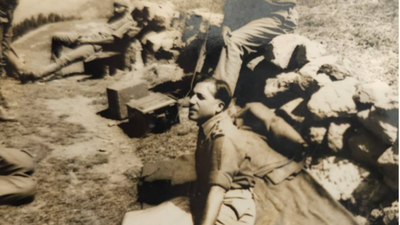
When Pakistan launched Operation Gibraltar in August 1965, sending thousands of trained infiltrators across the Ceasefire Line (CFL), as the Line of Control was then known, into Jammu and Kashmir, it set off a chain of events that culminated in one of the most iconic battles in independent India’s military history: the capture of the Haji Pir Pass.The operation was born out of a dangerously optimistic assessment at Pakistan Army headquarters in Rawalpindi. The plan, backed by then Foreign Minister Zulfikar Ali Bhutto, assumed that Kashmir’s population would rise in armed revolt as soon as Pakistani-trained fighters crossed the CFL. Bhutto is also alleged to have convinced President Ayub Khan that the incursions would not provoke India into widening the conflict to the international border. History would prove both assumptions wrong.The infiltration force was organised into numerous groups and subgroups, including Salahuddin, Ghaznavi and Tariq, each assigned to specific sectors stretching from the Kashmir Valley to Kargil and Rajouri. Some estimates put the total strength at around 30,000 men. The operation’s name was itself a historical reference: Gibraltar was the point from which the Umayyad conquest of the Visigothic Kingdom in Iberia, modern-day Spain and Portugal, was launched in the early eighth century.The infiltrators were tasked with sabotaging bridges, disrupting communications and triggering a popular uprising that would ultimately bring Kashmir under Pakistani control without the need for a full-scale war. Instead, meaningful local support failed to materialise. In many cases, local residents alerted Indian forces to the presence of infiltrators, allowing troops to systematically track them down. Pakistani artillery meanwhile opened fire along the CFL near Tithwal, Uri and Poonch in support of the infiltration effort.
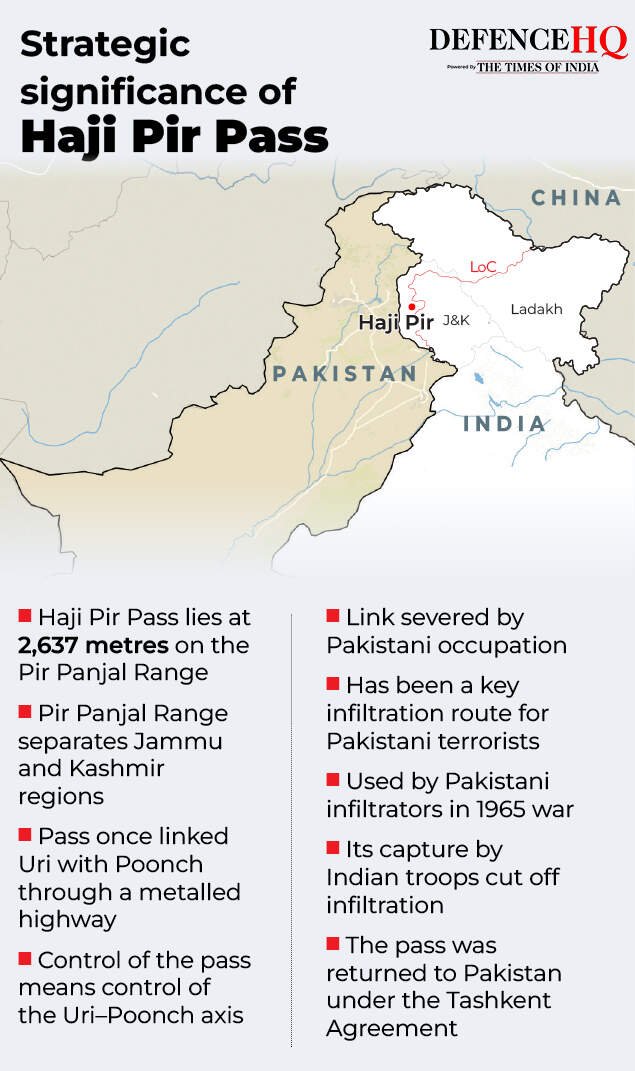
Haji Pir Pass is a very important feature on the Line of Control. It has great strategic value for who ever controls it.
Lieutenant General Harbaksh Singh, commander of the Indian Army’s Western Command, decided that simply containing the infiltration was not enough. He ordered his forces to take the fight to the enemy and strike at the routes sustaining Pakistan’s infiltration network.One of the most important targets was the Haji Pir Pass, an 8,652-foot gap in the Pir Panjal range connecting Uri and Poonch. The pass was also one of the principal routes used by Pakistani infiltrators moving into and out of the Kashmir Valley. Capturing it would not only block a critical infiltration corridor but also disrupt the flow of men, weapons and ammunition into the Indian-held areas.
A key offensive of 1965 focused on the strategic bulge between Uri and Poonch, aiming to recapture Haji Pir Pass, ground India had held briefly in 1948 before handing it back to Pakistan under the ceasefire agreement of that year. Five infantry battalions of 68 Infantry Brigade and 1 Para, backed by artillery support, were tasked with wresting back the pass and the dominating heights. Over four days of fierce fighting, between 28 and 31 August, Indian troops captured Haji Pir Pass along with seven other posts across the bulge. Major Ranjit Singh Dayal, a company commander with 1 Para who led the final assault. This operation also shut the door behind the infiltrators operating in the Kashmir Valley and thus was in a way the final nail in Operation Gibraltar’s coffin.
Air Vice Marshal Arjun Subramaniam (retd), historian and author of India’s Wars
The plan called for a two-pronged pincer movement, with Indian forces advancing on the pass simultaneously from the north and south.From the north, the 19 Infantry Division was tasked with advancing from Uri, with Brigadier Zoru Bakshi’s 68 Infantry Brigade spearheading the assault. The operation was codenamed Operation Bakshi. From the south, the 25 Infantry Division’s 93 Infantry Brigade would advance from Poonch through Kahuta under Operation Faulad, with the aim of linking up at Haji Pir and sealing the entire Haji Pir Bulge.For Operation Bakshi, Brigadier Bakshi divided his brigade’s assault into two main thrusts. On the left, 1 Para, commanded by Lieutenant Colonel Prabhjinder Singh, was tasked with advancing along the Sank–Ledwali Gali axis towards Haji Pir. On the right, 19 Punjab was to capture the formidable Bedori feature, after which 4 Rajput would push towards the final objective. The 6 J&K Rifles was tasked with holding the ground already captured.The monsoon soon disrupted the original timetable. Torrential rain delayed the assault by a day and forced last-minute changes to troop movements.When 1 Para launched its pre-dawn attack on Sank Ridge on August 25, it ran into intense machine-gun fire from well-entrenched Pakistani positions. The assault stalled and the battalion was forced to break contact after suffering heavy casualties.The following night, however, 1 Para tried again. Major Ranjit Singh Dayal, later Lieutenant General, led B Company in a renewed assault. This time, the attack succeeded. His men captured Sank before moving on to Sar, Ledwali Gali and Sawan Pathri in quick succession.On the right flank, 19 Punjab’s advance towards Bedori encountered equally formidable resistance. The approach lay along a narrow, exposed ridge, making a direct assault extremely costly. Repeated attempts to dislodge the defenders, including one by 7 Bihar, failed.With the brigade’s timetable slipping and Pakistani reinforcements moving into the bulge, Lieutenant Colonel Prabhjinder Singh made a bold request: allow 1 Para to advance directly towards Haji Pir even though Bedori remained in Pakistani hands and the battalion’s right flank was exposed.Brigadier Bakshi accepted the gamble.A company-sized force under Major Dayal, drawn from A and D Companies, was tasked with making the final advance. The men faced a punishing climb of more than 1,200 metres, much of it in darkness, through the Hyderabad Nullah. What followed was a gruelling 24-hour march through torrential rain and thick fog, after two days of continuous fighting had already exhausted the troops.Dayal’s column pressed on. Along the way, it captured an enemy house, taking weapons and prisoners, before reaching the old Uri-Poonch road at dawn.By mid-morning on August 28, the force was within 700 metres of Haji Pir Pass. The Pakistani defenders, having lost contact with their forward positions during the night, were caught off guard.In a daring daylight assault, two Indian platoons climbed the flanking spur and descended onto the Pakistani positions from above. The attack silenced the defenders’ machine guns and triggered a chaotic withdrawal.By 10am, Haji Pir Pass was in Indian hands. Major Dayal radioed back the news, marking one of the most celebrated tactical victories of the 1965 war.But the battle was far from over.Bedori finally fell to 19 Punjab on August 29 after a punishing assault up the mountain and the timely arrival of a mountain gun that helped break the Pakistani defences. Pakistani forces then launched a series of counter-attacks in an effort to recapture Haji Pir. The fighting became particularly intense at close quarters, with Major A.S. Baicher continuing to lead his men despite being wounded. Every attempt to retake the pass was ultimately beaten back.In the south, meanwhile, Operation Faulad was moving towards its objective. On the night of September 5-6, 2 Sikh and 3 Dogra attacked the heavily fortified Raja and Chand Tekri pickets in brutal close-quarters fighting. Several Indian officers were killed, including Lieutenant Colonel N.N. Khanna, the commanding officer of 2 Sikh, who was posthumously awarded the Maha Vir Chakra.The southern forces eventually linked up with the northern prong on September 10, completing the encirclement of the Haji Pir Bulge.For a battle in which a single battalion spearheaded an assault against a numerically superior and well-entrenched enemy, the achievement was extraordinary. Major Dayal and Brigadier Bakshi were both awarded the Maha Vir Chakra. 1 Para also received a Vir Chakra and four Sena Medals, along with the Battle Honour of Haji Pir.Yet the victory came with an extraordinary postscript.Just months after Indian troops had captured Haji Pir at considerable cost, the pass was handed back to Pakistan under the Tashkent Agreement. The decision remains controversial, with veterans and strategic commentators arguing that India surrendered a hard-won tactical advantage along one of the most strategically sensitive stretches of the Kashmir frontier.