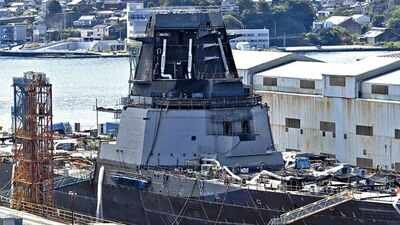
Japan is building a new generation of missile-defence warships equipped with powerful radar systems as it seeks to counter growing missile threats from North Korea and the wider region.The two Aegis System Equipped Vessels (ASEVs) will use the AN/SPY-7 radar as their primary sensor, forming a key component of Tokyo’s integrated air and missile-defence network.According to The War Zone (TWZ), the first of the two warships is taking shape with its large SPY-7 radar arrays integrated into the mast. The radar, derived from the US Missile Defense Agency’s Long Range Discrimination Radar programme, is designed to detect, track and discriminate ballistic-missile threats.The programme comes as Japan faces an increasingly challenging security environment, particularly from North Korea’s repeated missile launches and advancing capabilities. Tokyo is also closely watching China’s expanding military and missile capabilities.
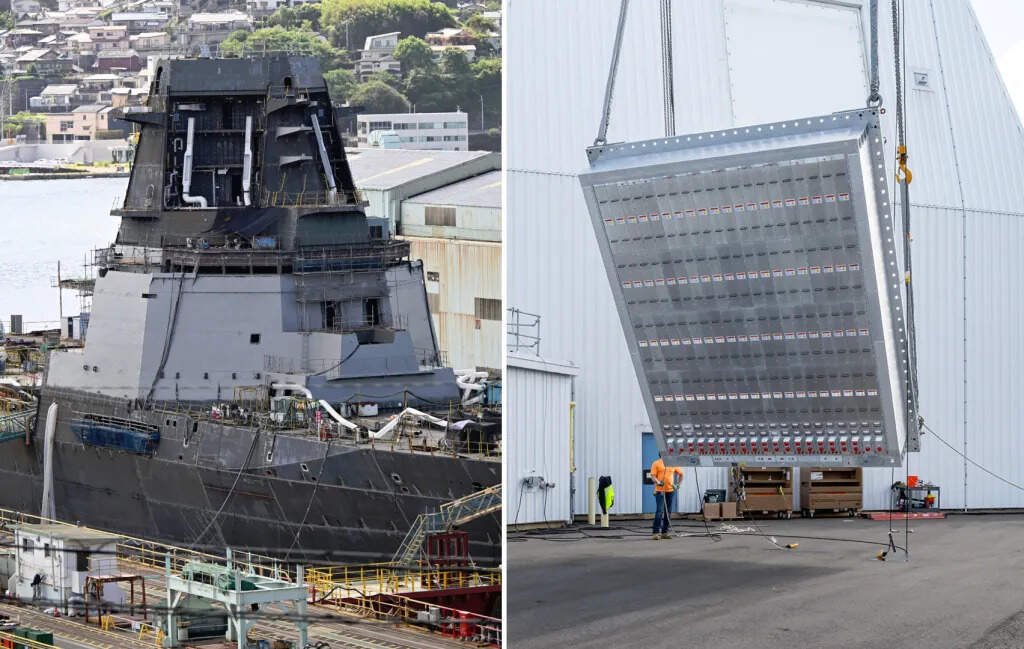
A close-up look at the main superstructure and integrated mast on the first ASEV under construction in Nagasaki, at left, and a stock picture of an AN/SPY-7(V)1 array at right. (Sakai/@kensakai9310)
Radar at the heart of Japan’s defence pushThe AN/SPY-7(V)1 radar is central to Japan’s new missile-defence vessels. Derived from the US Long Range Discrimination Radar programme, the system is designed to detect, track and discriminate ballistic missiles and other airborne threats before the Aegis combat system directs interceptors against them.Each ASEV will be equipped with four SPY-7 radar arrays, providing 360-degree coverage. Japan says the system offers significantly greater tracking capability than the older SPY-1 radar and can handle multiple ballistic-missile threats simultaneously.The radar has also demonstrated its ability to search, detect, identify, track and discriminate live targets. In March 2026, it underwent a test involving live-target tracking as part of Japan’s ASEV programme.
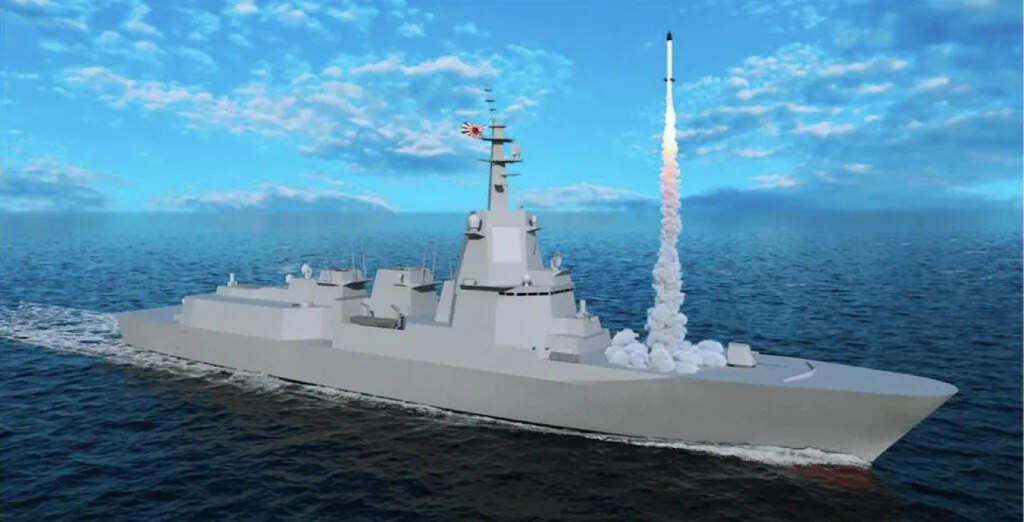
A rendering of what the finished ASEV is currently expected to look like. Japanese ministry of defense
Two ships built for missile warfareJapan began developing the ASEVs after abandoning its planned land-based Aegis Ashore missile-defence system. The ships are intended to provide Tokyo with a mobile and persistent sea-based ballistic-missile defence capability.The first vessel is scheduled to enter service in fiscal 2027, followed by the second in fiscal 2028. Both will combine the SPY-7 radar with the Aegis Weapon System.Each warship will feature 128 vertical launch system cells, providing a substantial magazine for interceptors such as the SM-3 Block IIA and SM-6. The vessels are also being designed with capacity for future weapons and upgrades.The combination of four SPY-7 radar arrays, the Aegis combat system and 128 missile cells is intended to allow each ship to detect, track and engage multiple missile and airborne threats.North Korea remains Tokyo’s key concernNorth Korea is a major driver of Japan’s push to strengthen its ballistic-missile defences. Tokyo says Pyongyang continues to conduct repeated missile launches while developing increasingly sophisticated systems.In August 2026, Japan said a North Korean missile travelled about 690 km before falling into the Sea of Japan. Tokyo described the launch as a threat to Japan and regional security.Japan’s FY2026 defence budget identifies improving the ability to detect and track increasingly diverse and complex threats, including missiles and aircraft, as a priority.China is another major concern for Tokyo. Japan’s 2026 defence white paper describes China as its “greatest strategic challenge” and says Beijing has rapidly expanded the scale and capabilities of its nuclear, missile, naval and air forces.With the ASEVs, Japan is therefore betting on a combination of powerful radar, Aegis technology and a large missile magazine to keep pace with an increasingly crowded and sophisticated missile threat environment.