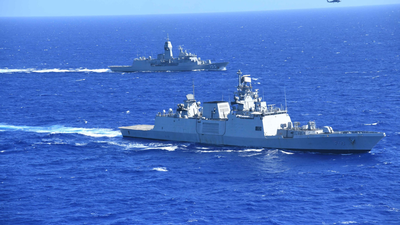
In the middle of a modernisation drive, the Indian Navy is seeking to improve its network centric warfare capability. The navy has floatted an Expression of Interest (EoI) for the development of indigenous ship-based satellite communication (SATCOM) terminals designed to work with its latest satellite, the GSAT-7R. The project, seeks a domestically developed and industry funded SATCOM system. The indigenously developed advanced C-band and Ku-band terminals will let warships maintain secure voice, data and video links even while operating thousands of kilometres out at sea.The Navy has been leaning on satellite communication since 2013, when GSAT-7 Rukmini first went into service. This satellite provided the fleet with a single secure network. This capability was significantly expanded with the launch of GSAT-7R, this satellite launched in November last year extends secure communication coverage to roughly 2,000 kilometres across the Indian Ocean Region. What the Navy wants now is for the ship-based terminals that talk through this satellite.The enhanced capability will allow the navy to strengthen its network warfare capability. This capability links different ship and aircraft into a single shared operational picture, so commanders across the force can see the same real-time data on enemy dispositions, own-force locations and emerging threats. Rather than each platform fighting in isolation the entire fleet is fused and distributed instantly across the network, letting any unit engage a target even if it wasn’t the one that spotted the target.This capability was first demonstrated by the navy during Exercise TROPEX in 2014. Roughly 60 warships and 75 aircraft were connected into one network via the GSAT-7 Rukmini satellite, this resulted in faster decision-making and better coordination across a dispersed fleet. This provided the fleet with the ability to have different ships act as the sensor and the shooter platform.The system relies on Rukmini Terminals, the new systems are meant to reduce mechanical components wherever possible, improving reliability in harsh maritime conditions marked by constant rolling, pitching and yawing, salt-laden air, high winds and vibration. The programme will begin with three prototypes, a large C-band terminal, a large Ku-band terminal and a smaller Ku-band terminal, before moving to series production of around 30 units in total. As with other Make-II projects, companies will bear the full development cost themselves, with a minimum 50% indigenous content mandated across both hardware and embedded software, as per the EoI.Testing requirements are notably rigorous, including three-axis motion table trials to simulate real sea conditions and validate that the terminal can hold a stable satellite link, alongside evaluation at the Space Applications Centre in Ahmedabad and a mandatory vulnerability assessment clearance before integration into the Navy’s network. The project has been reserved for MSMEs for now, with startups and consortiums of up to five members also eligible to participate. Companies have until 22 September to raise queries, with the EoI submission deadline set for 24 October, followed by a 104-week window to develop working prototypes.