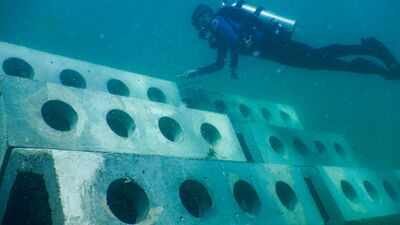
In 1998, researchers put 12 artificial reefs off Miami Beach to see how different materials would affect marine life. Over the next three years, divers recorded 97,826 fish from 146 species around the reefs. The study was published in the journal Aquatic Living Resources.According to the details of the study reported by Science Direct, the reefs are made from limestone, concrete-gravel aggregate and concrete containing waste tyre chips and were deployed on June 18, 1998, in about 7 metres of water. They were arranged in two lines, with six reefs in each line, and each reef was about 100 metres from the next. The study continued until February 2001, with SCUBA divers checking the reefs every two months.During these surveys, the divers recorded fish species, the number of fish and their lengths. They also counted spiny lobsters, Panulirus argus. By the end of the study, 97,826 fish belonging to 146 species were recorded.The researchers also compared fish abundance, species richness, fish biomass and spiny lobster abundance across the three reef types.
The artificial reefs
Four of the 12 reefs were made from limestone quarry boulders. Each consisted of a pile of 50 boulders. Limestone was chosen because it is strong, stable and resistant to erosion. Its rough surface can also provide space for marine plants and animals to attach.Another four reefs were made from concrete-gravel aggregate. These reefs used tetrahedron-shaped modules, with 25 modules measuring 1.5 metres along each edge and another 25 measuring 1.2 metres along each edge.The remaining four reefs used concrete-tire aggregate. This material replaced part of the gravel in concrete with chips made from waste automobile tyres. The researchers noted that this design could avoid some of the stability problems associated with reefs made from whole tyres, while leaving a mostly concrete surface for marine organisms.Whole used tyres had already been used widely in artificial reefs, but they could become mobile underwater if they were not properly secured and weighted. Moving tyres could scrape natural seabed areas. The researchers also noted that tyres were less effective than concrete or natural materials at attracting some invertebrates.The concrete-tire material was therefore studied as a possible alternative. Earlier research had compared smaller concrete-tire and concrete-gravel reefs and found no difference in fish species, total fish abundance or invertebrate preference.
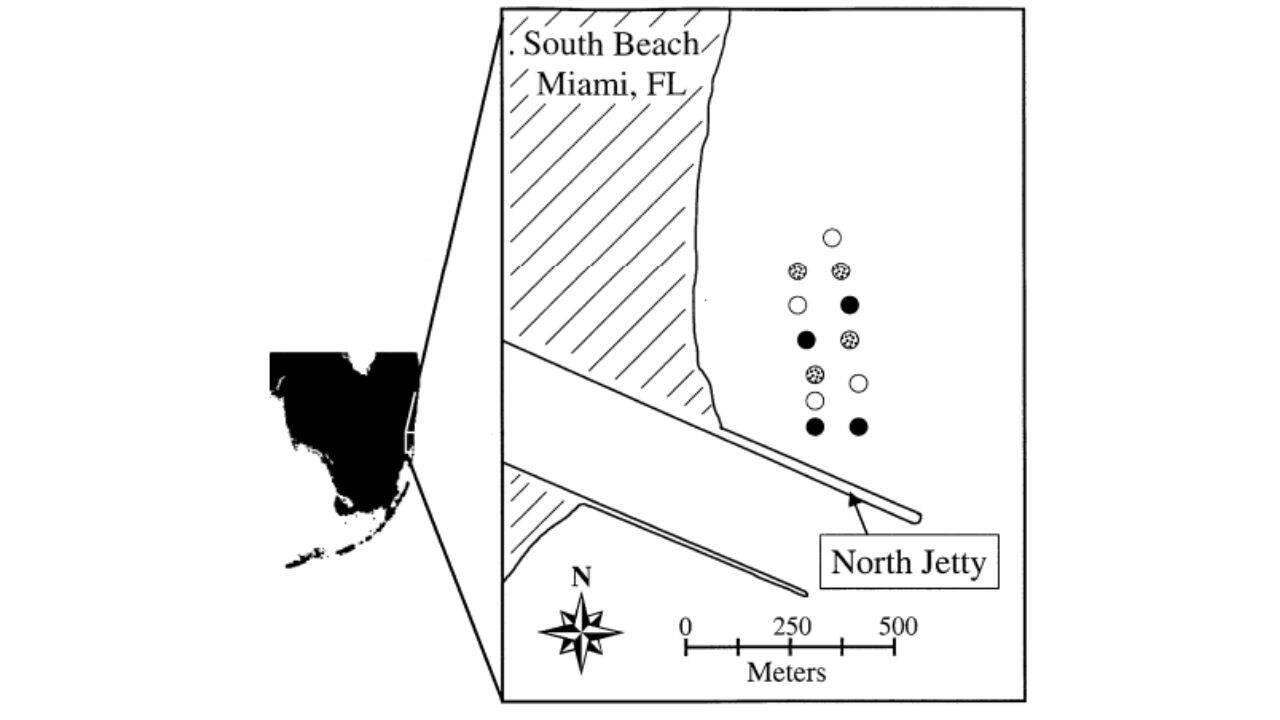
Boulder reefs aredepicted by filled circles, concrete-gravel reefs by patterned circles, andconcrete-tire reefs by open circles.
Fish numbers varied by season
The research found no significant difference in total fish abundance among the three types of reefs. They also found no significant difference in fish biomass or spiny lobster abundance between the reef materials.Fish species richness also did not show a significant difference based on the construction material. A statistical analysis of the fish communities did not show that fish assemblages were grouped according to whether the reefs were made from limestone, concrete-gravel or concrete-tire aggregate.However, the number and variety of fish changed with the seasons. Fish abundance and species richness were highest during the summer and lowest during the winter. The researchers said this seasonal pattern was consistent with other local studies.The total number of species recorded in this research was 146. That was higher than the 105 species recorded in an earlier study by Gilliam and colleagues. Researchers said several factors could explain the difference, including location, recruitment and currents.
Artificial reefs increased local fish
The study also compared fish counts from the reef locations before the artificial reefs were installed with counts taken two years after deployment. The researchers compared the sites with nearby hard-bottom areas and a jetty.Those comparisons showed that the artificial reefs increased both fish abundance and species richness in the local area.The researchers had designed the experiment to make the three reef types as comparable as possible. All 12 reefs were placed in the same general area and at the same depth. This helped reduce the effect of other factors that can influence which animals gather around artificial reefs.The study noted that many factors can affect fish and other marine communities around artificial reefs. These include reef design, depth, latitude, location and salinity. By keeping several of these conditions consistent, the researchers could make a clearer comparison between the construction materials.The reefs were not exactly identical in size. Their maximum height ranged from 1.6 to 2.6 metres, with an average of about 2.1 metres. Their maximum circumference ranged from 19.7 to 29.9 metres, with an average of about 24.2 metres.Overall, the study found that limestone, concrete-gravel aggregate and concrete-tire aggregate supported comparable fish communities when used in similarly placed artificial reefs. While the material itself did not produce a significant difference in total fish numbers, biomass or species composition, the artificial reefs as a whole were associated with higher local fish abundance and species richness after deployment.