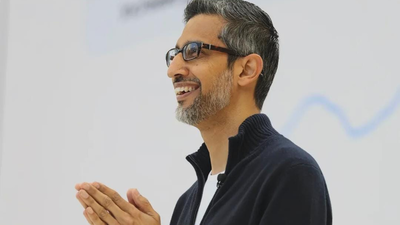
Google and Alphabet CEO Sundar Pichai has recorded a video message for IIT Kharagpur as the institute turns 75, and he spends most of it on the small stuff. Meals at Harry’s. The Illu festival. Nights spent studying in room B-308. The wingmates, and the professors who stuck with him. Campus, he said, is also where he met his wife Anjali, where he first learned to program, and where he carried floppy disks around to get time on one of the few machines available. “These moments shaped the course of my life,” he said, “putting me on a path to Google.”That last line is the pivot. The message, posted by IIT Kharagpur on X, works as two things at once—a nostalgia reel and a forecast. Pichai, who graduated in 1993 with a B.Tech in metallurgical engineering, uses the anniversary to set out where he thinks artificial intelligence lands over the next five years, and to make a case that universities, not just tech companies, will decide whether any of it reaches people who aren’t already using it.
Sundar Pichai’s IIT Kharagpur memories: Harry’s, Illu and room B-308
The specificity is what makes it land. B-308 in Nehru Hall is an unremarkable hostel room—bed, study table, chair, almirah—and it has quietly become a campus landmark, currently occupied by a final-year chemical engineering student. Metallurgy, meanwhile, sits nowhere near the top of India’s engineering pecking order, which is part of why the room has the pull it does.Pichai called an education from the institute “truly a gift” and said IIT Kharagpur “played a formative role in shaping the lens through which I strive to make an impact on the world.” He also noted how far its graduates have travelled, in India and outside it.
Pichai’s AI prediction: from labs to farmers, doctors and government offices
The forward-looking half is the newsier one. “When I look at the next five years, I see AI moving away from the lab and the early adopters and into the hands of people doing the work,” Pichai said—”the healthcare workers, the government officials, the farmers, developers, and entrepreneurs.”The framing is deliberate. He is not describing AI as something to experiment with, but as something that sits inside jobs people already do. “We are building AI so that it can help all of us do our work at the next level and do it in a more fulfilling way,” he added.It also tracks with where Alphabet has pointed itself. Under Pichai, AI now runs through Search, Cloud and the Gemini family of models a shift the company’s own regulatory filings describe as central to its strategy. A prediction about AI spreading into everyday work is, conveniently, also a description of Google’s product roadmap.
IIT Kharagpur at 75: why Pichai is betting on students
On India, Pichai said the country is increasingly producing innovations that can benefit the whole world, and that an “ambitious, optimistic new generation of Indians” has the chance to reimagine what’s possible. AI can amplify that potential, he argued, but universities are what keep it useful to everyone rather than to a narrow few—a point that doubles as the institute’s brief for its next 25 years.Much of the current momentum, he said, is coming from students. He recalled meeting Gemini Student Ambassadors from across India at the AI Impact Summit in Delhi this year: “Their enthusiasm for how technology can improve lives was palpable, and it’s why I’m so optimistic about the future.” The role of IIT Kharagpur, he added, “will only grow in importance as you lead the next wave of technology.”The institute responded by calling the message a reflection of “the enduring global impact of the IIT ecosystem,” saying it now looks ahead “to nurture ideas, inspire generations and create solutions that make a difference to India and the world.”After Kharagpur, Pichai went to Stanford and then Wharton. He joined Google in 2004, worked on Toolbar and Chrome before taking charge of product and engineering across its major platforms, became CEO in 2015, and added Alphabet in December 2019.