
NEW DELHI: The Su-57 has emerged as one of the key defence proposals in focus during Russian President Vladimir Putin’s visit to India for the Brics summit, reopening a long-running question for New Delhi: should it acquire an off-the-shelf fifth-generation fighter from Russia while developing its own Advanced Medium Combat Aircraft (AMCA), or wait for the indigenous programme to mature?Russia has repeatedly offered India the Su-57, its fifth-generation multirole fighter, including a proposal for joint production and deeper technology cooperation. Ahead of the Brics summit, Kremlin spokesperson Dmitry Peskov said the issue of supplying Su-57 fighters remained on the agenda between Moscow and New Delhi.The Kremlin’s position was stated on September 8, when Peskov said: “ISSUES OF SELLING SU-57 IS ON THE AGENDA BETWEEN INDIA AND RUSSIA”
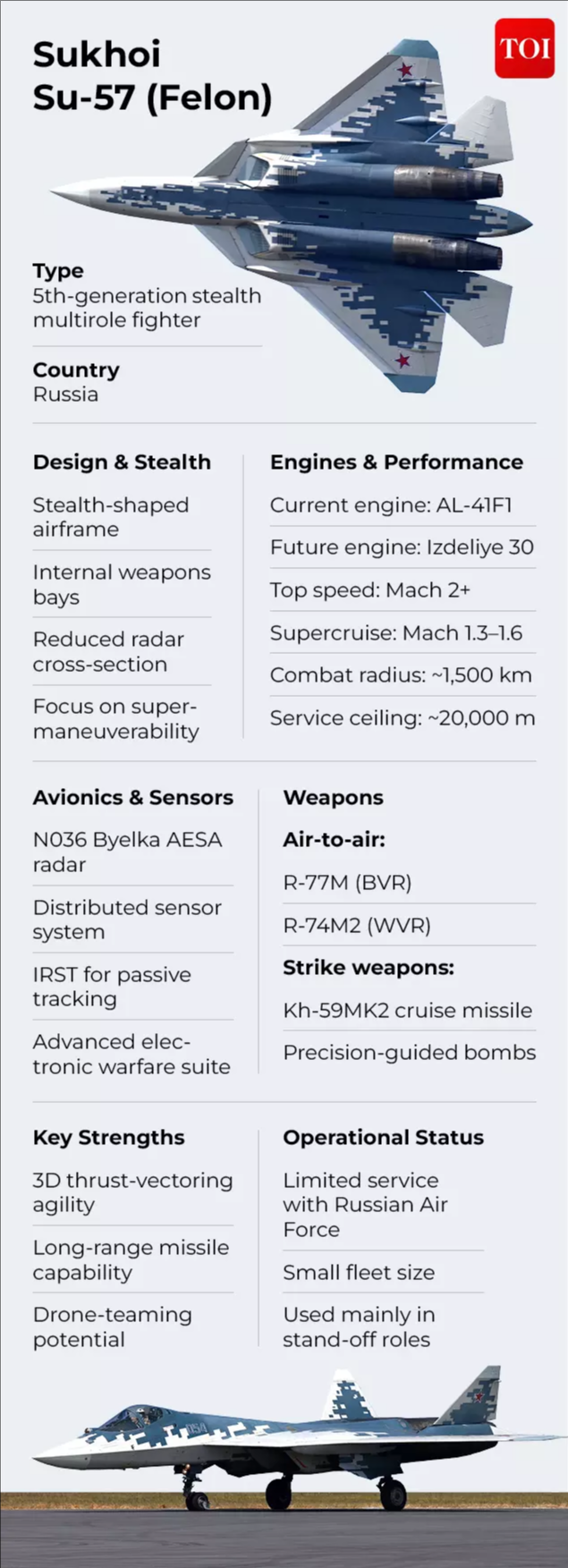
Russia’s fifth-generation stealth fighter combines low-observable design, advanced avionics, long-range weapons, high speed and supermaneuverability.
The issue assumed greater significance as Putin arrived in New Delhi for the Brics summit and held talks with PM Modi. Defence cooperation was among the areas expected to figure in the discussions, alongside energy, trade, technology and other strategic issues. Russian proposals reportedly include Su-57 cooperation as well as upgrades for India’s existing Su-30MKI fleet.There is, however, no publicly confirmed Indian decision to induct the Su-57. The question therefore remains whether Russia’s offer can provide India with an interim fifth-generation capability without undermining the country’s longer-term AMCA ambitions.
Why India needs a fifth-generation fighter
India currently does not operate an indigenous or foreign fifth-generation fighter, while China has built a rapidly expanding fleet of J-20 stealth fighters and is moving ahead with the J-35 programme. Pakistan is also pursuing closer military aviation cooperation with China, including reported plans for the J-35.This creates a significant capability gap for the Indian Air Force.
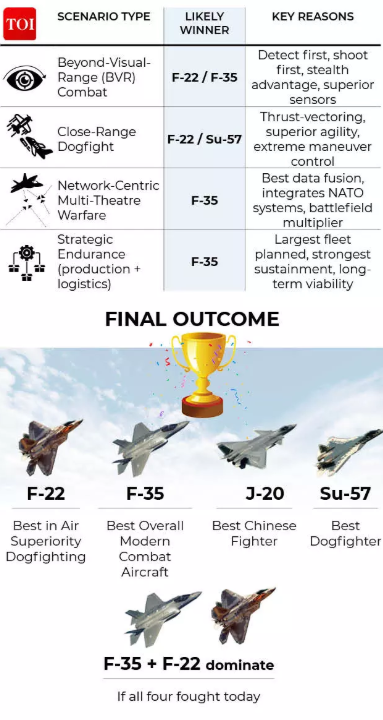
US vs Russia vs
The IAF has also been dealing with a shortage of fighter squadrons. Its authorised strength is 42 squadrons, while the actual number has remained substantially lower. The situation is complicated by an ageing fleet, delays in new aircraft deliveries and the long development timeline associated with a fifth-generation indigenous aircraft.The AMCA is intended to fill that gap in the long term. The government has moved the programme into a more concrete development phase, with the defence ministry issuing a request for proposal in May 2026 to three Indian private-sector-led bidders for the design and development of prototypes.But AMCA will still take years to become an operational combat aircraft. That creates the central dilemma for India: how to address the fifth-generation capability gap during the period before AMCA enters service.
What Russia is offering India
Russia’s proposition is attractive on paper because it combines an operational fifth-generation platform with the possibility of industrial cooperation.Putin had offered India joint production of the Su-57 and said Moscow was prepared to cooperate without “limitations”. The proposal has been presented as an opportunity to manufacture the fighter in India and potentially deepen technology cooperation under the Make in India framework.However, some of the more ambitious claims surrounding the proposal, including the precise extent of access to software source code, technology and intellectual property, should not be treated as final terms unless they are incorporated into a formal agreement.
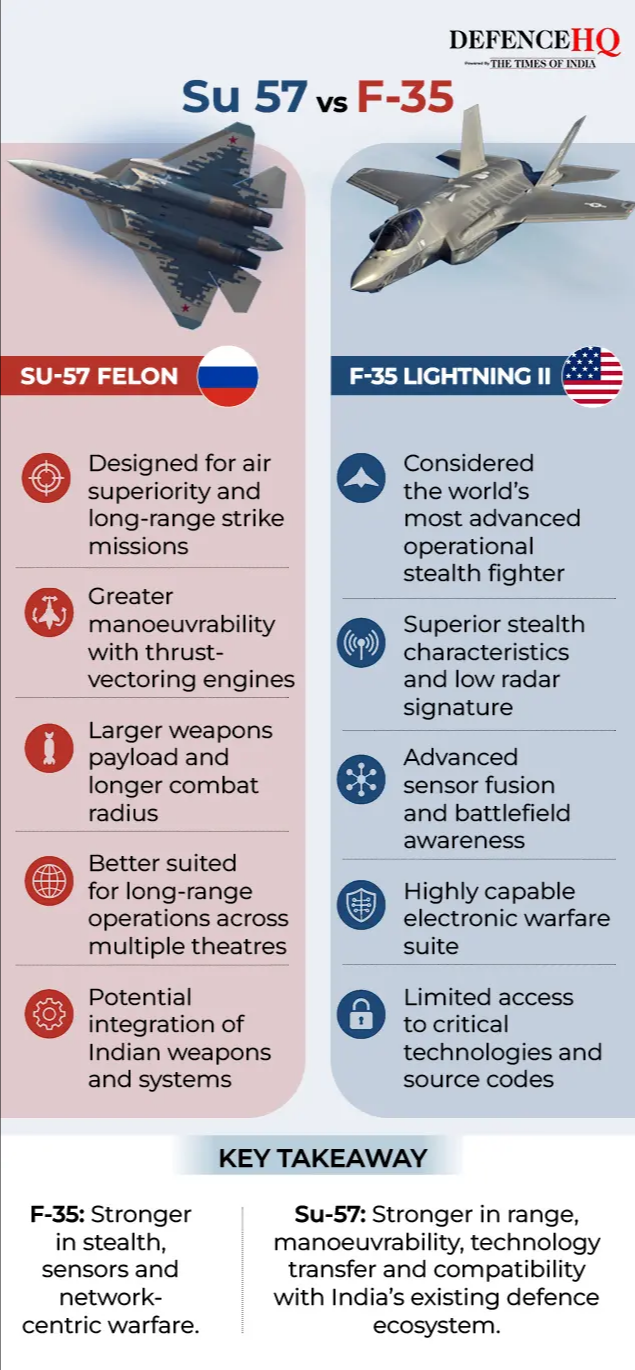
Russia’s Su-57 and the US F-35 represent two distinct approaches to fifth-generation air power, combining stealth, advanced sensors and precision-strike capabilities.
The same applies to reports that India could initially receive a specific number of aircraft before local production begins. No final publicly announced contract establishing such a production and delivery schedule has been confirmed.For India, the attraction is therefore not simply the aircraft itself. It is the possibility of obtaining a fifth-generation platform while simultaneously building domestic manufacturing and maintenance capabilities around it.
Su-57 vs Rafale: Different answers to different problems
The Su-57 and Rafale should not be viewed as direct substitutes. Rafale is a mature 4.5-generation multirole fighter with an established operational record and a large international user base. The Su-57 is designed as a low-observable fifth-generation fighter with internal weapons carriage, advanced sensors, high manoeuvrability and a substantially different combat philosophy.India’s reported plan to acquire 114 additional Rafales is aimed primarily at increasing overall fighter strength and replacing older aircraft. The Rafale therefore addresses India’s immediate force-structure problem.The Su-57 would address a different requirement: giving the IAF access to a fifth-generation capability before AMCA becomes operational.The distinction is important because buying more Rafales does not eliminate India’s stealth-fighter gap. Conversely, buying Su-57s would not by itself solve the IAF’s broader shortage of fighter squadrons.India could therefore theoretically pursue both tracks: Rafale for near-term squadron strength and Su-57 or AMCA for the fifth-generation requirement. The difficulty would be cost, manpower, infrastructure, logistics, training and the need to maintain multiple fighter ecosystems.
Why the Su-57 remains attractive
The strongest argument for the Su-57 is timing. AMCA is India’s strategically important long-term answer, but the aircraft is still in development. A mature indigenous fifth-generation fighter cannot simply be accelerated into operational service without accepting substantial technological and developmental risks.The Su-57 already exists as a flying and operational Russian platform. Russia says the aircraft has been used in combat operations, although the extent and nature of its combat employment are not independently transparent enough to establish broad claims of battlefield superiority.The aircraft also offers characteristics that India could value in its geographical environment. It combines low-observable design with high speed, long range, internal weapons carriage and high manoeuvrability. It is designed as a multirole aircraft rather than solely as a stealth interceptor.The Russian fighter’s large airframe and emphasis on range and weapons carriage could also be relevant to India’s requirement for long-range operations across both the western and northern theatres.But these advantages should not be exaggerated. Radar cross-section, detailed sensor performance, electronic-warfare effectiveness and many other critical parameters remain classified or unavailable for reliable independent comparison.
Su-57 vs F-35: Stealth is not the whole story
The American F-35 is the most widely deployed and exported fifth-generation fighter programme in the world. It has a much larger production base, extensive international participation and a mature ecosystem of training, maintenance, software and allied operations.The Su-57 takes a different approach. The Russian aircraft places greater emphasis on a combination of low observability, speed, manoeuvrability, range and weapons. The F-35 places exceptional emphasis on stealth, sensor fusion, electronic warfare, situational awareness and network-centric operations.That makes the question of which aircraft is “better” difficult to answer in isolation.The F-35 has a major advantage in operational maturity, fleet size, international deployment and networking. The Su-57 can claim advantages in areas such as speed, manoeuvrability and potentially range, although exact comparative figures are difficult to independently verify.Russian industry officials have made much stronger claims. United Aircraft Corporation CEO Vadim Badekha said: “The Su-57 is the only fifth-generation aircraft in the world that is actually seeing combat and demonstrating its superiority over the best foreign weapons systems every single day. Our friends are well aware of this. We can say with confidence that the F-35 is not being considered on the Indian market today,”The statement should be understood as a Russian industry assessment rather than an independently established ranking of fifth-generation fighters.
Su-57 vs China’s J-20 and J-35
China presents India with a more immediate strategic challenge than any Western fighter programme.The People’s Liberation Army Air Force has already fielded the J-20 in significant numbers, while China is advancing the J-35, a second stealth-fighter programme aimed at expanding its fifth-generation capabilities.The J-20 and Su-57 also reflect different design priorities. The J-20 is generally associated with long-range air combat, low observability and the ability to engage targets beyond visual range. Its large airframe allows substantial internal weapons carriage and long-range operations.
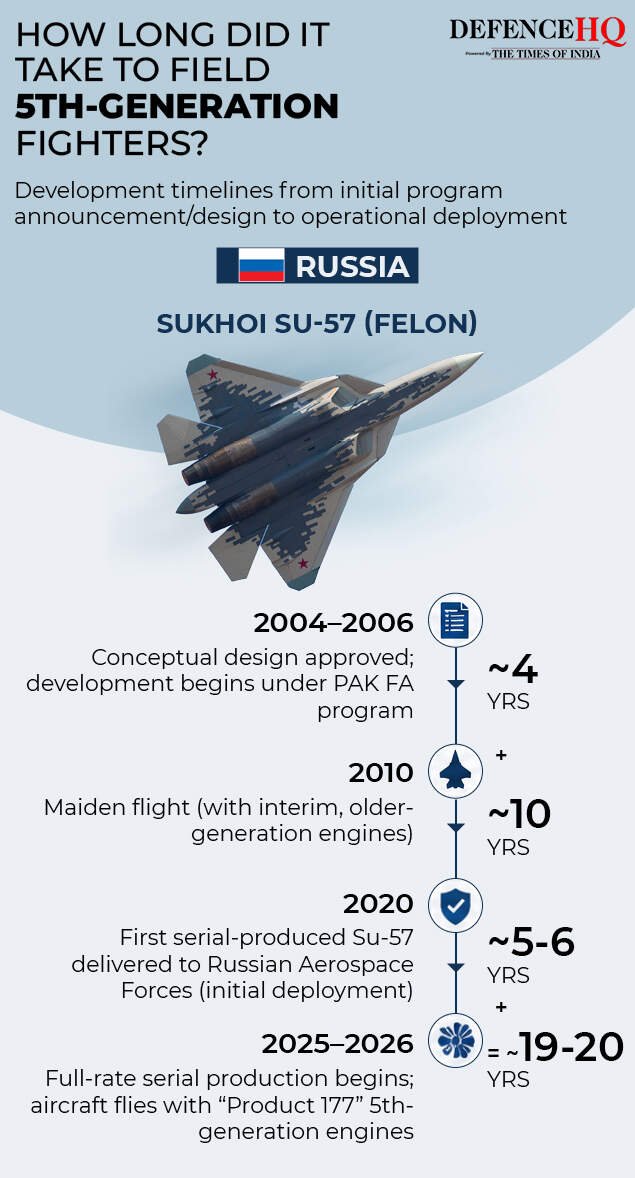
SU-57 induction journey in Russia
The Su-57 puts greater emphasis on multirole capability, manoeuvrability and a combination of stealth with conventional fighter performance. China’s advantage, however, extends beyond the aircraft itself. Beijing has a much larger industrial base for producing combat aircraft and is building an increasingly sophisticated network of airborne early-warning aircraft, electronic warfare systems, long-range missiles, drones and other supporting assets.That ecosystem matters because modern air warfare is increasingly determined by sensors, data links, electronic warfare and long-range missiles rather than by the performance of a fighter in a one-on-one dogfight.The J-20 should therefore not be dismissed simply because the Su-57 may have advantages in speed or manoeuvrability.
Where US, Russia and China stand
The United States remains the most mature fifth-generation fighter power, with the F-35 programme operating across a large international network. The F-22 Raptor also remains an important American air-superiority platform, although it is not available for export.China has the J-20 and is expanding its fifth-generation capabilities through the J-35. Russia has the Su-57, but its fleet is considerably smaller than the American F-35 fleet or China’s J-20 force.The comparison therefore goes beyond aircraft specifications. The US has the advantage of scale, combat experience, global basing and an extensive network of partner air forces. China has the advantage of industrial scale, rapid production and a rapidly expanding military aerospace ecosystem. Russia has a smaller fifth-generation fleet but offers India something Washington and Beijing are unlikely to offer on the same terms: extensive defence-industrial cooperation built around decades of military ties.
Why Russia remains India’s most practical partner
For India, Russia’s biggest advantage may not be that the Su-57 is universally superior to the F-35 or J-20. It is that Moscow has historically been more willing to pursue deep industrial cooperation with New Delhi.India and Russia have decades of experience in licensed production and joint defence projects, including the Su-30MKI and BrahMos programme.That existing ecosystem matters when considering a fighter expected to remain in service for several decades.Russia’s willingness to discuss local production, technology cooperation and modifications could also provide India greater freedom to adapt the aircraft to its own weapons and operational requirements, subject to the final contractual terms.There is another consideration: India already operates a large Russian-origin combat fleet. The Su-30MKI forms a major part of the IAF’s fighter inventory. A Russian fifth-generation aircraft could therefore potentially offer some commonality in training, weapons, maintenance philosophy and logistics, although the Su-57 would still represent a major new technological ecosystem. This is where the Russian proposal becomes strategically relevant.
But the Su-57 could also create problems
The biggest risk is that India could end up investing heavily in another foreign fighter programme just as it is attempting to establish AMCA as the centrepiece of its indigenous aerospace industry.India’s earlier experience with the Fifth Generation Fighter Aircraft programme with Russia is a major cautionary example.India and Russia had agreed in 2007 to jointly develop a fifth-generation fighter based on the Russian programme. The project eventually stalled amid disagreements over cost, design, technology access and other issues, and India subsequently focused on developing its own fifth-generation aircraft.The current Su-57 proposal is therefore not simply a new aircraft purchase. It raises the question of whether India wants to repeat a major foreign fighter-development partnership while AMCA is already moving ahead.A large Su-57 programme could consume money, engineering resources and industrial capacity that India needs for AMCA.There is also the geopolitical dimension. India has expanded defence cooperation with the United States, France and other Western countries while maintaining its long-standing relationship with Moscow. A major new Russian fighter programme could complicate this balancing act, particularly because India’s future fighter ecosystem will depend on Western technology in areas where domestic capability remains limited.
Why Su-57 could still make sense as an interim solution
The strongest case for the Su-57 is therefore not that India should abandon AMCA. It is that India could use a limited number of Su-57s as a bridge until AMCA becomes operational.Such an approach would give the IAF experience operating a fifth-generation platform, allow Indian personnel to develop expertise in low-observable aircraft, sensors, electronic warfare and internal weapons carriage, and potentially provide an operational capability against China’s expanding stealth-fighter fleet.A limited acquisition would also reduce the risk of committing the bulk of India’s fighter-modernisation budget to another long-term foreign programme.However, even a limited fleet would require dedicated infrastructure, training, maintenance, spares and weapons. A fighter’s acquisition cost is only one part of its lifetime expense.
The real choice: Buy time or build the future
India’s fighter dilemma is ultimately about time. Rafale can help address the immediate fighter shortage. AMCA is designed to provide the long-term indigenous fifth-generation capability. The Su-57 sits between the two, offering a potentially faster route to a fifth-generation aircraft while creating an opportunity for deeper cooperation with Russia.That makes the Russian proposal difficult to ignore. But India does not need to choose the Su-57 because Russia says it is superior to every rival. Nor should it reject the aircraft simply because AMCA is India’s preferred long-term option.The decision should rest on what Moscow is actually prepared to put into a binding agreement: the price, production rights, technology access, weapons integration, software access, maintenance support, delivery schedule, localisation, future upgrades and guarantees against supply disruption.If those conditions are favourable, the Su-57 could provide India with a bridge to the AMCA era. If they are not, diverting resources from AMCA to another foreign fighter programme could repeat the very dependency India is trying to overcome.For New Delhi, the most compelling argument for the Su-57 is therefore not that it is definitively the world’s best fifth-generation fighter. It is that Russia may be willing to offer India a combination of a fifth-generation aircraft, local production and deeper industrial cooperation at a time when the IAF has a capability gap that AMCA cannot immediately fill.The final question for India is whether that bridge is worth the cost, and whether it can be built without delaying the indigenous fighter that is ultimately supposed to replace the need for such a bridge.