In December of 1971, the Indian army dashed to Dhaka, for the war which began on December 3, 1971 and by the 16th of December Lt Gen AAK Niazi surrendered. The war on the eastern front was characterised by quick sprints of armour, heliborne operations over wide rivers and air borne operations. Some of thee operations were required due to the peculiarities of the terrain in Bangladesh. Rivers that criss-cross the flat lands of Bangladesh, giving life to the land also act as protective moats shielding the country. An old military adage states that ‘terrain dictates tactics’. Obstacles, both natural and man made have had significant impact on how operations are carried out. Terrain is seen as a force multiplier, a good example of this is the Battle of Thermopylae, during which a smaller Greek army under King Leonidas-I of Sparta kept at bay a much larger Persian army using terrain as a force multiplier. Armies around the world have dedicated combat engineers, who are trained to turn terrain as an obstacle for the enemy and as an ally for friendly forces.
Maneuver and the military
Maneuver and mobility have been key parts of warfare. From the earliest days of horse to now when tanks and other vehicles move across vast spaces of the battlefield to flank or out flank the enemy. Germany’s Blitz across the low countries and France in the early part of the Second World War on the western front and the swift armoured thrusts in to Poland and then the Soviet Union and then in more recent years both the Gulf Wars, show what a rapidly moving and well supported armoured column can accomplish.
Obstacles and types
Military obstacles come in several forms, these can be either natural or man-made. They are designed to block, slow, or channel enemy troop movement in ways that disrupt an adversary’s planned maneuver. Constructed obstacles typically support a defensive plan that is designed by combat engineers, known as Sappers, in a combined arms setup in conjunction with infantry, artillery, air defence and armour. Natural terrain, meanwhile, can be used defensively by anchoring a flank on ground the enemy simply cannot cross, denying the adversary the ability to close into direct fire range.Tactically, obstacles are designed to achieve one of four specific effects, understood jointly by engineers and maneuver commanders to match the terrain and support the broader scheme of maneuver. A disruptive obstacle forces the enemy to break formation and separates its advancing echelons, making them easier to destroy piecemeal. A fix obstacle slows the enemy’s tempo and forces it to commit breaching assets, holding it in place long enough for direct fire and support weapons to engage. A turn obstacle forces the enemy to change direction entirely, steering it into ground where it becomes more vulnerable to targeting and a block obstacle denies an avenue of approach outright, making any attempt to breach it tactically unsound. These effects need to be sequenced coherently, essentially telling a defensive force has scripted the way it intends to defeat the enemy. Obstacle design itself must account for both commander intent and the enemy’s own capabilities, ensuring the obstacle is dense enough to genuinely hinder mobility and force the adversary to expend disproportionate resources overcoming it.
Water obstacles: the greatest barrier
Water bodies have long posed some of the toughest tactical challenges for militaries. Operation Market Garden, one of the most daring large scale operations of the Second World War involved capturing and crossing a series of bridges, which included major river crossings at Eindhoven, Nijmegen and Arnhem in the Netherlands, with the aim of crossing the Rhine. This operation was expected to reduce the duration of the war had it succeeded. The inability to capture the last of the three major bridges, located in Arnhem, put an end to this attempt. The western allies were not able to cross the Rhine almost six months later after the capture of the Ludendorff Bridge at Remagen in March 1945. This was despite the fact that Germany was severely weakened by this final phase of the war and the Allies were only becoming stronger.On the other hand , in 1973, Egyptian forces pulled off one of the most audacious water gap crossings in modern warfare during the Yom Kippur War, breaching Israel’s fortified Bar-Lev Line along the Suez Canal using high-pressure water cannons to blast through sand embankments, catching Israeli defenders off guard.India took an altogether different approach to the river crossing problem during the 1971 war. Rather than attempting a conventional river crossing over the formidable Meghna, Indian forces executed a daring heliborne assault, ferrying troops directly across the river by helicopter. This bypassed the need for a slow, contested crossing entirely, allowing Indian troops to leapfrog the obstacle and accelerate the advance toward Dhaka, a manoeuvre that proved decisive in the war’s rapid conclusion. India also used PT-76 amphibious tanks during the conflict.
Obstacles designed to stop militaries
In the Indian context, the terrain in both Punjab and Jammu regions are criss-crossed with rivers, streams and canals. Water bodies make up a key portion of a composite obstacle system, which is designed with a water body as its central feature. A force approaching such a system will first have to negotiate a minefield, till the edge of water, which may have to be crossed under the full gaze of the enemy, to reach the far bank of the waterbody, which would be held. A force crossing the water body would have to concentrate at a particular point. With the adversary sending reinforcements to the area to strengthen its own defences, now with the knowledge that the opposing force is grouped at a particular area.
Pakistan, particularly in its high value areas, has designed their defences based on a multiplier obstacle system. The idea being to separate the infantry from the armour as also to break up the momentum of the attack.
Brig Rohit Kapoor (Retd)
In such instances time is off great importance, from the attackers perspective the breaching and the crossing should be done in a shrunken time frame so as to break out of the bridgehead formed on the other side of the water body. While for the attacker, the opposite is true. Like mentioned above, the key aims of the objective of an obstacle is to either slow down or stop. This makes the job of a defender relatively easy as a large adversarial force is sitting at a bottleneck and is trickling down on to the other side of the obstacle. The defender sitting on the other side will all the home advantages can in practical terms bring in more force to bear against the attacker.
These multiple obstacles systems comprise mainly of water bodies – rivers, canals etc duly reinforced by other obstacles like minefields, flooding schemes. These water obstacles are addressed by having the capability of assault bridging so that armour can marry up with the assaulting infantry across the water obstacles at the earliest and the momentum of the offensive is maintained.
Brig Rohit Kapoor (Retd)
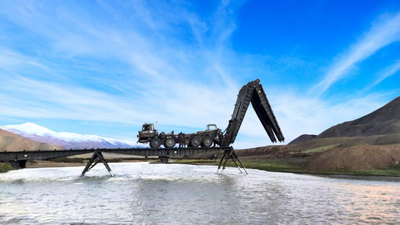
In such a scenario, both training and equipment are of great importance. India uses the domestically built Sarvatra bridge for this purpose. The Sarvatra bridge system is a multi-span mobile bridging solution mounted on a BEML 8×8 high mobility vehicle, developed to give India’s mechanised forces a fast, reliable way to cross obstacles in combat conditions. Capable of spanning up to 75 metres in 15-metre increments, the system can be deployed within 100 minutes, a critical advantage when armoured columns need to keep pace with a fast-moving operation. Rated for 70-ton class traffic, it can support the weight of India’s heaviest armoured vehicles. The yet to be inducted Arjun Mk-1A tank weighs 68 tons.The bridge uses a pier system with multi-stage telescopic legs that self-lock at any height, backed by advanced hydraulics for smooth, continuous operation. A rear cabin with dual-drive controls and a double A-shaped trestle design add stability during construction, while the system needs only a minimal crew to assemble. Beyond combat use, Sarvatra also doubles as emergency infrastructure during floods, earthquakes and other natural disasters.An indigenous bridge such as the Sarvatra can deploy a single span of 15 metres in 20 minute and the entire 75 metre span in two and a half hours. It is to note that the Bambawali-Ravi-Bedian (BRB) Canal, more famously known as the Ichogil Canal, that stands between India and Lahore is 45 meters wide. A bridge such as the Sarvatra, which means ubiquitous, can take Indian armoured formations across a water obstacle in quick time ensuring that India, if need be Indian armoured columns can over come any obstacle in quick time.