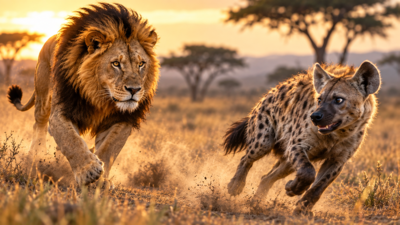
For years, researchers have assumed a common relationship between lions and spotted hyenas on the African savannah. It’s relatively simple: hyenas follow lions. The hyenas wait for the big cats to make a kill so they can take advantage of leftover food. But a new study suggests the relationship isn’t as one-sided as that long-held view suggests. When lions and hyenas encounter each other, hyenas often move away while male lions move toward them.The finding comes from a four-year study that combined GPS collars, camera traps and direct observations to examine how the two carnivores actually move around each other in the wild. Researchers tracked 17 African lions and 14 spotted hyenas across Etosha National Park in Namibia and the Chobe-Linyanti system in Botswana, using GPS locations recorded at intervals as short as five minutes.Results from the study, published in Frontiers in Ethology, indicate that spotted hyenas tended to retreat, while male lions tended to approach and follow. According to the scientists, the results offer a new perspective on real-time interactions between the predators.
Why researchers questioned the usual lion-hyena relationship
Nancy Barker, an ecologist at the University of KwaZulu-Natal and lead author of a new study, had observed behaviour that did not fit this explanation while studying brown hyenas during her Master’s.“I repeatedly observed lions tracking hyenas,” Barker noted. “I was often told I had the relationship backwards… and that what I had seen was simply a series of chance encounters. I felt there was more to the story.”To investigate, Barker and her colleagues used GPS-accelerometer collars, camera traps and night observations to study 17 adult lions and 14 adult spotted hyenas in Etosha National Park in Namibia and the Chobe-Linyanti system in northern Botswana.The collars recorded locations every five minutes during periods around sunset and sunrise. Researchers analysed only simultaneous GPS fixes from animals in the same pair, allowing them to determine whether each predator was moving towards, away from or sideways relative to the other. The dataset contained 349,163 GPS relocations and produced 23 usable animal pairings, including 10 lion-hyena dyads.
GPS data revealed an unexpected pattern
The clearest pattern emerged for spotted hyenas. In lion-hyena dyads, hyenas statistically tended to move away from lions at distances of 2, 5, and 10 kilometres. At 5 kilometres, all nine dyads had movement ratios below 0.5, meaning the hyenas tended to move away from lions.The following Etosha dyad illustrates this tendency. The lion OF-34309 moved towards the hyena SA-33872 in 68.7% of cases, and the hyena moved towards the lion in only 29.9% of cases.In contrast, lions were somewhat inconsistent in their behaviour, but closer inspection revealed sex-based trends. In all three dyads of male lions, the movement ratio was greater than 0.5, averaging 0.573, whereas in seven dyads of female lions, the average was 0.486. As the authors note, however, the male lion results have limitations because the sample included only two male lions.The field observations supported the researchers’ GPS findings. Barker found that male lions followed hyenas at night, while female lions’ behaviours were based entirely on their prides.
The meaning of the findings to coexistence between lions and hyenas
Moreover, the researchers even observed some specific patterns among lions and hyenas. They found that lion mating pairs and the satellite pride system moved in coordination, while collared hyenas in separate groups did not approach each other closely, reflecting the territorial structure of spotted hyena clans.These results certainly do not mean that hyenas do not pursue lions or scavenge in their company. Rather, the observations indicate an asymmetric interaction between the two species when they meet.The researchers suggest this movement response may help the two competing carnivores share the same landscape, although the study does not establish whether these short-term movements affect survival or reproduction.“I would love to extend this approach to other members of the carnivore guild, to understand how the entire community negotiates space and risk,” Barker added. “Ultimately, I want to connect these movement patterns to what matters most for the animals: their survival and reproduction.”