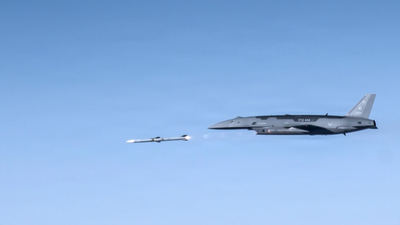
The book on air combat is being rewritten as the US Air Force is now operationally experimenting with Collaborative Combat Aircraft (CCA). These remotely piloted aircraft are designed to fly in support of manned fighters to improve situational awareness, reduce risk to manned platforms, perform better in complex environments and reduce the need for more expensive crewed units. These unmanned aircraft are also more attritable than manned platforms and can readily be sent to operate in highly contested air-space.The United States Air Force has taken a major step toward the future of aerial warfare, with the arrival of its first two CCA, at Creech Air Force Base in Nevada. The move marks the beginning of efforts to integrate uncrewed, semi-autonomous fighters into frontline combat operations alongside manned aircraft.The two aircraft, General Atomics’ YFQ-42A and Anduril’s YFQ-44A, were delivered under an accelerated acquisition programme built around competition, speed and early involvement of operational pilots. Anduril handed over the YFQ-44A to the Experimental Operations Unit last month, while General Atomics delivered the YFQ-42A just last week. Both aircraft will now support Air Combat Command-led experimentation aimed at refining how such drones will operate alongside crewed fighters in contested airspace, while also shaping the training, sustainment, manpower and infrastructure needed to field the technology at scale.The programme has already notched up key milestones, including Anduril’s live-fire test of an AIM-120 missile from the YFQ-44A in July, and the second Agile Combat Employment exercise held the same month. With contracts awarded ahead of schedule, both the General Atomics Dark Merlin and the Anduril Fury have been cleared as meeting mission requirements and ready for full-scale production.At the heart of the concept is Manned-Unmanned Teaming, where fighter pilots effectively become mission commanders, directing robotic wingmen that act as sensors, shooters and weapons carriers. These unmanned aircraft will fly ahead of crewed jets, serving as forward eyes and ears while also absorbing enemy fire to shield the far costlier manned platforms behind them. The approach is expected to boost combat mass while reducing reliance on manned aircraft alone. Concepts under development range from standardised aircraft capable of both manned and unmanned roles to smaller, attritable drones such as Boeing’s MQ-28 Ghost Bat, currently undergoing flight trials.India, too, is moving down a similar path through the Hindustan Aeronautics Limited-led Combat Air Teaming System (CATS). Under this programme, a twin-seat Tejas will serve as a mothership, coordinating swarms of unmanned aerial and combat vehicles. Central to the effort is the CATS Warrior, a low-observable loyal wingman drone developed jointly by HAL and NewSpace Research and Technologies. First unveiled in 2021, the broader CATS programme aimed at delivering affordable combat mass across a wide spectrum ranging from CCAs to smaller drones. The CATS Warrior, which will be the CCA member of the family, is expected to be a sensor amplifier for the fighter it will support. The internal weapons bay of the aircraft is designed to carry weapons such as the next-generation close combat missile and the smart anti-airfield weapon. Testing is underway for these aircraft.