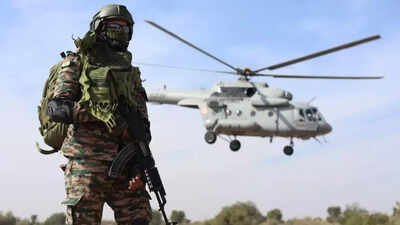
India has now become the world’s fifth-largest military spender after its defence budget surged by 8.9 per cent. The spike comes amidst a larger rise in the global military expenditure.According to a report released by the Stockholm International Peace Research Institute (SIPRI) on Monday, global expenditure hit a record $2.89 trillion last year, and India stands in fifth position with a spending of $92.1 billion in 2025.The annual “trends in world military expenditure” report identifies a brief but intense conflict between India and Pakistan in May 2025 as a primary driver for the regional increase. The skirmish, which featured combat aircraft, drones, and missiles, prompted India to bolster its outlays and led Pakistan to increase its own spending by 11 per cent to $11.9 billion.“Pakistan’s military spending grew by 11 per cent to $11.9 billion in 2025. The increase was largely due to new orders for aircraft and missiles placed with China in 2025 following the armed conflict with India in May, as well as payments for earlier procurement contracts nearing completion,” the report noted.
Global trends and the big five
While global spending grew for the 11th consecutive year, rising by 2.9 per cent, the concentration of wealth remains high. The five largest spenders in 2025 were the United States, China, Russia, Germany, and India. Together, these nations accounted for 58 per cent of total world military expenditure, totalling USD 1,686 billion.The global “military burden” – the percentage of global GDP devoted to defence – reached 2.5 per cent, its highest level since 2009. On average, governments across the world allocated 6.9 per cent of their total budgets to the military, amounting to $352 for every person on Earth.“Global military spending rose again in 2025 as states responded to another year of wars, uncertainty and geopolitical upheaval with large-scale armament drives,” SIPRI stated.
The US decline and European surge
In a notable shift, US military spending fell by 7.5 per cent to $954 billion. This decline was attributed to the absence of new financial military aid for Ukraine, a stark contrast to the $127 billion approved in the preceding three years.However, SIPRI researchers suggest this dip may be temporary, as approved funding for 2026 already exceeds $1 trillion.Conversely, Europe saw a massive 14 per cent increase in spending to $864 billion. This was fueled by the ongoing war in Ukraine and a rapid rearmament phase among NATO members, marking the sharpest growth in Central and Western Europe since the Cold War.
Asian modernisation
In Asia and Oceania, total expenditure rose by 8.1 per cent to $681 billion. China, the world’s second-largest spender, increased its budget by 7.4 per cent to $336 billion, marking its 31st consecutive year of growth.“A renewed campaign against corruption in military procurement does not appear to have constrained spending,” the report observed regarding China’s modernisation efforts.
Middle East and conflict zones
While West Asia saw only marginal growth, some specific nations reported declines as active conflicts shifted. Israeli spending fell by 4.9 per cent to $48.3 billion as the war in Gaza wound down, while Iran’s expenditure dropped for a second year to $7.4 billion.Looking ahead, the outlook for 2026 suggests the upward trend will persist.“Given the range of current crises, as well as many states’ long-term military spending targets, this growth will probably continue through 2026 and beyond,” SIPRI concluded.