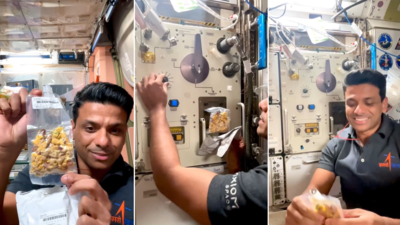
What does lunch look like when you are eating hundreds of kilometres above Earth? Indian astronaut Shubhanshu Shukla has shared a video on Instagram, showing how he prepared one of his favourites, mango salad during his Axiom-4 (Ax-4) mission. After previously sharing a video of his team baking a cake in space, Shukla has now shown the surprisingly simple process of turning a packet of dehydrated mango salad into a meal in microgravity. Sharing the video, Shukla wrote, “What’s for lunch when your restaurant is travelling at 28,000 km/h?”He explained that food on the space station comes in different forms, including dehydrated, freeze-dried and thermally stabilised foods. Each type requires a different method of preparation before it can be eaten.
From a dry packet to mango salad
In the video, Shukla holds up a packet containing dehydrated mango salad and explains that it needs water before it can be eaten. “Okay, preparing for lunch. What I have with me is mango salad in this packet. Let’s see how this gets ready,” he says. “It is dehydrated. We need to add water. It says 50 ml cold water for 5 to 10 minutes and I’ll show you how it is done.” Shukla then takes the packet to a machine designed to add water to the packaged food. He connects the packet to the machine and starts the process. “Come on. So we plug into this machine. We do this,” he says.The machine dispenses 50 ml of cold water into the packet. Once the required amount of water has been added, Shukla removes the packet and mixes its contents. “It says 50 ml water. Look at this. It gets filled up with water,” he says. He then takes the packet out and gently mixes the contents. “And then you take it out. You gently squeeze it. Centrifuge it,” Shukla explains. Once the mango salad is mixed, he repeats the process before placing the packet in a refrigerator. “Okay. Once it is mixed. Do this once again. And put it in the fridge,” he says.
The ISS has a fridge, but no microwave
In the caption accompanying the video, Shukla explained that astronauts can choose how they want certain foods prepared after they have been rehydrated. “Add water, let it rehydrate, and then choose your preferred temperature,” he wrote. “You can put it in the refrigerator, yes, there is a fridge on the ISS or warm it up in the food warmer.” There is, however, one familiar kitchen appliance that astronauts do not have access to on the International Space Station. “A microwave, however, is one piece of earthly technology we don’t have on the ISS,” Shukla wrote. That means food preparation in orbit depends on the equipment available on the station, rather than the appliances commonly found in an Earth-based kitchen.
Why crumbs are a problem in space
Shukla also pointed out another difference between eating a meal on Earth and eating one in microgravity: crumbs do not simply fall onto the table. “And then there is the small matter of crumbs. In microgravity, they don’t politely fall onto your plate. They float around, looking for adventure and potentially finding their way into equipment,” he wrote.For astronauts, keeping food contained is therefore an important part of eating in space. Loose particles can float through the cabin instead of settling on a surface. Shukla summed up the process by writing, “So, even a simple mango salad comes with a little science, a little technique and, occasionally, a lot of patience.” At the end, he wrote: “Bon appétit… from orbit.”