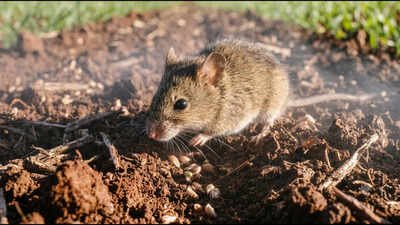
Australian scientists have tested a non-toxic way to protect wheat seeds from hungry mice by making it harder for the rodents to locate them. In an experiment carried out in 2021, instead of poisoning the mice or using bait, the researchers sprayed diluted wheat germ oil across farm plots to camouflage the smell of wheat seeds.According to a report by The University of Sydney, the field experiment was carried out on a farm about 10 kilometres north-west of Pleasant Hills in New South Wales. During the experiment, researchers tested five different treatments across 60 plots to see whether changing the smell around newly sown wheat could reduce the damage caused by mice.Mice rely heavily on smell to find seeds underground. As the smell of wheat was spread across the surrounding area, the rodents could no longer easily work out where an individual seed was buried. Researchers also found that wheat seed loss was 63 per cent lower than in untreated plots when the wheat crop was sprayed with diluted wheat germ oil during and after sowing.The reduction was even greater when the plots were sprayed before planting. In this case, seed loss fell by 74 per cent compared with untreated plots. According to the scientists, this could happen because mice had already learned to ignore the widespread wheat odour by the time the seeds were planted.The research was led by PhD student Finn Parker, with Professor Peter Banks, Dr Catherine Price and Jenna Bytheway from the University of Sydney’s Sydney Institute of Agriculture and School of Life and Environmental Sciences. Their findings were published in Nature Sustainability.
The scent trick
Mice are precise foragers. They can smell wheat seeds in the ground and then dig in the exact place where they detect the smell. The wheat germ oil treatment changed that signal.Instead of allowing the mice to pick out individual seeds by their smell, the treatment made the wheat odour present across the area.Professor Banks explains that the approach worked by making it difficult for mice to find the food they were looking for.“We found we could reduce mice damage even during plague conditions simply by making it hard for mice to find their food, by camouflaging the seed odour. Because they are hungry, they can’t spend all their time searching for food that’s hard to find,” he said.The widespread smell gave the mice less reason to keep digging for individual seeds. “When the smell of the seed is everywhere, they will just go and look for something else instead of being encouraged to dig,” he added.“That’s because mice are precise foragers that can smell seeds in the ground and dig exactly where a seed is, but they can’t do that in this situation because everything smells like the seeds,” Banks said.The same principle could potentially be used in other situations where animals depend on smell to locate food. “This misinformation tactic could work well in other crop systems, indeed any animal that finds food by smell is potentially vulnerable to us manipulating that smell and undermining their ability to search,” Banks said.
A lasting protection
For wheat growers, the timing of the treatment was important because wheat is particularly vulnerable to mice between sowing and germination. Parker said the camouflage appeared to remain effective until after the seeds had germinated.“The camouflage appeared to last until after the seeds germinated, which is the period of vulnerability when wheat needs to be protected. Most mouse damage occurs from when seeds are sown up to germination, just under two weeks later,” he said.Researchers also said the method does not give mice an obvious way to develop resistance to it because the treatment uses the same odour that the animals normally depend on to find wheat seeds.The 2021 experiment was conducted during a period of severe mouse problems in Australia. The University of Sydney said NSW Farmers estimated at the time that the mouse plague could cause $1 billion in damage to Australian crops.The field trial included two treatments using the wheat germ oil solution. The other three were control treatments in which plots were covered with canola oil, trampled or left untreated. All three control treatments performed similarly and suffered significantly more damage than the plots treated with wheat germ oil.