India and Pakistan delivered on the promise of the fixture. An India-Pakistan contest at the Asian Games, their first meeting at the tournament, had threatened to be a mismatch. Instead, it became a thriller.
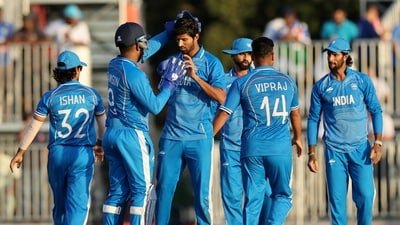
India, the world champions, arrived in Japan with a near full-strength squad while most teams brought second-string sides. Their batting alone looked capable of overwhelming opponents. If Vaibhav Sooryavanshi didn’t get you, Abhishek Sharma could. If he didn’t, there was Sanju Samson or Ishan Kishan. Then came Tilak Varma.
But Pakistan came remarkably close.
India capped off their defence of the Asian Games title with a 19-run win over their geopolitical rivals, but not before being pushed a little. At Korogi Sports Park in Nisshin, Abhishek and Tilak powered India to a formidable total on a surface offering plenty of turn and bounce. Pakistan, through Hasan Nawaz and Saim Ayub, then produced a chase that briefly had India looking vulnerable.
Abhishek made his seventh career fifty in 20 balls or fewer — the most by any player — and his 13th overall, taking on Saad Masood and Saim Ayub to give India the explosive start they wanted. They raced to 81/2 in the Powerplay, their highest Powerplay total against Pakistan in T20Is, bettering the 69/0 they had managed in the Asia Cup 2025.
For a while, 250 appeared firmly within reach before India’s momentum stalled. Arafat Minhas, Ahmed Daniyal and Abrar Ahmed struck through the middle overs.
The left-hander launched a late assault to take India beyond 200, finishing unbeaten on 51 off 22 balls, which eventually proved decisive. His 62-run stand with Shivam Dube (27) provided the final surge, giving India 211/6.
Pakistan also helped India along the way. Dropped catches and missed run-out opportunities gifted crucial second lives to Shreyas Iyer and Abhishek, reprieves that could have proved costly in a tighter contest.
But cricket rarely follows a simple script. A persistent concern for India in recent times has been the lack of reliable fifth and sixth bowling options. It was particularly evident in their recent T20I assignment against Afghanistan, when the frontline bowlers appeared to need greater support. That vulnerability resurfaced just when Pakistan sensed an opening.
Shivam Dube and Ravi Bishnoi proved expensive and neither completed their four-over quota, leaving India increasingly reliant on their frontline attack. Hasan Nawaz anchored Pakistan’s stunning response with his unbeaten 51-ball 96, while his 87-run partnership with Saim Ayub threatened to turn the final into a heist.
Washington Sundar’s experience finally came to India’s rescue. He bowled an excellent 18th over to rein in the partnership and restore some control. Bumrah then applied the brakes in the penultimate over, leaving Pakistan needing 33 from the last six balls.
Nawaz had played an innings to remember. But it had come a little too late. Dube defended the last over and India clinched their seventh consecutive T20I victory over Pakistan, and the Indian men repeated their women did earlier, winning the gold.