Shreyas Iyer has returned as a gold medallist from the 2026 Asian Games. After a torrid start as India’s T20I captain, things have changed, and the results have started to follow. The team now appears far more settled under him, with Iyer even leading India to a win over arch rivals Pakistan in a tournament final. However, just as Iyer, the captain, is beginning to see the brighter side of things, it has turned gloomy for Iyer the batter. His primary identity as a prolific run scorer has taken a severe hit.
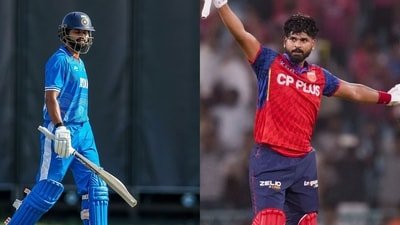
A look at Iyer’s last 10 innings brings the concern into sharp focus. He is yet to cross 30, with scores of 28, 28*, 25, 27, 8*, 11, 29, 16, 13 and 21. That’s 206 runs in these 10 innings at an average of 25.75 and a strike rate of 126.38, underwhelming figures for an India captain. This is a huge change, given how his captaincy stint began. After proving himself as an able leader who thrives under pressure in the IPL, Iyer returned to T20Is when he was appointed captain ahead of the Ireland and England tours in June. In his first six innings, Iyer carried his IPL form into international cricket, scoring 203 runs at an average of 40.60 and a brilliant strike rate of 149.26. He smashed 68 against England at Chester-le-Street, followed by an unbeaten 80 off just 49 deliveries at Bristol. At the time, no one could have envisioned the dip in form that awaited India’s new T20I captain. But ever since, the numbers have only gone south.
The decline is not only in runs
While the absence of a big score is worrying, the bigger concern is the lack of intent and scoring rate in Shreyas’s batting. In his last six innings, he has scored 98 runs off 85 deliveries at a strike rate of just 115.29. This is the opposite of what Shreyas has delivered as a batter while leading Punjab Kings in the IPL and India in his first six innings as captain. The sequence of scores – 8*, 11, 29, 16, 13 and 21 – also shows that the impact his team expects from him in the middle overs has gone missing.
His problems were even more visible during the recently concluded Asian Games. In the semi-final against Sri Lanka, Iyer scored 13 runs off 13 deliveries, followed by 21 off 24 balls in the gold-medal match against Pakistan. That’s just 34 runs from 37 balls across the two matches, at a strike rate below 92. In fact, in the final, his presence in the middle slowed India’s progress and sucked the momentum out of the innings. His lack of intent and inability to play the role expected of him may have gone unnoticed because the others played their roles perfectly and inflicted the required damage. But this is what makes the current version of Shreyas different from the player India gained during the IPL. That was the version that ultimately earned him the captaincy.
Where is the Shreyas of Punjab Kings?
Across the previous two IPL seasons, a different T20 version of Iyer emerged. He scored 604 runs in IPL 2025 at an average of 50.33 and a strike rate of 175.07, and another 498 runs at an average of 55.33 and a strike rate of 168.81 earlier this year in IPL 2026. That’s 1102 runs at a strike rate of nearly 170, while registering 12 scores of 50 or more, including a century in 2026. Iyer showed impeccable consistency in the destruction he brought about in the middle overs, making himself a lethal option in that phase. The fact that he struck 82 fours and 69 sixes across his two seasons with PBKS shows just how violent he had become as a middle-order batter. The intent and aggression he put on display made him one of the most dangerous options a team could have at No. 4.
But his numbers since the UK tour have been strikingly different. Shreyas has scored 178 runs off 147 balls in that period, with 14 fours and hit just three sixes. That translates to one boundary every 8.65 balls. Simply put, he is taking almost twice as many deliveries to find a boundary compared to his last two IPL seasons. This, more than the absence of big scores, is what has hurt India.
India possess an abundance of power hitters and players capable of changing the complexion of a match single-handedly. The Indian T20I side does not need Shreyas to score 60 every time. With players like Abhishek Sharma, Sanju Samson, Tilak Varma and others in the line-up, the demand will not always be for him to change a game on his own. But the PBKS version of Shreyas Iyer could alter the tempo of a game almost immediately after walking in. The recent Indian version of him has not been able to compensate for the deliveries he takes to settle in during the initial stages. You could even argue that he has altered the tempo of games in recent matches, but in a way that has worked against India.
Why the difference
The difference between the two versions can be partly attributed to the ecosystem around him. At Punjab Kings, Priyansh Arya and Prabhsimran Singh are primarily used to provide aggressive starts, while the middle order features Josh Inglis, Marcus Stoinis and Shashank Singh. That gives Iyer the licence to keep attacking through overs 7-16. Abhishek Sharma often provides India with an aggressive start, while Iyer has the likes of Shivam Dube and Tilak Varma around him to up the ante in the middle overs. However, there appears to be a difference in the depth of power-hitters between the two combinations, which might sometimes prompt Iyer to play more of a holding role for India.
Although context matters, the drop is too large to ignore. His middle-overs strike rate has fallen from 162.72 over the last two IPL seasons to 122.22 in the recent India sample. For PBKS, Iyer was hitting a six every two overs; in his recent India innings, that frequency has dropped to one six every 8.2 overs in the middle phase. The issue, therefore, is not merely that he is playing a different role for India; the attacking output that made him so effective at PBKS has not travelled with him.
Captaincy a burden?
It’s too small a sample size to come to that conclusion. On the contrary, the overall numbers suggest that there hasn’t been much of a difference, as in the 16 innings in which Iyer has batted as captain, he has scored 409 runs at an average of 31.46 and a strike rate of 136.79.
The numbers do not paint a worrying picture, and any change in leadership is still miles away. Yet 10 innings without a score of 30 must draw the attention of the think tank. A batter who was consistently destroying bowlers in the middle overs while leading his team has lost his touch to a considerable extent. Hence, this is probably the right time to at least have a chat with him, identify the barrier or blockage developing in his batting as captain, and address it before it is too late and India lose a genuine middle overs enforcer.