New Delhi: “He is pushing the boundaries of what finger spin means” – That’s how Dinesh Karthik frames Krunal Pandya, as the Royal Challengers Bengaluru’s spin-bowling all-rounder is attempting to solve a major problem.
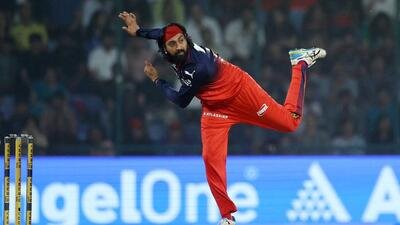
In a format where batters prepare obsessively, where match-ups are studied and variations are catalogued, he sees deception as necessity. The Indian Premier League, in his words, has become a mental arms race.
“Every ball has a sixer vibe,” he said – it’s not an exaggeration because the rules, pitches and approach seem to be relatively advantageous for the batters. There are now very safe lengths to bowl now.
His question is survival-driven: What else can I add to stay one step ahead in the mental game?
His answer for the last couple of seasons has been a spinner’s bouncer. According to CricViz, Krunal’s bouncer has become more efficient but less incisive. His economy rate has improved from 9.42 to 8.00, suggesting better control and fewer boundary leaks. But the strike rate has dropped from 7 to 24, a sharp drop in wicket-taking potency. The edition is still ongoing but Krunal is using both his bouncer and lower-arm variation far more often now.
Batters aren’t quite dominating the ball, but they aren’t falling to it either. Which is precisely why the bouncer, in its current form, feels less like a finishing move and more like a disruption tactic. It is a question, not necessarily an answer but it does cause a moment of doubt in the batter’s rhythm rather than a guaranteed breakthrough.
That aligns almost perfectly with Karthik’s observation: “It creates a doubt in the batter…”
The low-arm variation with a side trajectory is already showing signs of fatigue. Its usage has spiked dramatically – from 11 deliveries in 2025 to 38 in 2026 – but the returns have diminished. The economy rate has worsened from 9.81 to 11.21, while wickets have remained static. Once a deceptive weapon, it is now increasingly anticipated.
And yet, the dismissals show that execution still matters. In 2025, it accounted for wickets like Will Jacks and Deepak Chahar – batters undone by something they weren’t quite ready for. A year later, it still finds moments, removing Shimron Hetmyer and Mitchell Marsh, but now in a landscape where the surprise has thinned.
However as a result, Pandya’s stock ball has quietly become a more potent wicket-taking option because batters are taking more risks off it. It has caused an increase in economy rate in the last two seasons (8.85 in 2026 and 8.24 in 2025) and it can also be attributed to bigger totals and the way batters are playing the game.
What must be noted, though, is the significant drop in strike rate from 28 (2023) and 33 (2024) to 16.24 (2025) and 18 in (2026). His wickets tally also surged in the last two seasons (17 in 2025) and 9* (2026).
The bouncer and sidearmer are being used more decisively in the last couple of years in Krunal’s game but its origin story is from long before data and tactical suggestions. It came while playing on a matting wicket in a village game where there were small boundaries and his conventional left-arm spin came with the inevitability of getting hit.
“I used to get hit a lot,” Krunal admitted. So he improvised – bouncers, wide yorkers, anything that could disrupt a batter’s rhythm on surfaces that offered little margin for error.
There’s also a physical reality to all of this. A spinner’s bouncer or the lower-arm variation isn’t just unusual, it’s also demanding. It requires a strong bowling action, precise control and above all fitness. “It’s difficult to come from two steps and put the bouncer on pace,” Krunal explained.
It also carried risk. During an IPL 2026 game in Bengaluru, he had a brief groin injury scare while bowling late in the match against Gujarat Titans. The stress isn’t limited to one area either. The fast, short deliveries from a spinner’s action inevitably place strain on the back as well, something fast-bowling great Dale Steyn had pointed out last year.
Karthik also believes he is a trendsetter. Around the league, more spinners are experimenting, borrowing from Krunal’s playbook. While they are not consistent wicket-taking weapons as it is, they are unsettling, containing and disrupting. Which may essentially be the point.