Yashasvi Jaiswal did not own the final frame of Rajasthan Royals’ chase against Punjab Kings. Donovan Ferreira did. Shubham Dubey’s late violence carried the finishing signature. But Jaiswal’s 51 off 27 balls gave RR the thing every 220-plus chase needs before the finishers arrive: permission to believe the target could be achieved.
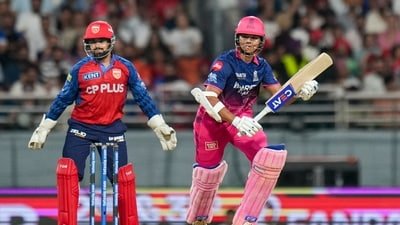
Rajasthan chased down Punjab’s 222/4 with four balls left, finishing at 228/4 in 19.2 overs at Mullanpur. The result ended PBKS’ unbeaten run in IPL 2026 and pushed RR to 12 points after nine matches, making the win significant beyond the scorecard. Jaiswal’s innings sat inside that larger match-shaping arc: not the last blow, but one of the blows that made the last blow possible.
Jaiswal made the chase chaseable
A target of 223 can turn impossible quickly. One quiet powerplay and the required rate becomes a staircase without railings. One early cluster of wickets, and the finishers are forced to hit from ball one without foundation. Rajasthan avoided both traps.
Vaibhav Sooryavanshi supplied the first surge with 43, but Jaiswal gave the innings continuity. RR were not merely swinging blindly in the first half of the chase. They were building tempo. They crossed 100 inside nine overs, and Jaiswal’s presence meant the innings had both acceleration and shape. Rajasthan’s chase was built through a high-octane pursuit before Ferreira and Dubey added an unbeaten 77 off 32 balls to close it.
That is why Jaiswal’s 51 off 27 deserves a valuation lens. It was not a decorative fifty. It was a high-speed contribution in a successful chase of 223 against a side that had not lost all season. Context changes the weight of runs. A 51 in a soft chase and a 51 in this chase are not the same currency.
Yashasvi Jaiswal’s strike rate was 188.88. He hit seven fours and one six. He absorbed only 27 balls while producing 51 runs. That matters because in a chase above 220, even a half-century can become expensive if it consumes too much time. Jaiswal’s innings did the opposite. It added runs and preserved overs.
Also Read: Arshdeep Singh wins war of nerves vs Vaibhav Sooryavanshi, but only after brutal punishment forces complete rethink
An innings worth INR 1.90 crore
Under our valuation model, Jaiswal’s innings generated approximately INR 1.90 crore in gross match value.
This model is based on a program designed exclusively by the author that converts cricketing impact into monetary value.
Jaiswal’s per-match cost, calculated using the INR18 crore retention value spread across 14 matches, is approximately INR1.29 crore.
That gives the final match ledger:
- Match worth: INR1.90 crore
- Match cost: INR1.29 crore
- Net profit: INR 61.45 lakh
The sharper number is the per-ball return. Jaiswal faced 27 balls. His net profit of INR 61.45 lakh works out to roughly INR 2.28 lakh profit per ball.
That is the heart of the story. Every ball Jaiswal faced against the Punjab Kings generated around INR2.28 lakh in profit for the Rajasthan Royals under the revised model.
Why the per-ball number matters
Per-ball profit is not just a flashy figure. It captures the true nature of a T20 batting contribution.
In T20 cricket, balls are not neutral units. They are inventory. Every ball used by a batter has a cost because it cannot be used by someone else. The best innings are not only about runs scored. They are about how much value a batter extracts from each delivery consumed.
Jaiswal’s 51 off 27 produced a healthy scoring return. But the valuation becomes stronger because it came in a chase where tempo had tactical value. Rajasthan were not chasing 160. They were chasing 223 against a Punjab side that had just posted 222/4 and entered the night unbeaten. In that setting, Jaiswal’s speed did two things at once: it reduced scoreboard pressure and protected the finishers from having to perform a miracle.
That is why the innings generated profit despite his premium cost base. An INR18 crore player has a high bar. A quiet 30 does not clear it. A slow 50 may not clear it either. But a 51 off 27 in this chase crossed the line.
The model’s INR 61.45 lakh profit estimate shows that Jaiswal did not merely contribute. He beat his match cost. He turned an expensive retention slot into a positive asset for the night.
Ferreira finished it, but Jaiswal helped price the chase correctly
Ferreira’s unbeaten 52 off 26 was the most visible match-winning hand. He was named Player of the Match, and rightly so. Dubey’s 31 not out off 12 made the finish brutal. Their unbroken 77-run stand in 32 balls was the closing engine.
But those finishing bursts often become possible because the chase has not been allowed to decay earlier. Jaiswal’s job was not to bat till the end. It was to ensure RR stayed close enough for the middle and lower-middle order to launch from a position of strength.
That is where his valuation lies.
At the end of the powerplay and through the early middle overs, Rajasthan were not asking their finishers to chase a fantasy equation. They were asking them to complete a chase that had been kept alive. Jaiswal’s innings was part of that transfer of pressure back onto Punjab.
The difference between 51 off 27 and 51 off 38 is enormous in this kind of a match. One keeps the chase fluid. The other hands control back to the bowling side. Jaiswal’s innings belonged to the first category.