Much more is at stake than another India victory at Ranchi for the second T20I against West Indies. With the 2028 T20 World Cup still some distance away, India have something increasingly valuable—time. This is the phase in which they can afford to ask questions of their bowling resources, and, perhaps more importantly, give themselves enough answers to survive the demands of a crowded international calendar.
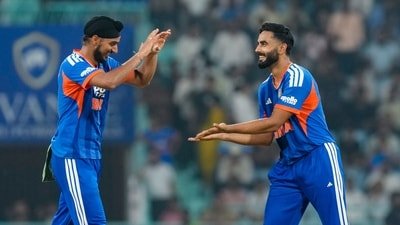
At Lucknow, Naman Dhir provided one. He wasn’t supposed to be the main story of India’s bowling attack. Yet on a surface that offered enough uncertainty to reward restraint, Dhir bowled with the assurance of someone who had been doing this for years. He flighted the ball, changed his pace, and rather than retreating into safety after being hit, went back to the batsman with more air. It was the sort of performance that makes selectors sit up.
“I have seen him bowl in MI. That time he was more like a part-timer,” Ishan Kishan said afterwards. “But looking at his seam position, the way he was bowling today… you usually go defensive after being hit for six, but he was giving extra flight today. You can figure out that this man has worked on his skills.”
That, in a sense, is precisely what these games should be about. India have already established what their frontline attack looks like. Arshdeep Singh brings the left-arm angle and the ability to operate at both ends of an innings. Axar Patel offers control and variety. Kuldeep Yadav can alter the middle overs with his wristspin. Mayank Yadav brings the possibility of primal pace that can change the geometry of a T20 innings.
But a World Cup squad is built from a pool, not just four or five bowlers. And India need to deepen theirs. The logic is partly strategic and partly unavoidable. Jasprit Bumrah’s workload has to be managed carefully. Mohammed Siraj is being handled with an eye on the longer formats. Prasidh Krishna has been elevated into India’s Test plans. Kuldeep and Axar cannot reasonably be expected to carry every white-ball assignment. The international calendar, meanwhile, has developed an appetite that seems almost impossible to satisfy.
The answer can’t always be asking the same bowlers to do more. It has to be to find others who can do something. That is why Ranchi, and by extension, this series matters. The absence of a T20 World Cup this year gives India a luxury most teams rarely enjoy—experimentation without an immediate tournament deadline hanging over every decision. The 2028 World Cup may still feel distant, but this is exactly when a serious contender should be building its inventory.
There will be no point discovering in 2028 a promising bowler who probably needed five more matches to understand the pressure of the format. And now India know Dhir is almost there. Which is ironic as well since Dhir has always been discussed primarily because of his batting. His value to Mumbai Indians has been associated with power, particularly late in the innings, where a clean striker can turn a par score into something considerably more imposing. His bowling has existed almost as a footnote. At Lucknow though, his 3/31 became the headline act.
Dhir insisted it was no sudden transformation. “Even if you haven’t seen me bowling, I am bowling the same amount that I have done here,” he said. “It’s not like I am a batting allrounder or a bowling allrounder. Yes, my batting is a plus point, but at the same time, I am working as hard at bowling.”
More batters are doing that by the way. Ask Abhishek Sharma, or even Tilak Varma who was seen bowling at the Duleep Trophy in August. India don’t necessarily need another specialist bowler but more players who can alter the composition of a side. Washington Sundar’s withdrawal from the T20I series created precisely such an opening.
Dhir stepped into the role of the lower-order batter who could provide a fifth or sixth bowling option. If that option is credible enough to deliver two or three useful overs while retaining the ability to clear the ropes at the death, India’s bowling potential is maximised. It is the sort of flexibility that becomes invaluable at a World Cup. So the question really is how India plan to add to this flexibility.
Dhir is a successful experiment. Prince Yadav, who has already been in the mix for a while, is another name worth watching. So is Nitish Kumar Reddy, whose all-round abilities have already been talked up. India have enough established quality to allow themselves to look beyond the obvious choices. That is the real advantage of this period. Ranchi, therefore, could offer India the stage for an extended audition.