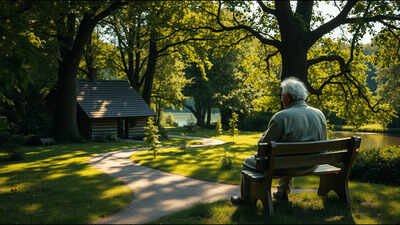
Albert Einstein turned 50 on 14 March 1929, and Berlin planned to mark the occasion by providing him with a country house. The proposed gift fell through after difficulties over the properties offered and became the subject of public controversy. Einstein subsequently secured a site in Caputh, near Potsdam, and financed the construction of a timber summer house designed by architect Konrad Wachsmann. The retreat became a place where he could read, think, sail and welcome friends away from the demands of public life. Einstein spent much of the year there between 1929 and 1932, and a guestbook associated with the house offers a glimpse of some of its visitors. Today, the property remains connected to his life and work, as well as to the political circumstances that forced him to leave Germany.
Why Berlin’s birthday gift fell through, and how Einstein built his Caputh summer house
The plan for a house originated with Berlin mayor Gustav Böss, who wanted to honour Einstein on his 50th birthday. However, the original property under consideration had tenants, whom Einstein did not want evicted. Other proposals followed, but the city did not provide him with a completed house. The dispute attracted press attention and became entangled in political arguments in Berlin, including antisemitic remarks. Elsa Einstein learned of a possible site in Caputh through their neighbours, Adolf and Elsbeth Stern. Adolf Stern had offered land from his property, and the proposed gift ultimately led Einstein to pursue a summer house there. Accounts of the property’s history indicate that the land-register arrangements involved Einstein’s stepdaughters, Ilse and Margot, so the transaction should not be described simply as Einstein personally registering the land in his own name.Elsa learned of a possible site in Caputh through friends who offered part of their property. Einstein chose the location and decided to proceed with the house, which was designed by the young architect Konrad Wachsmann. Einstein financed the construction himself. The building permit was applied for on 12 May 1929 and approved in June. The house was completed in time for the family to move in during September 1929.The house was built primarily of wood and designed as a relatively simple summer retreat rather than a grand residence. Konrad Wachsmann, a young architect at the time, was responsible for its design. The house provided Einstein with a quiet place away from public demands, with the surrounding landscape and nearby Havel lakes offering opportunities for walks and sailing. The house itself was not the birthday present Berlin had intended to provide. Einstein received a sailing boat named Tümmler for his 50th birthday, which he used on the nearby lakes.
Einstein’s Caputh guestbook: Tagore, Max von Laue and other visitors
Einstein welcomed visitors from scientific, literary and cultural circles, and the family’s guestbook preserves a partial record of these encounters. The neighbouring Sterns gave the book to the family as a housewarming gift, and Einstein jokingly instructed guests to write in verse rather than ordinary prose.Among the figures associated with Einstein’s Caputh circle was the Indian poet and philosopher Rabindranath Tagore. The painter Hermann Struck illustrated a page of the guestbook in autumn 1931, and the page also bears the signature of Zionist leader Chaim Weizmann. Other visitors to Caputh included conductor Erich Kleiber and violinist Ruggiero Ricci, although their names should not be presented as guestbook entries unless independently verified. The original guestbook is held by the Leo Baeck Institute in New York.
What happened to Einstein’s house after he left Germany?
Einstein and Elsa left Caputh for the United States in December 1932. As the Nazi regime consolidated power, Einstein did not return to Germany. The house was searched on 20 March 1933. Accounts of its confiscation give different dates in 1935. Its subsequent history reflected the political upheavals of the period and changing decisions about how the property should be used and maintained. The East German Academy of Sciences restored the house in 1978–79, around the centenary of Einstein’s birth, and used it as a guest house and memorial. After German reunification, the Einstein Forum assumed administrative responsibility for the property in 1993. A later renovation, supported by the German federal government and the Cornelsen Culture Foundation, prepared the house for the Einstein Year in 2005. The Hebrew University of Jerusalem is the property’s majority owner.Today, Einstein’s summer house remains a place for historical reflection and intellectual exchange. Public access and guided tours depend on current arrangements, so visitors should confirm details with the Einstein Forum or the property’s administrator before travelling to Caputh. The house offers a glimpse of Einstein’s life away from public duties, but its history also reflects the antisemitic persecution that forced him to leave Germany and the later efforts to preserve the property as part of his legacy.