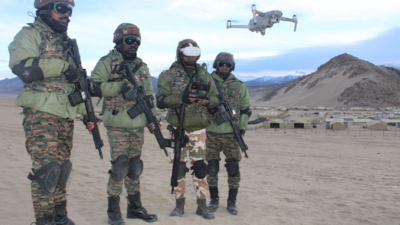
NEW DELHI: The Indian Army has placed an order for 225 First-Person View (FPV) drones that will be deployed in the high-altitude environs of Ladakh.The remote and desolate region has several high-altitude posts, some of which are located on ridges that rise above 18,000 feet. The Army has increased its deployment in the area since the Galwan clashes in 2020 and the stand-off that followed. China has also been demonstrating and operating drones in the region since then.China has since set up a drone centre near Mount Everest, with the aim of advancing drone technology for border patrols, security, logistics and emergency operations.Another significant development is that a Chinese-origin drone has reportedly reached an altitude above Mount Everest, while a Nepali firm has been using Chinese drones for logistics in the same region, including on the world’s highest mountain itself.
Tested at 17,500 feet: The Army’s new drone order
Gurgaon-based Aerodrone Robotics Pvt Ltd, founded by retired Army officer Lt Col Randeep Hundal, will deliver these FPV drones to the Army. The firm won the contract following a lengthy competitive evaluation and field trials that included flights at altitudes of up to 17,500 feet.The drones were assessed on endurance, accuracy, speed and other functional requirements, including performance in the thin, cold air where much of the Army’s frontier work is carried out.The order comes as the force is in the middle of a wide-ranging modernisation drive, with unmanned systems becoming one of its central priorities. The contract’s value has not been disclosed, and the number of drones is modest by the standards of the Army’s recent procurement plans.Reports on the order note that 17,500 feet was the altitude reached during the trials and should not be read as the drones’ certified operational ceiling.What stands out is how the systems were tested. The Army has been trialling drones from Indian manufacturers in the high-altitude terrain of Ladakh and Spiti in Himachal Pradesh, where difficult terrain and extreme weather place heavy demands on equipment.The process also has a history. Two years ago, the Army held the second Him-Drone-a-Thon at Wari La in Ladakh, at over 15,000 feet, where more than 20 manufacturers showcased surveillance, logistics, loitering munition, swarm and FPV systems designed for high altitudes.Seen against that backdrop, the 225-drone order marks a step from demonstrations to an actual contract.
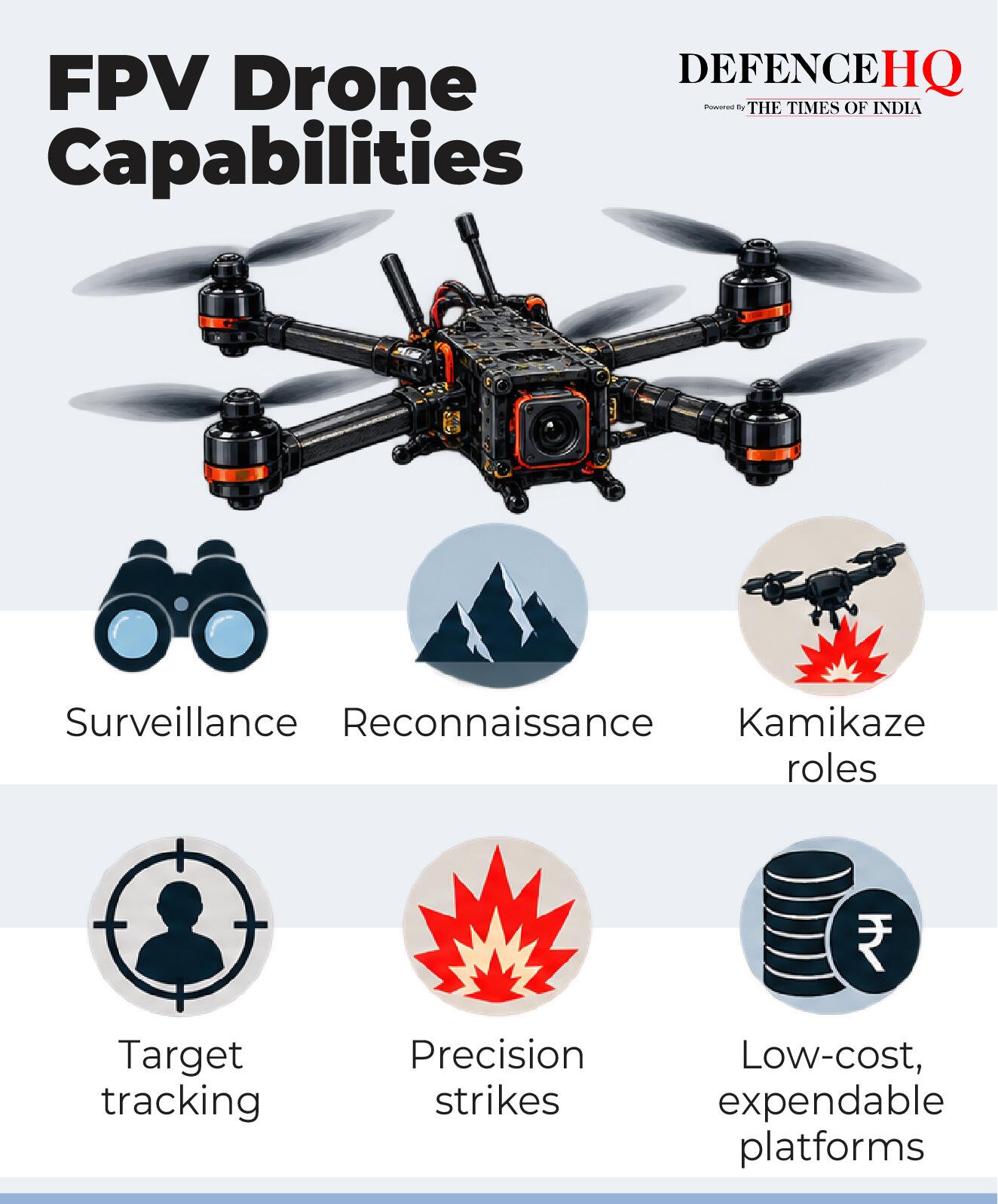
The FPV drones are like the Swiss-army knife of drones and can carry out different types of roles to aid soldiers and commanders alike.
Why drones are changing the way wars are fought
Our drones have taken off from 16,000 feet and climbed beyond 18,000 feet, operating in some of the world’s most challenging terrain. Light enough for a soldier to carry, they give him the decisive advantage of spotting threats before being detected.In modern warfare, whoever sees first, strikes first. These indigenous drones will transform how the Indian Army patrols, dominates terrain and engages the enemy. Our mission is to give every soldier that technological edge.
Lt Col Randeep Hundal, Managing Director, Aerodrone Robotics
The reason the Army is investing so much in drones lies in how wars are now being fought. In Ukraine, what began as a contest involving tanks and artillery has increasingly become a drone war, with drones estimated to account for about 70% of Russian casualties, according to recent Ukrainian media reports.Drones have also been central to recent fighting involving Israel. Their uses now range from surveillance and logistics to precision strikes and communications, allowing forces to strike targets or monitor a frontline without directly exposing soldiers and pilots to the same risks.For a small, inexpensive aircraft, that is a remarkable return, and it is one reason armies around the world are rethinking their concepts of operations around these machines.For India, the case is especially strong along the Line of Actual Control (LAC) with China and the Line of Control (LoC) with Pakistan, where troops operate at altitudes as high as 21,000 feet overlooking the Siachen Glacier.These conditions degrade both human performance and conventional equipment. Supplying remote forward posts has traditionally depended on soldiers, mules and an ageing fleet of Cheetah helicopters.Helicopter sorties are costly and weather-dependent. Drones could offer a faster, cheaper and safer alternative for some tasks.Facing the digitised air defence and surveillance networks that China has built along the LAC also calls for a modern, agile and unmanned response.
Thin air, freezing batteries: Why flying drones in the Himalayas is difficult
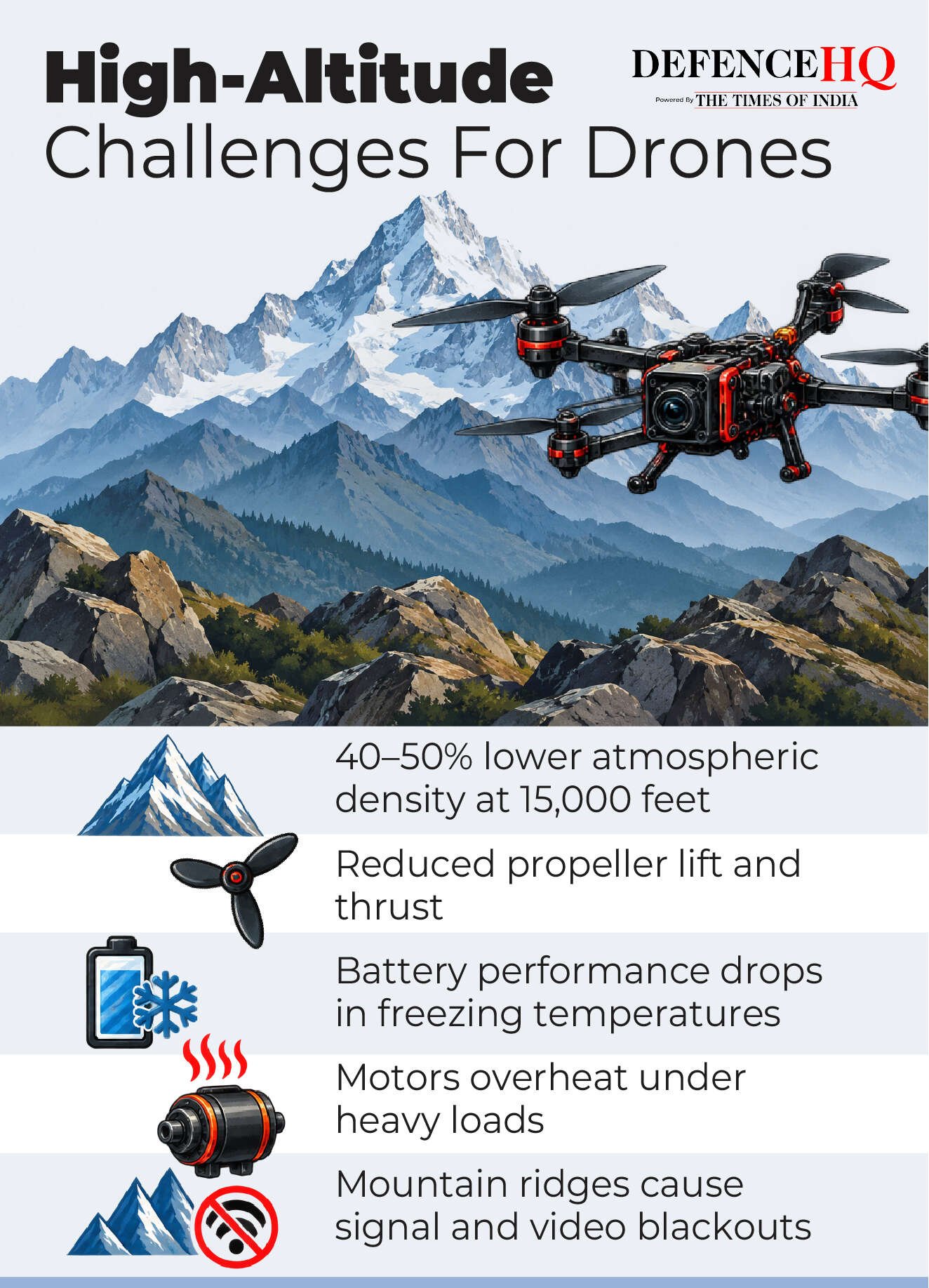
Drones , like other equipment as well as humans, experience problems at these high altitudes due to both thin air and cold.
The terrain makes this a difficult engineering problem. At 15,000 feet, atmospheric density is roughly 40% lower than at sea level. The thinner air leaves propellers with less air to work with, reducing lift and thrust.Motors, which rely on airflow for cooling, can run hotter and burn out under heavy loads. Operators may therefore need larger or higher-pitch propellers or different motor configurations, which can increase power consumption.Cold compounds the problem, as lithium-based batteries perform less efficiently in freezing temperatures, causing voltage sag and a reduction in usable capacity. Depending on the conditions, battery capacity can fall significantly, sometimes to around half its normal level.Batteries may need to be preheated before launch and insulated during flight. Jagged peaks and ridges can also block radio signals, causing sudden video or control blackouts, while stray radio interference can affect sensitive FPV receivers.
The Indian companies building the Army’s drone fleet
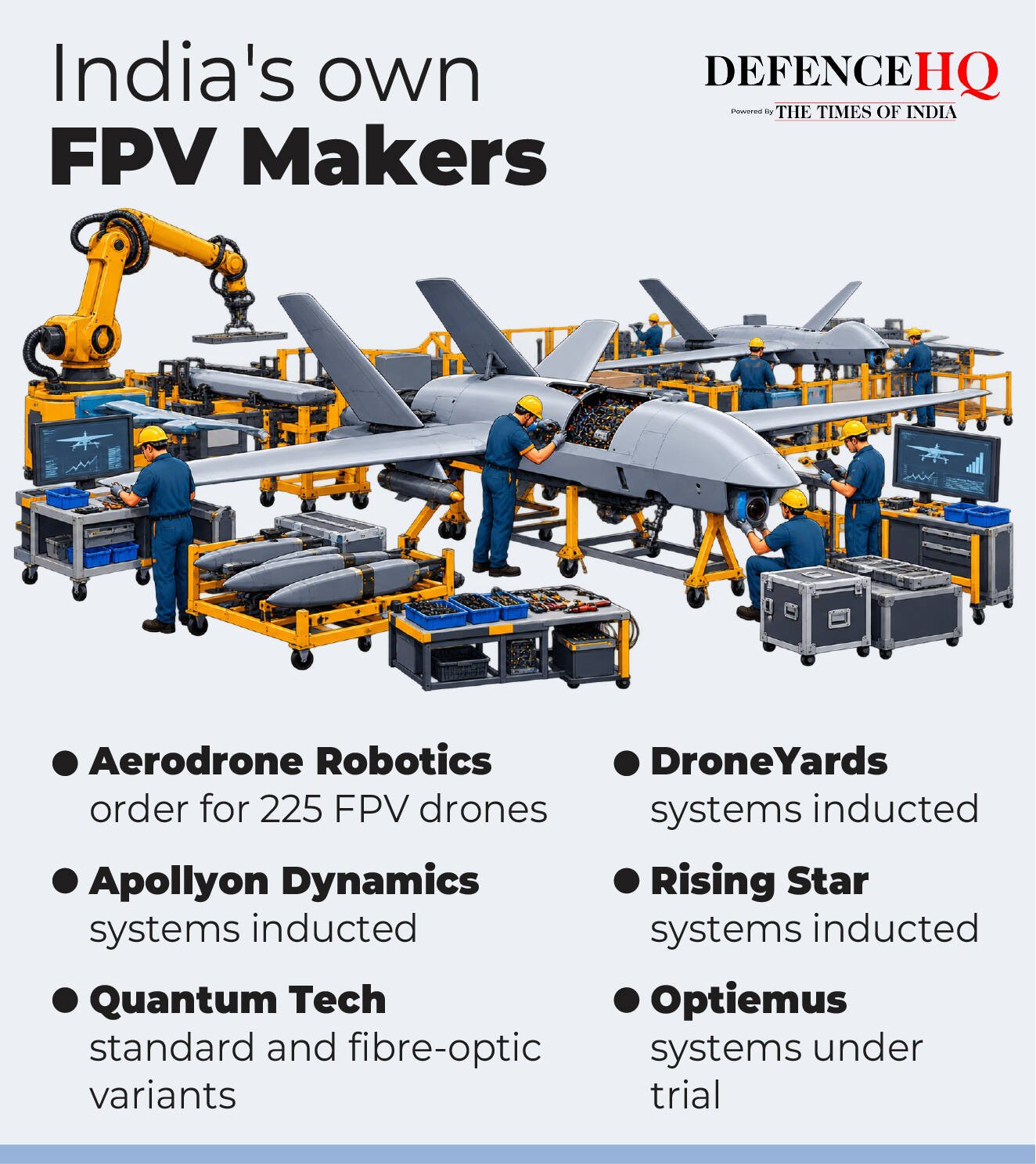
The domestic industry in India is developing drones within the country; this has led to an increase in the indigenous content of these systems .
Aerodrone works in the military unmanned aerial systems segment and has developed combat, surveillance and logistics platforms, along with operator training and technical support.It describes its platforms as military-hardened, with software developed in-house, an approach meant to provide greater control over configuration and allow systems to be adapted to specific operational needs.That fits the government’s push for Atmanirbharta in defence, where owning the software matters as much as building the airframe.Aerodrone is not the only supplier, though. A study by the Centre for Joint Warfare Studies earlier this year lists several other Indian FPV drone manufacturers whose systems have already been inducted or are undergoing trials.Inducted platforms include those from Apollyon Dynamics, Quantum Tech, which offers standard and fibre-optic variants, DroneYards and Rising Star, while Optiemus and others were at the trial stage.The same study puts one inducted vendor’s airframe at about Rs 1.4 lakh. That is a single vendor’s price and not the cost of this order, but it gives a sense of how inexpensive these systems can be compared with a helicopter sortie.The picture is of an Army buying relatively small numbers of drones as it develops its concepts of operations.
From Operation Sindoor to new drone units: The Army’s modernisation push
Drones are all set to revolutionise how the army will see and strike.
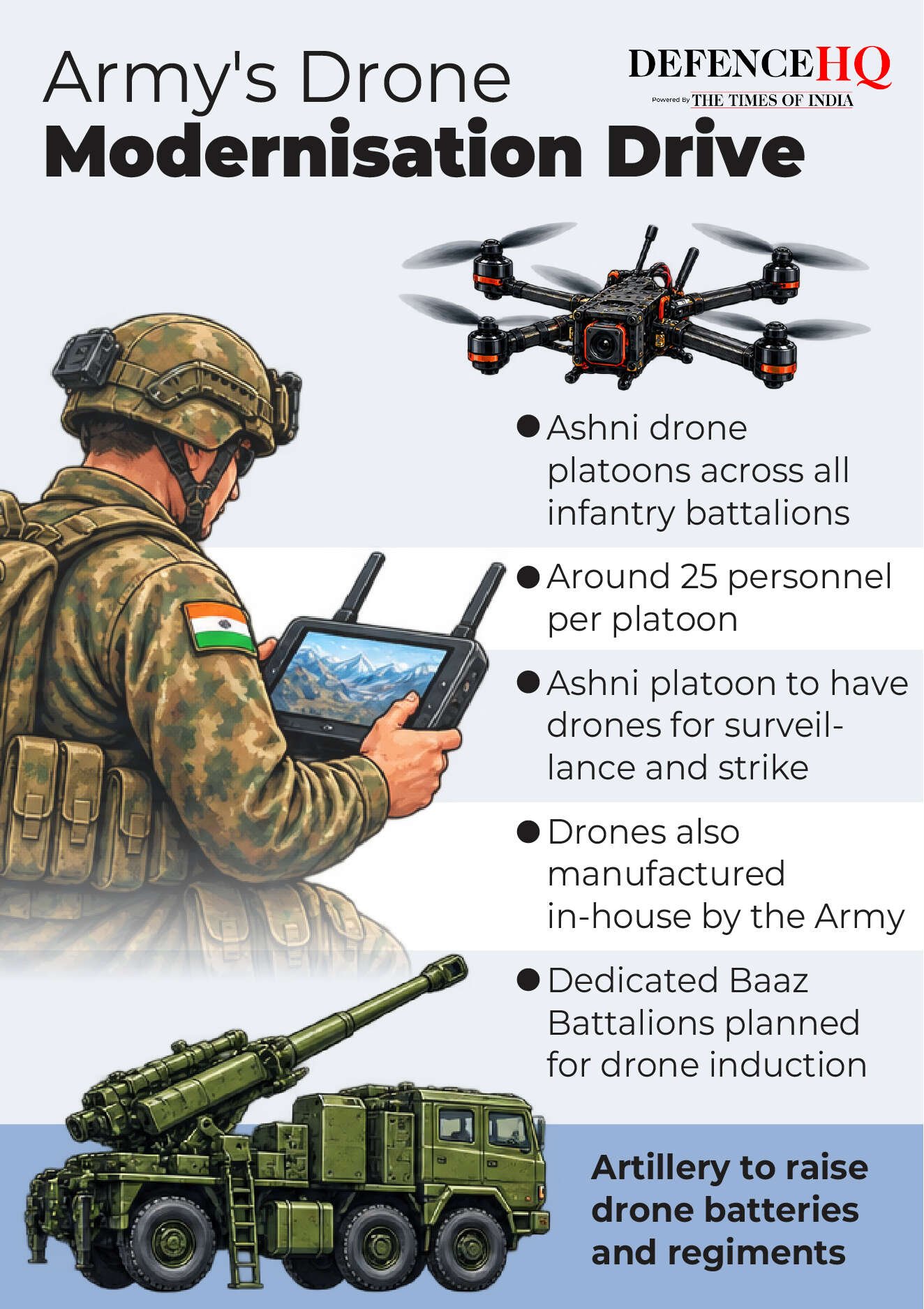
The order is one part of a much larger overhaul. General Upendra Dwivedi, who retired as Army chief in June 2026, described the present period as the force’s ‘Decade of Transformation’, with changes cutting across its structure, equipment and training.New formations are being introduced, including Rudra all-arms brigades, Shaktibaan regiments, Divyastra batteries and Bhairav battalions. Drones sit at the centre of this effort rather than at its edge.Current Army chief General Dhiraj Seth has also stressed modernisation through his ‘VIJAY’ mantra, in which ‘I’ stands for innovation and transformation, while ‘A’ stands for Atmanirbharta.These initiatives show how the Army sees the road ahead.A significant push came after the active phase of Operation Sindoor, following which the Army carried out a comprehensive review with a sharper focus on unmanned systems, counter-drone capabilities, electronic warfare and faster procurement.The Army has decided to place an Ashni drone platoon in every infantry battalion. These platoons operate drones that can be used for both surveillance and strike missions.The Ministry of Defence’s Annual Report for 2025-26 adds that the Army has built in-house drone manufacturing capacity with the help of small firms.Training is the other half of the effort. The Army wants every soldier to learn to operate a drone, just as soldiers are trained to use weapons.The Army has also raised a dedicated Baaz battalion to manage the induction, upgrading and replenishment of remotely piloted aircraft.
The next challenge
Electronic warfare is emerging as another important aspect of drone warfare, as radio-controlled FPV drones are vulnerable to jamming, a lesson highlighted by the war in Ukraine.A Centre for Joint Warfare Studies (CENJOWS) study argues that new FPV purchases should favour fibre-optic variants.Apart from this, the armed forces are also looking at kinetic methods, such as guns and low-cost missiles, to bring down drones, as well as using drone swarms. The Defence Research and Development Organisation (DRDO) has also developed laser-based systems to bring down drones.As India works to develop both drones and counter-drone systems, many of these platforms could be deployed along the ridgelines overlooking the Tibetan plateau, often referred to as the Roof of the World.Their deployment could ease the burden on soldiers and equipment alike.As combat increasingly incorporates autonomous and remotely operated systems, these technologies are expected to reach even India’s most remote frontiers.The procurement of these platforms will not only give Indian soldiers improved surveillance and strike capabilities but also strengthen the domestic defence industry and expand the country’s technological capabilities.