The five-match India v West Indies T20I series met its soggy end on Saturday night when the skies above the M Chinnaswamy Stadium opened up almost anguished, maybe saying, “We can’t have any more of this”. Then feeling for the crowd and mega-crore viewers transfixed on idiot boxes/silly screens, they dithered with an okay well, just a bit then. Just to see if a damp track would make things a little more interesting. But once Naman Dhir began depositing the ball in the outer reaches of Sarjapur, the skies said ‘enough, let’s rip and finish it’. This parade deserves to be rained on.
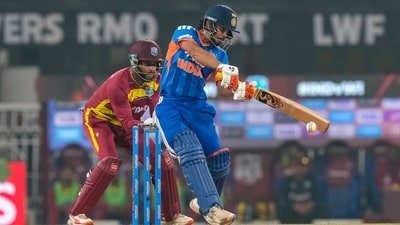
The Chinnaswamy is known as six-hitting heaven but evening rains also make unexpected appearances through the year. There are ‘mango showers’, others are cheeky “IPL specials’, but this bunch felt particularly perverse, like a cantankerous cloudburst.
For a series that motored along with batters showing off their range-hitting, flexing muscle and ego, being hosed down in Bengaluru and having to share the prize was good. No more world records, the lot preening over one six per 9.3 balls, the highest amongst full-member teams. After the tom-tomming of 98 sixes off 981 balls, with “only 23 sixes” left to beat the “record set” from the 2023 West Indies v England T20I series. Well, hold the horses.
Yet, others may ask why Boomers, Millennials, etc., aren’t “getting with it”. Was this series not a message that we should stop seeing the game as runs, wickets, tempo and tug.
Consider T20 a bowler-agnostic, six-hitting contest which today is at the point that tech bros call “escape velocity”. Sanjay Manjrekar was being zeitgeisty on his X handle when he said there really was “scope” to make pitches flatter, boundaries smaller, and create more rules against bowlers. His followers responded with zestful creativity.
One Amit Singh suggested that only underarm bowling should be allowed, plus no pacer over 120kph, and every batter gets two chances. Others said let’s Powerplay on in all 20 overs. “Why should openers have all the fun?”
When I did a quick poll audit around a group of cricket-tragic friends, they offered these paths — three mandatory boundary balls every over or the bowler can’t bowl further in the match, a ‘slot’ marker on the pitch, etc. There was this energy-saver: ban run-ups, the bowlers just stand and bowl. Let the batters stand and deliver. More time for ads also, see?
My trade-marked idea is to convert all cricket pitches from turf to concrete slabs. If the game’s mandarins find that brutalist, choose a tennis surface: the Rebound Ace / Deco Turf variants now used at the Australian and US Open. That will remove the shoot-in-the-dark fun of the pitch-report-panto which turns us into cloud-gazing, chin-scratchers.
Ooh, I had another thought: after the toss, the batting team gets to decide how far or close the boundary ropes must go. That rope ceremony could be shown live and have a separate sponsor.
In this day and age, nerds, it’s high time the game went “out of its comfort zone” and opted for a futuristic, AI-driven approach to help batters “push the envelope”. This will also make for a more cost-efficient cricketing governance model — this would please the boards.
A friend suggested that instead of bowlers, humanoids or cyborgs are required to be a part of the “contest”. Robots would be a better fit, standing dutifully next to the umpire programmed to bowl only into the slot.
We don’t want them going sentient and developing furrowed brows, bad tempers and victim complexes. This will be the first step to cost-cutting in terms of support staff salaries — data analysts can be replaced by AI engines that can write succinct team plans. The robots can run the bowling machines at the nets. No more human sidearm throwers. (It can be called the robo arm).
The coach’s job will be whittled down to two simple functions — managing batters’ egos and keeping the pre-match speech brief. “Come on, lads/ladettes, go out there and hit it out of the park — that one in the next pincode.” Robot umpires are an option too, but it’s no fun if the batters can’t blame someone else after messing up shot selection.
If you study recent changes in the laws of the game, while all the quotes mention a “contest between bat and ball,” “giving back to the bowlers,” and an “even balance between bat and ball,” the governing bodies are definitely inching out of their comfort zones.
In its 2025 amendment to the “Laws of Cricket”, MCC banned the “bunny-hop catch”, ruling that any fielder who has gone outside the boundary can touch the ball only once while airborne, must come back and be fully grounded for the catch to stand.
Just in case everyone felt the poor batter was being hard done by, ICC’s 2026 playing conditions have headlined the regulation where batters wasting time can cost their side five runs (tough). But they slipped in another change where fielders must have “complete control of the ball” while effecting a run-out or stumping. Merely touching it with the hand while breaking the stumps is not enough.
In 2026, a fine endorsement for the move towards becoming a bowler-agnostic sport —no freewheeling concessions to fielding teams.
We’re at escape velocity, bro.