Jason Holder’s catch to dismiss Rajat Patidar quickly became the main talking point from the Gujarat Titans vs Royal Challengers Bengaluru clash. The West Indies all-rounder produced a sharp effort in the deep, all while trying to avoid a collision with Kagiso Rabada running in from the other side. Holder appeared to get both hands under the ball and complete the catch, but as he slid on the turf and then got back to his feet, the ball seemed to make slight contact with the ground, raising questions over its legality.
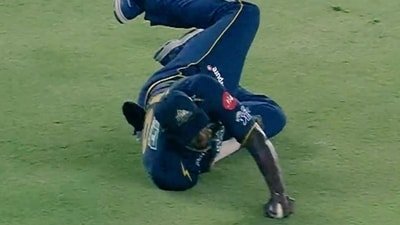
The moment led to a prolonged discussion on the field, with RCB players seeking clarity from the officials. Virat Kohli, in particular, was seen having an animated exchange with the fourth umpire near the boundary line, clearly unhappy and unconvinced with the decision that went against his side.
Weighing in on the controversy, veteran India spinner Ravichandran Ashwin broke down the mechanics of the catch, explaining how hand size and grip can create a misleading visual, suggesting that what appeared like the ball touching the ground may not have actually been the case.
“This is the ball used in the match, which is the Kookaburra ball, and this is my hand, which is a little bigger than a normal person’s hand, a little bigger by Indian standards. And look where my finger ends. See, my thumb is here and see where it is. Okay, consider Jason Holder’s hand, which is almost twice as big. So, in his hand, the ball can even pass like this. So if you can see the ball through the gap between the fingers, that does not necessarily mean it has hit the floor. It probably wrapped around and was at this angle. So maybe the ball did not touch the ground. Maybe,” Ashwin said on his YouTube channel.
Also Read – Jason Holder catch controversy: Why umpire ruled Rajat Patidar out despite doubts – MCC law explained clearly
“If you are from RCB’s side, it may seem unlucky”
Continuing his explanation, Ashwin turned to how such decisions are judged, stressing that it often comes down to the umpire’s interpretation in real time and the angle from which the play is viewed, adding that while it may feel harsh from one side, it can still fall well within the rules.
“The second thing is rule interpretation. Understanding interpretation is very important for us. What is rule interpretation? It is the interpretation of the umpire’s description. What does it mean from the perspective through which the umpire is viewing it? And we should remember that all these umpires, the third umpire and the match umpires, have a lot of experience. And he had skidded like this and then rotated the hand like this. So maybe if you are from RCB’s side, it may seem unlucky. If you look at it from GT’s side, it is a clean out. But if you are viewing it neutrally, it is completely fair within the umpire’s jurisdiction to give that out. Hope I am clear,” he added.