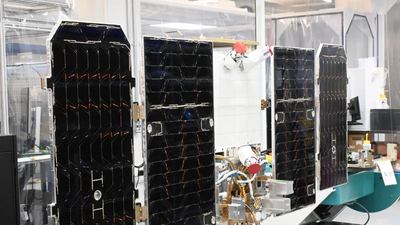
Google has run its first AI prompt in space. Its Project Suncatcher prototype satellite, sent to orbit earlier this month, received a command from the ground, powered on one of its Tensor Processing Units (TPUs), ran the prompt and returned a complete answer. The task was a haiku written from the perspective of a TPU orbiting Earth, with the world spinning beneath it.Sundar Pichai called it a “hello world” milestone, borrowing the phrase programmers use for the first test of any new system. The model behind the poem was Google DeepMind’s Gemma 4, loaded onto the satellite before it left the ground, and it wrote about the blue planet below and starlight feeding its core. Engineers also had the satellite report on conditions around it, and Google says the spacecraft is working as expected.
Power and radiation are the real tests for Google’s TPUs in orbit
There are four TPUs on board, but the satellite generates up to 1 kW, which is enough to run just one chip at a time for about 20 minutes. Those short windows also have to line up with ground station contact, which makes every exchange a scheduling exercise.Built with Planet, the satellite rode a SpaceX Falcon 9 on the Transporter-18 rideshare with more than 100 other spacecraft. Its chips had to survive forces of 50 to 100g on the way up, and engineers spent about three weeks checking every subsystem before sending the first prompt.The longer test is only starting. Cosmic rays and solar events can cause bit flips, where a value stored in memory changes on its own and corrupts data without tripping the usual checks. In a proton beam at UC Davis, Google’s Trillium TPUs took more radiation than a five-year mission would deliver, and ground tests suggest inference will suffer far less than training. Heat is the other concern. With no air in space, the chips shed heat through heat pipes and radiators rather than fans.
Google plans two more Suncatcher satellites with laser links in 2027
If this prototype holds up, two more satellites follow in 2027 with higher power and laser links between them. Google wants them flying close enough to split one large AI workload while drawing on sunlight that can yield up to eight times more solar power than on Earth.SpaceX’s planned orbital data centres will also use lasers but are expected to orbit too far apart to share processing, while Starcloud and Cowboy Space are building around single satellites. The economics still depend on SpaceX. Suncatcher’s own researchers estimate Starship would need about 1,800 flights to bring down the cost of reaching orbit enough for the plan to work in the 2030s.One haiku from one chip doesn’t settle that. The radiation and heat data this satellite sends back over the coming months will, and it decides whether those two satellites go up on schedule.