“There are a few emotions that are very easy to provoke the audience with. Violence is one of them, and sex is another.”
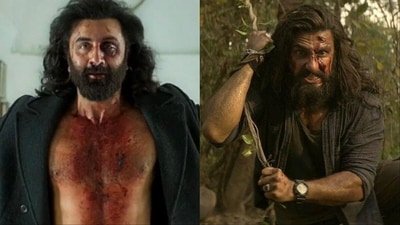
This observation by Aamir Khan in an old interview resurfaced on social media when Sandeep Reddy Vanga’s Animal was released in 2023. Among the many aspects of the film that sparked debate, its graphic violence became a major talking point online. However, Animal was far from the only film to face criticism over its portrayal of violence. Over the past five years, several blockbusters across film industries have been called out on social media for not just depicting extreme violence but also seemingly glorifying it on the big screen. The Dhurandhar duology, which emerged as the highest-grossing Indian films of 2025 and 2026, is among the latest and biggest examples.
Real-life cases bring debate around screen violence back into focus
Violence in cinema has always been a subject of debate, but the two recent troubling real-life instances have once again brought the conversation into focus.
In Haryana’s Panchkula, an eight-year-old boy allegedly assaulted a six-year-old girl inside a school classroom, repeatedly hitting her with an object that appeared to be a brick. In another disturbing incident in Andhra Pradesh, a 21-year-old allegedly entered a Class 10 classroom carrying a chainsaw and attacked a girl student, leaving two injured.
While there is no direct link between these incidents and what we see in films, the graphic nature of these cases has once again raised questions about how far filmmakers should go when depicting violence on screen. For instance, in Dhurandhar, Akshaye Khanna’s character, Rehman Dakait, is seen smashing a man’s face. In Animal, Ranbir Kapoor’s character enters a college classroom carrying a rifle to intimidate students.
Violence in cinema across industries
The debate is not limited to Hindi cinema. When Rajinikanth’s Jailer was released in 2023, its graphic sequences, including scenes involving torture and acid, drew criticism from some viewers. Similarly, Allu Arjun’s blockbuster Pushpa 2: The Rule, the highest-grossing Indian film of 2024, drew criticism for its graphic climax sequences, with some viewers finding the brutality on screen hard to digest.
Effect of violence on screen on kids: What do experts say?
With screens becoming an increasingly unavoidable part of children’s lives, monitoring the content they consume has become important. Experts point out that younger children may not always have the ability to distinguish between fiction and reality and, hence, they can’t fully understand the consequences of imitating what they see on screen.
‘Kids can admire the way heroes are rewarded for their violent actions’
Dr Subhrajit Parida, consultant, paediatrics and neonatology, Manipal Hospital, Bhubaneswar, explains that children can imitate the behaviour of characters they admire, particularly heroes who are often rewarded for their violent actions.
“As children are not able to differentiate between fiction and reality, it is difficult for them to understand the consequences of violent content on screen. At times, they try to imitate superheroes by fighting, kicking, boxing, killing and performing many other such acts. They also admire the way superheroes are rewarded for their violent actions. Though not every child behaves this way, repeated exposure to similar violent content can gradually lead children to absorb such behaviour into their everyday lives,” he said.
‘Repeated exposure to violence can make kids less sensitive to others’ pain’
Dr Shivananda Pai, consultant neurology, KMC Hospital, Mangaluru, explains that children learn through observation and imitation, and repeated exposure to aggression can influence how they perceive conflict.
“From a brain science point of view, children learn a lot by watching and copying what others do. If they see violence used to solve problems or gain control, they might start to think that aggression is a way to act. Repeated exposure can also make kids less sensitive to people’s pain and suffering. They may become emotionally numb over time,” he said.
‘Repeated exposure to such content can increase anxiety’
Muskaan Trikha, clinical psychologist, Institute of Neurosciences, Medanta, Noida, points out that the concern is not limited to films. Edited scenes from movies that circulate as reels and short-form videos can also expose children to graphic content, sometimes without them actively seeking it out.
She said, “Children today have easy access to short videos. Graphic visuals can expose them to disturbing material even when they are not actively looking for it. Repeated exposure to such content can increase anxiety and create an exaggerated perception that the world is unsafe.”
Creative freedom vs social responsibility: What celebrities say
The debate over screen violence has also divided the film industry, with several celebrities expressing concerns about its glorification, while others have defended filmmakers’ creative freedom.
Veteran screenwriter Javed Akhtar had questioned the growing appetite for violent cinema. Speaking at the Ajanta-Ellora International Film Festival in January 2024, he described the violence in some contemporary films as “meaningless violence” and suggested that it reflected a certain frustration among audiences.
Similarly, in an interview with The Hollywood Reporter India, actor Radhika Apte also spoke about how the portrayal of violence as a source of entertainment deeply disturbed her. Expressing concern about the kind of content children are exposed to.
Amid the recent debate, Animal director Sandeep Reddy Vanga strongly pushed back against attempts to link his films to real-life violent incidents. Taking to X, he wrote, “When someone commits a heinous crime, the first response should be empathy and an attempt to understand the larger problem. Not finding a convenient scapegoat in cinema.”
Filmmaker Ram Gopal Varma and singer-composer Amaal Mallik also came out in support of Sandeep, arguing that cinema alone cannot be held accountable for an individual’s actions.
Can cinema’s influence be ignored?
Like any debate, this one has two sides. However, what cannot be ignored is cinema’s immense influence in India. For instance, in 2003, when Salman Khan popularised the middle-parted hairstyle, many youngsters adopted the look in real life. Even today, fans gather outside Shah Rukh Khan’s Mannat on his birthday, recreating his iconic pose.
While the craze surrounding today’s stars may not be what it once was, cinema’s ability to influence popular culture, fashion and behaviour remains undeniable. The debate, therefore, is not necessarily about whether violence should have a place in cinema, but about its treatment and how audiences consume it.