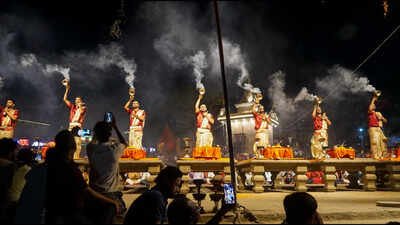
To linger in Banaras is to linger in another era, an era which one cannot quite date by century,” wrote Harvard scholar Diana L Eck in ‘Banaras: City of Light’. The inaugural CII Banaras Biennale, which opens on Nov 27 and is on view till Dec 31, gives art lovers a new excuse to linger in one of India’s oldest cities.Despite its noisy, crowded lanes and walls with their own artwork of paan stains, the city is more than the Instagram reels of Ganga aarti and sunset boat rides suggest. Aptly themed ‘Kashi/Light; City as Sensorium’, the biennale seeks to put Banaras on the cultural map, but without treating it as a mere backdrop. “The biennale is envisioned as a long-term commitment to positioning Banaras as a global capital of living culture,” says Madhav Singhania, chairman of the steering committee of CII Banaras Biennale 2026. The Biennale spans visual art, textiles, craft, music, performance and scholarship, with events spread across ghats and galleries.That approach is rooted in the idea that the city’s past and present need not be kept apart. At the centre of the exhibition is Bharatiya Kala Bhavan (BKB) inside the Banaras Hindu University campus, where lead curator Gayatri Sinha has chosen to place contemporary work among the museum’s extensive collection of more than one lakh objects. “Can we make the ancient and the contemporary conversational?” she asks.The question is the aesthetic thread that ties the biennale together. There is a more literal dhaga, too – of silk and zari. Pramod Kumar KG, who is curating the textile and craft section, is looking to connect Banaras’s mastery of the loom with contemporary fashion and design.BKB’s collection began with art historian Rai Krishna Das, who started collecting in 1920. Its present building was inaugurated by Jawaharlal Nehru in 1962. The main gallery houses Sinha’s exhibition, ‘The Cycle of Life: Samsara’, which looks at life, death, livelihood and renunciation in Banaras. “If you visit Varanasi, sooner or later, this integration between life and death, between life, livelihood and renunciation, between the appropriation of a certain sensibility and the letting go of your human education becomes very important.“Sinha draws from BKB’s impressive collection of terracotta sculptures, miniature paintings, textiles and coins, and makes connections with contemporary art. Terracotta heads, some nearly 2,000 years old, are shown alongside a contemporary work in the medium by Ravinder Reddy. Manu Parekh, whose artistic practice has repeatedly returned to Banaras, also features in the exhibition. An 11ft-by-11ft tapestry based on his work, woven by Karishma Swali’s Chanakya School of Craft, evokes the city at night.
Share your thoughts in the comments
Be respectful · TOI community guidelines
Biennales in India have usually been led by artists, curators or foundations, but this one brings industry and cultural institutions such as the Kiran Nadar Museum of Art and Sunil Munjal’s Serendipity Arts together. “This is sort of curatorially led, but industry-driven,” says Tarana Sawhney, chairperson of the CII Art & Culture Committee.The intention is not simply to parachute a festival into the city and leave. “We didn’t want to create a festival that just went in, kind of engaged with the city and left,” Sawhney says. Skilling and textile development initiatives are part of a larger effort that will continue after visitors have gone. For Sinha, the work is ultimately about bringing objects, histories and artistic practices together without erasing their differences. In Banaras, where the old and the everyday share the same streets, that conversation is already part of the city.