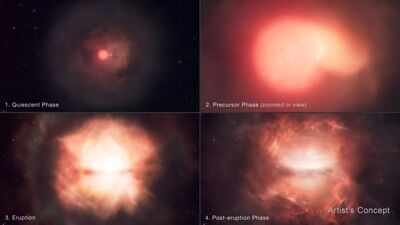
Astronomers have observed a rare stellar merger in which an ageing giant star swallowed its smaller companion in the Andromeda Galaxy, around 2.5 million light-years from Earth. The discovery has given scientists an unprecedented opportunity to follow the process from its early stages to the final eruption. The two stars had been orbiting each other for thousands of years before their separation gradually narrowed, eventually bringing them together in an event that unfolded over approximately seven years. The observations could also help them better understand how similar stellar mergers occur across the universe.
Giant star swallowing its companion offers first complete view of a stellar merger
According to a study published in Nature, researchers tracked a binary star system on the outskirts of the Andromeda Galaxy and witnessed its transformation into a single object. The system, nicknamed Bao, consisted of an ageing red giant and a much smaller companion star.The University of Turku, which was involved in the research, reported that the observations allowed astronomers to reconstruct the complete evolution of the merger, including what happened before, during and after the two stars came together.The discovery is particularly important because stellar mergers are difficult to observe as they happen. Such events are unpredictable, and astronomers have generally had to study their aftermath rather than follow the entire process as it unfolds.
What made the two stars come together after thousands of years
Before the merger, Bao was considerably larger than its companion. The University of Turku reported that the red giant had approximately seven times the mass of the Sun and had expanded to around 350 times its radius. It was also shining about 18,000 times brighter than the Sun.Its companion was much smaller, with a mass estimated at around 70% of the Sun. Although the two stars had remained in orbit around each other for thousands of years, their relationship changed as the larger star expanded and its outer atmosphere began to engulf the smaller object.According to the study, the process started around 2018 when the companion entered the outer atmosphere of the red giant. As it moved through the surrounding gas, friction gradually slowed its orbit and caused it to spiral towards the giant’s centre.The smaller star completed fewer than ten orbits during the approximately 7-year process before eventually reaching the giant’s core.
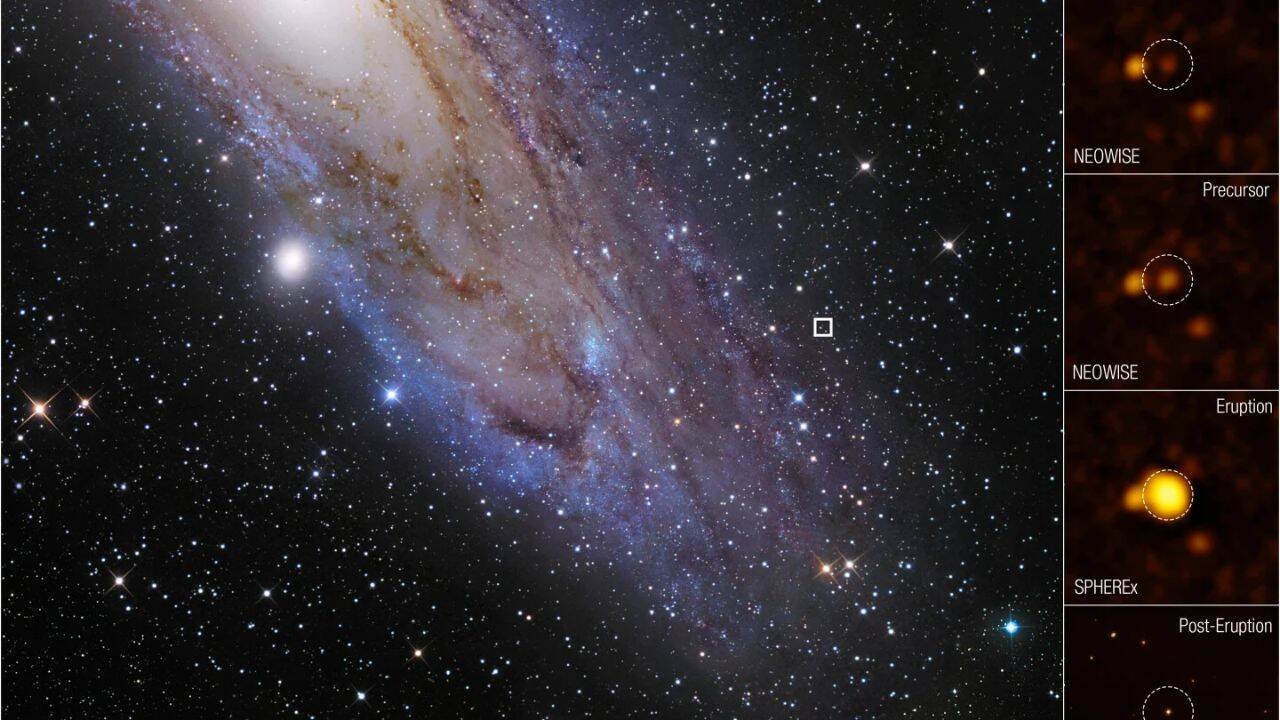
AT 2025abao in the Andromeda galaxy (telescope image). In December 2025, NASA’s James Webb Space Telescope provided the final evidence that allowed researchers to reconstruct what happened before, during and after the merger of a binary star system nicknamed Bao. Image Credit: Nasa/University of Turku
How did astronomers identify the approaching merger
The behaviour of the system was first noticed through observations made by Nasa’s now-retired Near-Earth Object Wide-field Infrared Survey Explorer, also known as NEOWISE. Although the spacecraft was originally designed to identify asteroids, it also helped astronomers detect changes in distant objects.As Live Science reported, researchers noticed that the previously stable binary system had started becoming brighter. The changes attracted the attention of astronomers, who continued monitoring it to understand what was happening.In 2023, researchers began following the system more closely. Observations from the Wide-field Infrared Transient Explorer, a near-infrared instrument at California’s Palomar Observatory, revealed that the system was also releasing dust.The event reached a dramatic stage on 17 October 2025, when the star system suddenly erupted. According to the University of Turku, its brightness increased approximately 100 times in less than a month.Viraj Karambelkar, the study’s lead author and a Nasa Hubble Fellow at Columbia University, said that such mergers are difficult to observe in real time because they are hard to predict.
James Webb telescope revealed what happened inside Bao
One of the most important parts of the investigation came from Nasa’s James Webb Space Telescope. On 24 December 2025, approximately two months after the eruption began, the telescope observed the system using its powerful infrared instruments.The observations provided evidence that helped researchers understand the material surrounding the star. In particular, the telescope detected dust that the giant had released over several centuries.According to the University of Turku, researchers compared these observations with computer simulations to establish what had happened during the merger. Their findings showed that the smaller companion had not escaped the giant’s atmosphere. Instead, it had travelled towards the centre and plunged into the red giant’s core.The collision released an enormous amount of energy, forcing material outwards from the giant. The researchers estimated that approximately the outermost 10th of the giant’s gas was expelled at around 10 times the speed needed for it to escape the star’s gravitational pull.However, the expelled material did not spread evenly in every direction. The University of Turku explained that gas travelled freely above and below the star, while older dust surrounding its middle restricted its movement in that region.This pattern helped scientists reconstruct the final stages of the merger and understand how the surrounding material responded to the sudden release of energy.
Why could this stellar merger change our understanding of stars
The discovery gives astronomers an opportunity to understand a process known as ‘common envelope evolution,’ which plays an important role in the development of closely orbiting pairs of stars.During this process, a smaller star becomes surrounded by the outer gas of a much larger companion. As it moves through this material, friction causes its orbit to shrink until the two objects either merge or develop into a different system.According to the University of Turku, understanding this process is important because it helps explain how closely orbiting stellar pairs form. Some of these systems may eventually produce gravitational waves, which are ripples in space and time caused by the movement of massive objects.These gravitational waves are among the signals that the future Laser Interferometer Space Antenna, known as LISA, is being designed to detect. The team also expects that upcoming sky surveys, including observations from Nasa’s Nancy Grace Roman Space Telescope, could identify more stellar mergers.