Like a surprise gift, an unreleased film starring Irrfan has arrived, ever so quietly, on YouTube. For so many fans of the actor, like me, it is quite something. The actor’s death in 2020 has left a void in Hindi cinema like no other. Sometimes I wonder what kind of characters he would choose to play at a time like this, when Hindi cinema is producing more and more films centred on blood-soaked machismo. I would like to believe that The Last Tenant is Irrfan’s answer to that question.
A ghost story with a heart
Irrfan plays Saagar, a gifted musician who has recently had a difficult breakup with Maanvi (Vidya Balan, wonderful in a supporting role). He’s too caged by his emotions to express them, and amid this, he decides to pursue research in the States. Perhaps this is the only way he can escape: from heartbreak, from the industry, and from the constant reminders of his own incapability to move on. However, he still has one month left to go, and desperately needs a place to stay for the time being. Through a friend, Saagar finds himself in a quiet cottage a few hours away from the city. But there’s a catch. No one has been able to stay here for more than a few days. They believe that there’s a spirit which haunts this place.
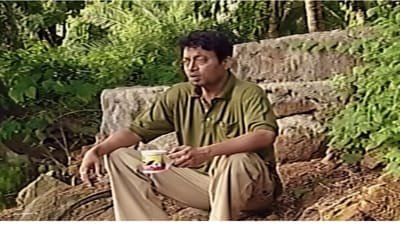
The Last Tenant has all the ingredients of a ghost story and could have become predictably jaded if not for Irrfan’s presence. His Saagar slowly resigns himself to the new residence, trying to find closure in the presence of no one else but his thoughts. As The Last Tenant accommodates the actor within its frame, the film finds a rhythm to its emotional beats. Irrfan is playfully aware in these scenes as he takes the hint of a shift in the room. Rather than being scared, he simply talks to the black space, as if he knows someone is listening to him ramble without judgment. Watch him register the shadow of someone in the room with just a flicker in his eyes. He breaks into a sweat, but he rubs it off with his hand. In the hands of a lesser actor, this could have been so caricaturish, but with Irrfan, there is a gentle, delicate weight of distress and emotional burden that takes centre stage.
I am reminded of a recent film I saw, which featured a nearly identical narrative juxtaposition. In the Malayalam film Sarvam Maya, Nivin Pauly’s Indu is also, coincidentally, a musician who encounters a (female) ghost. What begins as an unlikely friendship begins to transmute into something more. The Last Tenant goes nowhere close to that fixation of a ghost becoming a friend. It is a bit unscathed in its inhibitions and thankfully, more sincere. This film recognises that one person’s experience of grief and loss cannot transmute into another’s. Saagar can understand the reasons, but only to a certain extent. He must choose whether he wants to leave or stay and find his answers. The Last Tenant is about the way grief endures, and how there’s no single way to accommodate it to our present.
Final thoughts
In the same manner, Irrfan’s presence and, in extension, his absence, accommodates itself in frames of The Last Tenant. The grainy texture, the boyish charm of his face, and the rather indulgent background score are all reminders of a past that was once there. Now, it’s nowhere to be found. But at what cost? How has the Hindi film industry evolved in the last few years? Which films are getting the most attention, and which are having to fight for space? Irrfan is gone for a few years now, but his immense and eclectic body of work, which now includes The Last Tenant, reminds us that conscience is an intangible thing that can persist. Perhaps Irrfan was providing the answers himself, just as he was there, aware of another presence in the room. It is his absence now that permeates and confronts the many contradictions in an industry, revealing its parochial stoicism. Irrfan holds back and searches for answers. The Last Tenant is guided and shaped by his presence as well as his absence. It is a gift and a reminder.