The ultra-aggressive batting approach in IPL 2026 has triggered a surge in 200-plus totals, with such scores now arriving almost thrice every two games. The season is comfortably on course to surpass the 52 200-plus totals recorded in 2025. Six-hitting frequency has also touched unprecedented levels, leaving bowlers with little room for error. The average economy rate this season stands at 9.67 — the worst in IPL history.
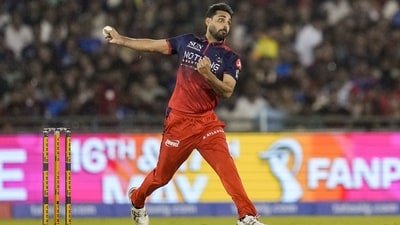
Yet amid the carnage, Bhuvneshwar Kumar has stood apart. Among the 38 bowlers to have delivered at least 25 overs this season, he is the only one with an economy rate below eight and a strike rate under 15 — a remarkable combination in modern T20 cricket.
In 11 innings, Bhuvneshwar has claimed 21 wickets at an economy of just 7.46, striking once every two overs. Four of those came against Mumbai Indians in Raipur, where he removed Ryan Rickelton, Rohit Sharma and Suryakumar Yadav with the new ball before returning later to dismiss Tilak Varma.
Ever-evolving Bhuvi
Bhuvneshwar has long been regarded as one of white-ball cricket’s most skilful operators. But between 2018 and 2022 — the year he last played for India — his IPL returns had begun to taper off. Though he remained economical at 7.46 runs per over, he managed only 43 wickets across 56 innings.
Since 2023, however, he has reinvented himself.
In an era shaped by the Impact Player rule and exploding batting numbers, Bhuvneshwar has picked up 65 wickets in 55 innings while still maintaining an economy rate below nine.
Primarily known as a swing bowler, he continues to be among the game’s finest powerplay specialists. More than 40 per cent of his IPL wickets (92) have come inside the first six overs — comfortably the most by any bowler in league history.
This season alone, he has taken 12 powerplay wickets, second only to Kagiso Rabada’s 13, while conceding at a far superior economy of seven. Remarkably, 51.4 per cent of his deliveries in the powerplay this season have been dot balls — in a tournament where teams are scoring at a record rate of 10 runs per over in that phase.
Where Bhuvneshwar has quietly expanded his reputation is at the death. The knuckleball and pinpoint yorkers have added another layer to his game. Seven of his 21 wickets this season have come in the final overs, where he has conceded at just 7.8 per over.
His death-over value was evident last year, too, during his first season with Royal Challengers Bengaluru, when he picked up seven wickets in that phase, including a decisive double-wicket over in the final against Punjab Kings.
Yet, India comeback reality looks grim
The discussion around a potential India comeback inevitably resurfaced after Sunday’s spell against Mumbai Indians — particularly after he also finished the chase with a match-winning six.
Purely on numbers, Bhuvneshwar has a compelling case.
But selection decisions are rarely made in isolation from long-term planning.
India’s T20 roadmap is now centered around the 2028 Olympics and the next T20 World Cup later that year. By then, Bhuvneshwar will be 38. For a fast bowler with a long history of injury concerns, that becomes a difficult projection for selectors to fully invest in.
There is still a possibility that India view him as a short-term bridge option. With Jasprit Bumrah likely to prioritise ODIs and Tests in the lead-up to the 2027 ODI World Cup, experience in T20 cricket could still hold value. Even Ian Bishop recently included Bhuvneshwar in his alternate India T20 squad during a discussion on ESPNCricinfo.
But the comparison with Dinesh Karthik’s comeback in 2022 only goes so far. India were then desperately searching for a specialist finisher ahead of a World Cup just months away. The demand was immediate and specific. For fast bowlers, particularly those in their late 30s, the equation is far more delicate.
That is why, despite the brilliance of his IPL campaign, Bhuvneshwar is more likely to remain a reserve or emergency option than a central figure in India’s long-term T20 plans — unless another exceptional season forces a rethink.