
No country has fallen as fast as the Albion in recent memory. In two decades, the UK has gone from being mocked for going along with George Bush’s WMD hoax to a point where no one cares about its opinion anymore. A small island whose entrepreneurs sailed the globe to sell opium and torture natives by making them read Dickens and Shakespeare, an endeavour that eventually saw them controlling the biggest landmass of any empire in history, one on which the sun never set, has become a punchline, an afterthought whose politics is now followed mainly for its King’s comedic timing. And there is nothing more comical than how the Brits pick their PM in a bicameral, first-past-the-post system that somehow involves sacrificing a prime minister every few months. The one whose head is now on the proverbial chopping block is Keir Starmer, a man with the air and personality of a chartered accountant who only gets excited during tax-filing season.A version of the British Parliament has been around since 1265 in one form or another, and has survived murderous kings, civil and world wars, lord protectors, skirmishes that inspired the Game of Thrones Red Wedding, and one lettuce that briefly became a constitutional actor. It has seen its fair share of entertaining characters.Starmer was supposed to be the antidote to the Tory tawdriness that began after the self-inflicted Brexit referendum, and included a prime minister who had to remain tight-lipped about a rumour involving a tallywacker and a deceased pig, a follicularly challenged rugby-tackler who was called out for bragging about Scotch deals in a gurdwara, a premier who somehow couldn’t last longer than a lettuce and yet managed to oversee the death of a long-living monarch who shared her name, and a finance bro who is definitely not putting in the number of hours that his father-in-law demands.So, why is Starmer under fire?The first thing to understand is that Starmer’s 2024 victory was huge but hollow, the political equivalent of Manchester City winning the Premier League time and again as the league pays lip service to financial “fair play”. Labour did not win because Britain had discovered some deep longing for Starmerism. It won because the Conservatives had turned government into a hostage video featuring Brexit, Boris, Truss, Sunak, scandal, austerity, sewage and vibes-based statecraft. Starmer looked like the least alarming surgeon because the previous four had dropped their instruments inside the patient.
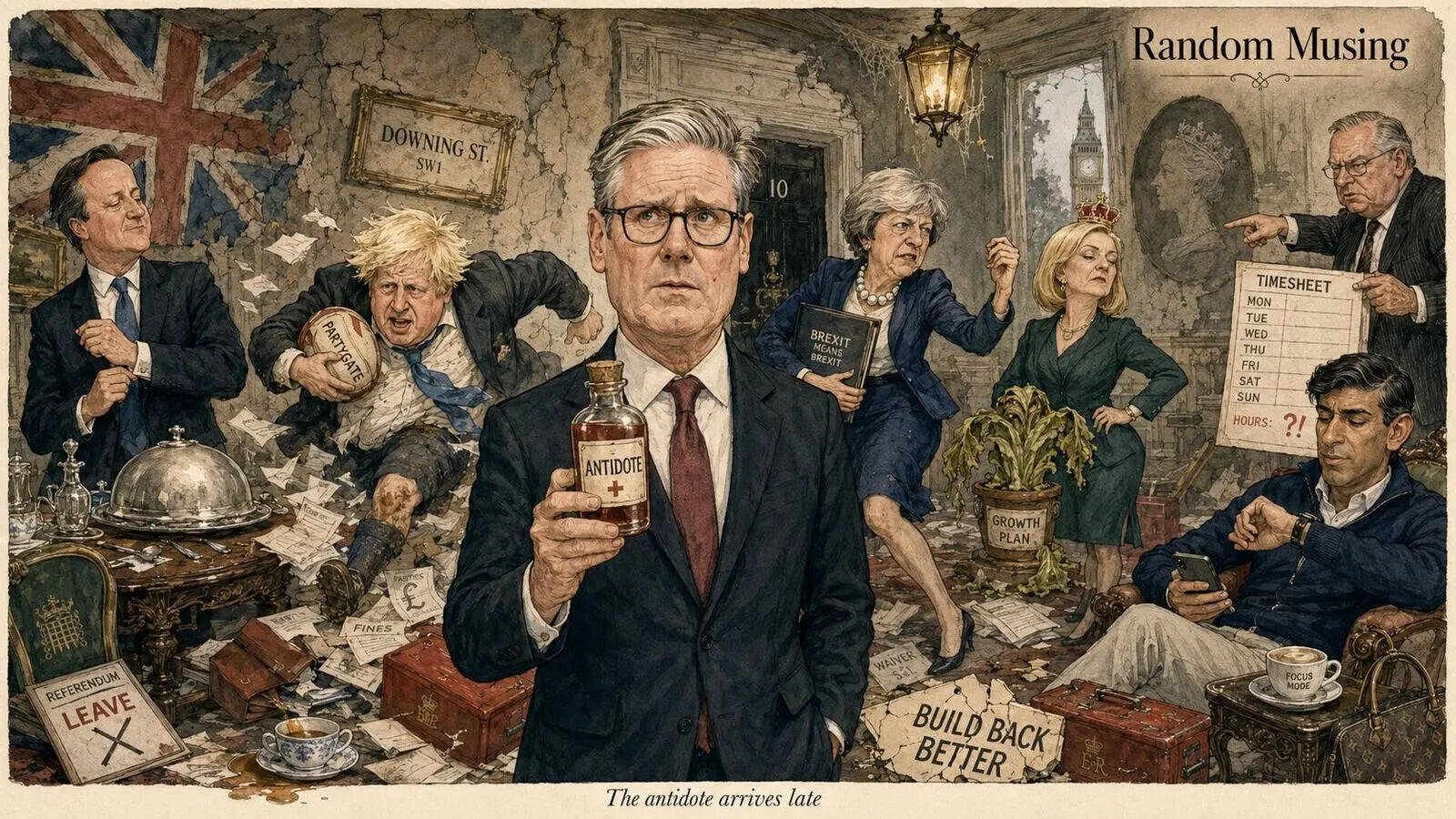
That is the problem with becoming prime minister because everyone else has set themselves on fire. At first, merely not being ablaze looks like statesmanship. Starmer seemed boring in a way that felt medicinal. He would read the brief. He was the anti-chaos candidate, a human risk-assessment form.But competence is a method, not a myth. It can run a meeting and soothe markets. It cannot give voters a story. No one cares about a five-year delivery framework when they cannot get a doctor at the NHS.
This is why the Scottish Parliament election has landed like a frying pan to the face. Labour was supposed to use Scotland to prove that the 2024 revival had roots beyond England, that the party had finally crawled back from its post-Blair Scottish grave. Instead, the SNP won again with 58 seats, Labour slumped to 17, Reform also won 17, and the Greens rose to 15.That is the real warning from Scotland. Labour’s coalition is leaking in opposite directions. Reform is taking voters who think Labour, and the Tories, have gone soft on borders, crime and national pride. The Greens are taking voters who think Labour has gone cold on Gaza, climate, housing and conscience. The SNP survived because Labour could not become the obvious alternative. In Scotland, as increasingly across Britain, Starmer’s offer looked like a spreadsheet in a knife fight.The deeper problem is that Labour does not quite know what story it is telling. It wants growth, stability, lower waiting lists, cleaner energy, public service reform and a nicer relationship with Europe. All sensible ideas on paper, but they make no sense to the average voter who has to wait ten years for an NHS appointment.Politics is the art of selling hope, and Starmer looks like the last person to offer any. But there are others who can give voters rage. With the Tories also going through their comatose phase, two new political animals are eating in.Reform is chewing through Labour’s old working-class flank: post-industrial towns, Red Wall seats, coastal communities, places where politics is a daily argument about wages, migration, crime, housing, pride and whether anyone in London knows the price of anything. Farage speaks plainly: you were betrayed, immigration is out of control, Labour no longer speaks for you, and the old parties are two branches of the same rotten shop.It is crude, but it is also the way of the hyper-connected world we live in, where Tommy Robinson can get more views than a Starmer speech. Robinson has become a unique problem for all political parties, a symptom, a symbol and an accelerant. Given the mainstream political parties’ inability to voice the concerns of the working class, or even say “Pakistani grooming gangs” out loud, Robinson has dragged the national debate into a darker place, where anti-migrant anger, English nationalism and far-right grievance blur into a loud foghorn.And Starmer does not know how to deal with Robinson because the British establishment has no way of dealing with its cowardice over the scandal.Labour has lost the ability to talk about immigration, patriotism, Englishness and social order without sounding like a Home Office press release or a focus group pretending to enjoy the St George’s Cross.The Greens are attacking from the other side. They are taking voters who think Labour has traded moral urgency for managerial caution: young renters, climate voters, pro-Palestinian activists and urban liberals. On Gaza, climate, housing and civil liberties, the Greens can pose as the conscience Labour left behind in the focus-group room.This is Starmer’s dual problem. Reform says Labour has abandoned the nation. The Greens say Labour has abandoned its conscience.Then there is Europe, the ghost that keeps climbing out of Britain’s constitutional cupboard. Starmer wants smoother trade, more mobility, more influence and less post-Brexit paperwork. On paper, this makes sense. The UK has never quite figured out how to deal with Europe, staying inside only to make a pig’s breakfast of it. So Starmer is trapped between arithmetic and emotion.His resets make matters worse. One reset is humility. Two suggest drift. A fourth looks like a man switching a router on and off while the house burns down. Every time Starmer says he has heard the message, the obvious question follows: what was he listening to before?
The cruel truth is that Starmer may be right about many things and still doomed if he cannot make people feel improvement. Britain’s problems are structural. The NHS cannot be repaired by slogan. Housing cannot be fixed by vibes. Brexit has left scars. Growth is weak. But voters are not examiners marking an essay on structural constraints. They judge governments by their own lives. The bill comes due now. The appointment is delayed now. The migrant-hotel argument happens now. Democracy has many flaws, but its greatest virtue is impatience.Starmer’s departure now looks inevitable, even though he has insisted he wants to be prime minister for eight years, a line Boris Johnson also once floated before the proverbial guillotine swung. And if that happens, Britain will be back to doing what it now does with alarming efficiency: picking another prime minister, a man or woman who, to borrow the spirit of Yes, Minister, must be malleable, flexible and likeable, with no firm opinions, no dangerous bright ideas, and no intellectual commitment to anything beyond ensuring that his or her party does not lose the next election.