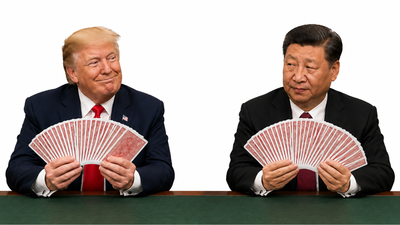
Driving the news
President Donald Trump’s China visit is coming at a time when the US-Iran war is at a stalemate. The closure of the Strait of Hormuz is causing disruptions all across the world, with no end in sight. Many analysts think that Xi Jinping will have more cards when he meets Trump in Beijing.
Trump as proof of US decline
To many in Beijing, Trump is not just an American politician. He is a symptom. His tariffs, attacks on allies, contempt for institutions, hardline immigration politics, and transactional foreign policy all seem to confirm a long-running Chinese argument: liberal democracy is unstable, American power is overextended, and the West’s best days are behind it.According to a NYT report by Li Yuan, many Chinese nationalists and state-linked commentators increasingly argue that Trump’s second term has validated Xi’s worldview centered on “the rise of the East and decline of the West.” In January, a Beijing think tank affiliated with Renmin University published a report on Trump titled: “Thank Trump.”
The US president’s trademark bravado will be used to obscure the weakness of his position. The Chinese are unlikely to rub his nose in it. They know how to give face to foreign visitors, when convenient. The reality, however, is that it is Xi Jinping who “has the cards” — to use a phrase that Trump likes.
Gideon Rachman in an article in FT
The report argued that Trump’s tariffs, attacks on allies, anti-immigration policies and assaults on the US political establishment had strengthened China while weakening America. It called Trump an “accelerator of American political decay” and described US hostility toward China as a “reverse booster” that unified Beijing and pushed it toward strategic self-reliance.“At this turning point in history,” the authors wrote, “what we hear is the heavy and haunting toll of an empire’s evening bell.”That language, once more common in nationalist corners of the Chinese internet, is now moving closer to the mainstream of Chinese political debate.
Why it matters
The core question is whether China is becoming dangerously overconfident about the coming decline of the US.A more confident China is not automatically a more reckless China. But a China that misreads US weakness could become more willing to test Washington in a crisis – over Taiwan, the South China Sea, rare earths, trade chokepoints or military pressure on US allies.Yanzhong Huang wrote in the NYT that a “dangerous new overconfidence” is taking hold in China, based on distorted perceptions of American decline. He warned that this mood could fuel Chinese intransigence and make Beijing more likely to weaponize its power in future confrontations with the US.A viral phrase in China – “the American kill line” – captures the mood. Borrowed from video game slang, it refers to the point at which a weakened character can be finished off. In Chinese discourse, it has become shorthand for the idea that millions of Americans are one lost job, illness or unexpected bill away from ruin. Huang called that perception false, noting that the US still retains unmatched geopolitical and financial power, low violent-crime rates by recent historical standards and an economy more than 50% larger than China’s. Still, the image of America as chaotic, violent and institutionally exhausted is gaining traction among Chinese audiences.That matters because public hubris can narrow leaders’ room for restraint. If Chinese citizens and elites increasingly believe the US is in irreversible decline, any compromise with Washington could be portrayed at home as weakness rather than prudence.
The big picture
China has real reasons to feel stronger.Its factories dominate global manufacturing. Its electric vehicles, batteries, solar panels, drones, shipbuilding capacity and clean-energy supply chains are reshaping global markets. Its military is more formidable than it was a decade ago. Its control over critical minerals gives Beijing leverage that Washington and its allies are still struggling to offset.As per a WSJ report by Brian Spegele, Xi’s China is pouring money into AI, electric cars and military power even as consumer confidence weakens and the job market grows bleak. The report describes a country that looks formidable from the outside but faces deep economic stress at home. That is the paradox of Xi’s China: it is projecting power abroad while many citizens are dialing back expectations at home.As per the WSJ report, China’s property bust has destroyed trillions of dollars in wealth, consumer confidence has been damaged and the job market has weakened. In Foshan, once a booming manufacturing hub near Hong Kong, a hiring agent named Yang Guolü said: “Right now, everyone is scared that next year there will be no more money left to earn.”
Between the lines
China’s reading of America is not entirely wrong. But it may be dangerously incomplete.Trump’s foreign policy has unsettled allies, strained Nato, injected volatility into trade and made many countries question Washington’s reliability. Chinese analysts see opportunity in that. They view a transactional Trump as easier to bargain with than a more alliance-focused US president.
US-Chinese competition is not zero-sum. One country’s loss is not necessarily the other’s gain. And today, both may be losing global influence at the same time.
An article in Foreign Affairs
Li Yuan’s NYT report noted that some Chinese foreign policy analysts believe Beijing can gain from a bilateral relationship that has become more transactional under Trump. Huang Jing, a professor at Shanghai International Studies University, said: “Only China can save Trump.” He argued that Trump needed visible wins from China – including purchases of American soybeans, corn and natural gas – that could play well politically in swing states.“Since Trump,” Huang said, “the United States has become increasingly prone to compromise.”That view helps explain why some in Beijing see Trump less as a purely hostile figure and more as a disruptive force who weakens the US-led order from within.However, Foreign Affairs offers a sharp warning against that assumption. David Shambaugh and Steven F Jackson argue that China has had a “golden opportunity” to exploit Trump’s missteps but has failed to turn Washington’s alienation of others into a decisive Chinese strategic windfall.Their central point: the competition is not zero-sum. America’s loss is not automatically China’s gain. Many countries are hedging against both powers.
Superpower trap?
China’s diplomatic footprint is broad but not always impactful. Beijing has embassies, officials and frequent exchanges around the world, but it rarely drives the agenda in major conflicts. It often calls for peace and negotiation without doing the harder work of brokering durable settlements, the Foreign Affairs report said.China’s soft power is also limited. Despite huge spending on public diplomacy, global media and overseas aid, international views of China remain poor in many advanced economies. The country’s political model does not travel well. Its culture commands interest, but its governance system does not attract broad imitation.Its military power, while formidable near its borders, still lacks US-style global reach. China has one treaty ally, North Korea, and one overseas military base, in Djibouti. The US, by contrast, has a dense global alliance network and hundreds of military facilities around the world, the Foreign Affairs report said.That is China’s core strategic weakness: it has influence, but few true allies. Many countries trade with Beijing, borrow from Beijing or depend on Chinese supply chains. Far fewer trust China to protect them, lead them or shape a world they want to live in.
What’s next
The Trump-Xi summit may produce short-term stabilization, especially on trade, Taiwan rhetoric, Iran-related concerns or market access. But it will not resolve the deeper strategic contest.The key variable is perception. If Beijing sees US weakness as temporary turbulence, it may stay cautious. If it sees US decline as irreversible, it may overplay its hand.That is why the debate over Chinese overconfidence matters. The danger is not only that China is rising. It is that China may believe America is falling faster than it really is.