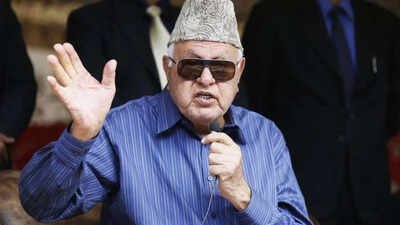
SRINAGAR: National Conference (NC) president and former Union minister Dr Farooq Abdullah Tuesday joined the debate over whether liquor should be banned in Jammu and Kashmir, saying his father, Sheikh Mohammad Abdullah, had refused to impose such a ban in 1977 as it generated substantial revenue for the UT (which was then a state).While Farooq claimed he did not drink, he added that banning liquor in J&K won’t stop tipplers from smuggling it from outside. “Those who want to drink will continue to drink. If they don’t get it here, they will bring it from outside. What can you do about it? And those who are making noise over this issue, ask them who is actually drinking alcohol,” the NC president told reporters.He recalled that when then PM Morarji Desai visited Kashmir after Sheikh Mohammad Abdullah’s victory in the 1977 election, he urged the latter to ban liquor. “My father told him, ‘I do not drink, but if you compensate us for the revenue we earn from it, then we will ban liquor’. Even today, if the Govt of India compensates us (for the revenue loss), I am sure (J&K) govt will ban liquor,” he said.Hitting back at critics, Farooq said the NC govt had not opened liquor shops. “Why didn’t these people raise their voice when liquor shops were opened in J&K? Why was there no protest when such shops were coming up in every village? They have nothing else to do except point fingers,” he said.Kashmir’s chief cleric, Mirwaiz Umar Farooq, however, said govt’s campaign against narcotics will only succeed when liquor is banned. “We are not demanding anything unusual. There are states where alcohol is banned, and it can be done in J&K as well,” Mirwaiz said.LG Manoj Sinha had launched a 100-day drive against drugs on April 11, which led to demands from various quarters that it should be extended to liquor sales.BJP, too, came out in support of prohibition, with the party’s former J&K unit chief Ravinder Rana Tuesday saying “we want drugs and liquor to be banned”.CM Omar Abdullah had on Sunday rejected calls for bringing in prohibition in J&K, and dismissed the opposition’s arguments that it amounted to encouraging alcohol consumption.