Suryakumar Yadav was Mumbai’s captain during their floundering campaign when the team arrived at Delhi’s Karnail Singh Stadium in 2014. The weather was cold, and the outfield wet. Mumbai, still reeling from a shock defeat to Jammu & Kashmir, were desperate to turn things around. With only 8.2 overs bowled on the opening day, time was running out. And to make matters worse, the venue’s giant Supersopper stopped working.
That’s when the skipper led from the front. He assembled a group of players, including veteran Abhishek Nayar, and stepped barefoot into the puddles, carrying buckets to help dry the area themselves. With coach Pravin Amre directing traffic, Surya grabbed a couple of sponges, cut them into smaller pieces with a knife and tried to soak up as much water as possible. The game eventually ended in a draw, but for Mumbai it was a lucky escape, with Railways having them on the mat with a lead of nearly 280. Less than a month later, Mumbai hit another low, suffering an innings defeat to Tamil Nadu. That proved to be the final nail in the coffin. Suryakumar stepped down as captain, and Aditya Tare took over.
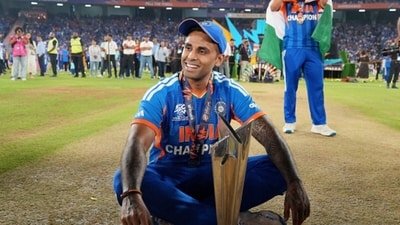
Not many fully appreciated the significance of that gesture on that chilly December morning as Surya faced flak for tarnishing the legacy of the domestic powerhouse Mumbai. Twelve years later, Surya found himself in a familiar position. In just his fifth year as an Indian cricketer, he led the team to the T20 World Cup title, yet the criticism and negativity directed at him were surprising. This was the World Cup-winning captain of India. Of the 73 captains in the history of Indian cricket, men’s and women’s combined, Suryakumar was one of only five to have lifted a World Cup. He did not deserve heat; he deserved recognition and respect.
When on song, Surya was every bit as devastating as Chris Gayle and AB de Villiers in their pomp. After Rohit Sharma, he holds the record for the most T20I centuries for India. In a span of just four years, Surya achieved all that and enjoyed a blockbuster 2022, emerging as the highest run scorer in T20Is with 1,164 runs at an average of 46.56 and a strike rate of 187.43. His 68 sixes that year are also the most hit by any batter in a calendar year. Add to that his captaincy record of 40 wins in 52 matches, giving him a win percentage of 82, the highest among India captains who have led the team in at least 50 matches. Higher than MS Dhoni, Virat Kohli and Rohit.
Surya, a man of moments
The effectiveness of Suryakumar can be gauged by feats that often go unnoticed. One such achievement was finishing as India’s second-highest run-scorer at the 2022 T20 World Cup. Against South Africa, and on a bouncy Perth surface, Suryakumar stood tall despite only three Indian batters reaching double figures. His 68 off 40 balls, featuring some ridiculous pulls and ramps for sixes against Anrich Nortje and Lungi Ngidi, was worth its weight in gold. It was the second incredible Suryakumar innings in a losing cause that year, following his 117 off 55 balls against England at Nottingham just a few months earlier. In many ways, 2022 in T20Is was for Suryakumar what 1998 was for Sachin Tendulkar and 2016 for Virat Kohli. He was untouchable. It was this rich vein of form that prompted the BCCI selectors to draft him in ODIs and one Test, even though the move didn’t pay dividends.
And then, there’s that 2024 T20 World Cup final catch.
If Suryakumar has indeed played his final match for India, his international career will be remembered as highly impactful. It was never likely to be a long career, but in the time he had, Surya made sure he was the very best. The ruthless nature of selection in Indian cricket, particularly in T20Is, means players rarely get much time. To Surya’s credit, captaincy did earn him a longer rope. Yet even when the runs dried up, he led India to the Asia Cup title in 2025, registering three consecutive wins over Pakistan without dropping a single game, an achievement he repeated during the T20 World Cup earlier this year.
As Ajit Agarkar pointed out, whatever was discussed between him and Surya will remain confidential. But this is hardly the first difficult decision Agarkar has had to make. Rohit Sharma was removed as India’s captain despite leading the team to an ICC title, and a similar call has now been taken with Surya, with an eye on the bigger picture. India have a T20 World Cup crown to defend in 2028 and an opportunity to win Olympic gold in the same year. By then, Surya would be 37 and, wrist concerns notwithstanding, persisting with a specialist T20 cricketer of that age makes little sense given the quality of players waiting in the wings.
Surya would be disappointed, and understandably so. But just as he stepped forward all those years ago in Central Delhi, he can look back with satisfaction at everything he achieved. If the curtains have come down, what a way to go out. A career that started with a six off Jofra Archer in Ahmedabad’s Narendra Modi Stadium would conclude by lifting a World Cup trophy at the same venue.