Like many great directors, Steven Spielberg has something of an allergy to sequels. Among his 35 features, the moviemaker has made a lone direct sequel—1997’s “The Lost World: Jurassic Park”—and directed multiple films in just a single franchise, the Indiana Jones series, which, after “Raiders of the Lost Ark” (1981), begat three Spielberg-directed entries.
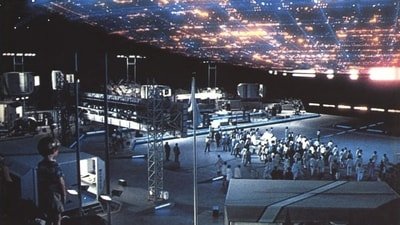
An image from ‘Close Encounters of the Third Kind.’
In modern Hollywood, Mr. Spielberg’s reticence counts as remarkable restraint, but it disguises the fact that, for nearly 50 years, he has been tending to what is a series of films in all but name. Call it his extraterrestrial trio: Starting with “Close Encounters of the Third Kind” (1977) and continuing with “E.T. the Extra-Terrestrial” (1982) and “War of the Worlds” (2005), Mr. Spielberg has pursued his abiding interest in the potential consequences of civilization’s contact with life from other worlds. Together, the films form a rich, sometimes contradictory but clearly distinct body of work within Mr. Spielberg’s canon. The trio will become a quartet with the release of his latest alien film, “Disclosure Day,” on June 12.
So longstanding is Mr. Spielberg’s fascination with interstellar travelers that it was the basis for what is considered his first notable amateur film, “Firelight,” directed as a teenager and exhibited in his then-hometown of Phoenix in 1964. Thirteen years later, Mr. Spielberg transmitted his youthful interest onto the gigantic canvas of “Close Encounters of the Third Kind,” the most solemn and contemplative science-fiction film since Stanley Kubrick’s “2001: A Space Odyssey” a decade earlier. The film, which Mr. Spielberg also wrote, stars Richard Dreyfuss as Roy Neary, a family man whose glimpses of psychedelically colored, freely perambulating UFOs birth a deeper obsession. Roy becomes seized with images and ideas that indicate his subconscious knowledge of visiting extraterrestrials—a knowledge shared by assorted others, including single mother Jillian (Melinda Dillon). François Truffaut, the leading French New Wave filmmaker, costars as the scientist Lacombe, whose humanity and undisguised joy at his part in the discovery mirror Mr. Spielberg’s.
“Close Encounters” can be terrifying, especially when Jillian’s little boy is beckoned from their house onto a visiting, quickly vanishing spacecraft, but Mr. Spielberg maintains a hopeful, expectant tone. Surely, the director seems to be saying, no menacing species would initiate dealings with a tuneful musical phrase, as the aliens do here. The finale confirms the benevolence Mr. Spielberg feels will flow from human-alien contact: Having landed their ship on a government runway, the aliens liberate various people whom they have accumulated through the ages, while a band of human volunteers, among them Roy, boards their ship willingly for parts unknown. The conclusion is transcendently majestic.
With “E.T. the Extra-Terrestrial,” Mr. Spielberg and screenwriter Melissa Mathison went even further. The film proposes that only a space being—E.T., erroneously marooned here by his fellow beings during a visit—can address the familial emptiness of Elliott (Henry Thomas), the middle child in a family upended by divorce. The predicament mirrors Mr. Spielberg’s family history, though loneliness at any age seeded his initial concept. “I began concocting this imaginary creature, partially from the guys who stepped out of the mother ship for ninety seconds in ‘Close Encounters’ and then went back in, never to be seen again,” Mr. Spielberg said in a 1982 Rolling Stone interview. “Then I thought, what if I were ten years old again . . . and what if he needed me as much as I needed him?”
Never in doubt is the deep kindliness and good intentions of E.T., who, it has been often observed, has Christ-like features: He is a sojourner from the heavens, and he possesses abilities that transcend biological realities, including, in an extraordinarily powerful moment, to revive himself post-death. In the end, though, the film is less theological or even astronomical than a brief on the comforts of companionship. Any of us would welcome a friend as true as E.T.
Mr. Spielberg makes “E.T.” cozy and inviting by incorporating alien life into the fabric of suburbia: Despite his strange appearance and intermittent ability to reproduce the English language, the creature becomes acclimated to the family kitchen, participates in Halloween and develops a notable fondness for bike rides.
More than two decades elapsed before Mr. Spielberg again attended to his favored theme, but when he did, his attitude had changed. Having reckoned with major historical events, including the Holocaust in “Schindler’s List” (1993) and D-Day in “Saving Private Ryan” (1998), Mr. Spielberg seems to have approached “War of the Worlds” with an unexpected wariness: Evil, he concedes, could emanate from the skies—one of several ways in which the movie reflects its post-9/11 context. Here, the space creatures bring not amity but pitiless destruction, as experienced through the eyes of a canny, resilient family led by divorced dad Ray Ferrier (Tom Cruise). Shockingly for a Spielberg film about alien life, peace comes only with the vanquishing of the visiting species. It is the outlier among the director’s extraterrestrial features, and it remains one of his most intense, involving works.
Whatever its tone or message, “Disclosure Day” is sure to be in dialogue with these earlier efforts. For much of his 79 years, Mr. Spielberg has wondered what good (or ghastly) things might find their way to Earth. More than any sequel, Mr. Spielberg’s extraterrestrial quartet may be the connective tissue that binds his exceptional career.
Mr. Tonguette, the Life & Arts editor of the Washington Examiner, writes about film for the Journal.