Main Vaapas Aaunga
Director: Imtiaz Ali
Cast: Diljit Dosanjh, Naseeruddin Shah, Vedang Raina, Sharvari
Rating: 3.5 stars
At this point, too many Hindi films look like they were run through the same Instagram filter: so ultra-smooth and polished, it barely resembles the real world. It leaves the film without any personality. The question arises: has Imtiaz Ali succumbed to it too?
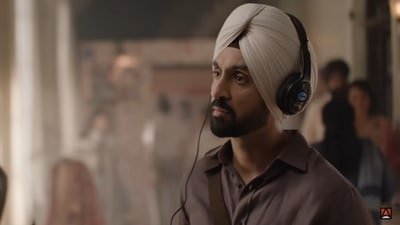
Thankfully, not. In fact, Main Vaapas Aaunga serves as a reminder that before anything else, filmmakers need to learn from him how to visualise a film that actually looks like cinema. Shoutout to cinematographer Sylvester Fonseca too.
What is the story of Main Vaapas Aaunga?
The story revolves around a 95-year-old Ishar Singh Grewal (Naseeruddin Shah), who suffers a stroke while desperately trying to rush to Sargodha in Pakistan. As his memory begins to fade, his grandson Nirvair (Diljit Dosanjh) returns from England to be by his side. As Ishar drifts in and out of recollection, fragments of his pre-Partition life start resurfacing, allowing Nirvair to piece together a buried past. Something is preventing Ishar from finding peace in his final days. What that is, forms the crux.
The Partition of India remains the largest mass migration in human history. For many of us, the horrific images exist as photographs in history textbooks. But what about the generation that actually lived through it? Those forced to leave behind their homes, loved ones? More importantly, the grief and scars they carried for the rest of their lives? Main Vaapas Aaunga doesn’t just revisit it all; it attempts to understand the human cost that lingered long after the borders were drawn.
There’s a certain skill to Imtiaz’s filmmaking. When skill is honed to this degree, it begins to resemble magic, and that’s precisely what one feels while watching his work. At my screening, another critic audibly gasped when the censor certificate flashed the runtime: “166 minutes?!” But Imtiaz has an uncanny ability to make you invest in his characters. Before you realise it, the minutes have slipped by, replaced by an emotional investment that’s more compelling than the clock.
The film grips you from the outset. However, after a point, the screenplay loses some momentum, and the interval arrives at a moment that leaves one wondering: what more could there possibly be to this tale of long-lost love? The second half answers that question beautifully, unfolding a story that is both heartbreaking and uplifting.
Performance report card
And a major share of the applause belongs to Naseeruddin Shah. In a portrayal that feels startlingly real, he captures both the confusion of a fading mind and the longing for a love that never left him. There’s a moment that lasts barely two seconds: a portrait of Jiya appears before him, and while lying on his deathbed, Ishar instinctively begins tidying his beard. I would rank this among the finest performances by an actor in recent times.
Next comes Sharvari, and it’s easy to see why Imtiaz chose her to play Jiya. She balances Jiya’s bubbliness with a quiet awareness of the hold she has over Ishar. Vedang, in just his third film, is already displaying versatility. Together, Sharvari and Vedang make for a compelling on-screen pair.
Surprisingly, it is Diljit Dosanjh who emerges as a weak link. His track with Banita Sandhu (as Kaveri) feels less engaging than the central relationships that drive the narrative. Vinod Nagpal is terrific in his short role. Anjana Sukhani and Sanjay Suri play their parts well.
The music and background score by AR Rahman, I can happily say, is top notch.
Overall, perhaps what lingers most about Main Vaapas Aaunga is that it isn’t really a film about Partition or even lost love. It’s a film about memory itself. About the people and emotions that refuse to leave us, even when everything else begins to fade. In an era where Hindi cinema often mistakes scale for feeling, Main Vaapas Aaunga delivers something far rarer: a deeply human story. It may stumble occasionally, but when it soars, it reaches the kind of emotional heights few filmmakers today can access. By the time the credits roll, you are left with moist eyes, and the lingering ache of a story that refuses to leave you long after you have left the theatre.